
What Is an Open-Jaw Flight? How to Book Multi-City Award Trips Without Backtracking
What Is an Open-Jaw Flight? How to Book Multi-City Award Trips Without Backtracking
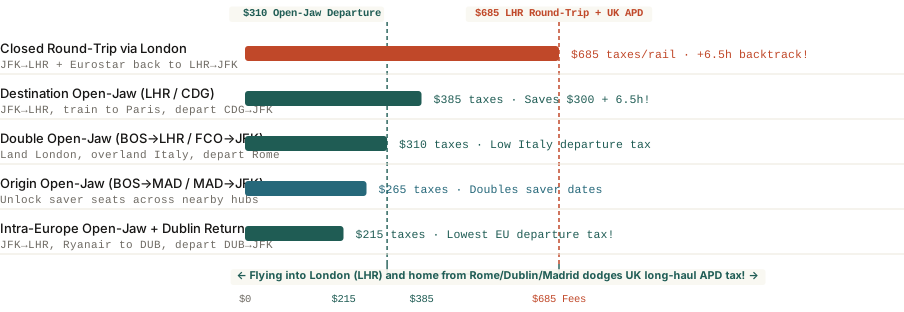
An open-jaw itinerary lets you fly into one city (such as London) and return home from another (such as Paris, Rome, or Dublin)—eliminating a wasted vacation day of backtracking while dodging up to $280+ in UK Air Passenger Duty departure taxes.
Imagine planning a ten-day European vacation to visit London and Paris, or Tokyo and Kyoto/Osaka. If you book a traditional round-trip flight into and out of London Heathrow (`JFK → LHR` and `LHR → JFK`), you have to spend your final afternoon packing up in Paris, boarding the Eurostar back to St. Pancras, transferring across London to Heathrow, and paying for an extra airport hotel night just to catch your return flight.
Even worse, by departing from a United Kingdom airport in a premium cabin, you trigger the UK's punitive Air Passenger Duty (`APD`)—adding roughly $250 to $280+ per passenger in luxury departure taxes on top of carrier surcharges. Replacing that closed round-trip with an open-jaw itinerary saves both a full day of vacation and hundreds of dollars in taxes.
The Three Types of Open-Jaw Itineraries
Plotted on a map, the two flown legs of a multi-city trip form a triangle with one unflown edge—looking like an open mouth or "jaw" viewed from the side. Airline routing rules recognize three distinct variations:
- 1. Destination Open-Jaw (`A → B`, then `C → A`): The classic vacation saver. You fly from New York (`JFK`) into London (`LHR`), travel overland by high-speed train or cheap regional hopper to Paris (`CDG`), Rome (`FCO`), or Dublin (`DUB`), and fly home directly from that second city (`CDG → JFK`).
- 2. Origin Open-Jaw (`A → B`, then `B → C`): You depart from one home-region airport and return to another—for example, flying out of Boston (`BOS → MAD`) where an off-peak Iberia business-class saver seat is wide open, and returning into New York (`MAD → JFK`).
- 3. Double Open-Jaw (`A → B`, then `C → D`): Both the origin and destination pairs are open (`BOS → LHR` outbound, `FCO → JFK` return)—ideal when hunting scarce saver award inventory across the U.S. East Coast and Western Europe.
The UK's $250+ Air Passenger Duty only applies when you take off from a UK airport—never when you land there. Always fly into London and open-jaw home from continental Europe or Dublin.
How to Book Open-Jaws With Points (Two One-Ways vs. Single Ticket)
When booking with cash on legacy airlines, booking two separate one-way international tickets is often prohibitively expensive (`$2,500+` each way), forcing you to use the airline's "Multi-City" search tab to price an open-jaw on a single ticket (where IATA rules typically require the unflown surface gap `B–C` to be shorter than the shortest flown leg). In award travel, however, the rules work in your favor:
- Book Two Separate One-Way Awards (90% of Cases): Almost every major transferable-points program—including Air Canada Aeroplan, Air France-KLM Flying Blue, British Airways/Iberia Avios, United MileagePlus, and American AAdvantage—prices one-way awards at exactly half the cost of a round-trip. Booking two separate one-way tickets lets you transfer Chase or Amex points to Virgin Atlantic for the outbound (`JFK → LHR`) and to Flying Blue or Aeroplan for the return (`FCO → JFK`), with zero restriction on how far apart your arrival and departure cities sit.
- When to Use a Single Round-Trip Open-Jaw Ticket: A few programs—such as ANA Mileage Club (which requires round-trip bookings) or United MileagePlus's Excursionist Perk—reward booking on a single multi-city ticket. On ANA, you can book `SFO → HND` (Tokyo) and return `KIX → SFO` (Osaka) on a single round-trip award while riding the Shinkansen bullet train in between.
To compare exact departure taxes, carrier surcharges, and cents-per-point returns across your outbound and return cities, you can Compare award tax valuations on Pointsuno before locking in your route.