
What Is Camera Crop Factor (1.5x APS-C vs. 2x Micro Four Thirds), and Does It Change Light or Depth of Field?
Few topics spark as much confusion in camera gear forums as crop factor equivalence. If you mount a 35mm f/1.8 lens on a 1.5× APS-C camera—or a 25mm f/1.4 lens on a 2.0× Micro Four Thirds camera—do you multiply the aperture by the crop factor too? And if you do, does that mean an f/2.8 lens on a smaller sensor lets in less exposure light and forces a slower shutter speed?
As derived in optical sensor physics in Image sensor format, Micro Four Thirds system, and Adobe's crop sensor guide, the answer separates into two distinct rules: exposure brightness per square millimeter never changes with crop factor, while angle of view, depth of field, and total light gathered across the whole sensor scale directly by crop factor. Plan focal lengths and vantage points for any camera sensor in PhotoSpots before heading out to shoot.
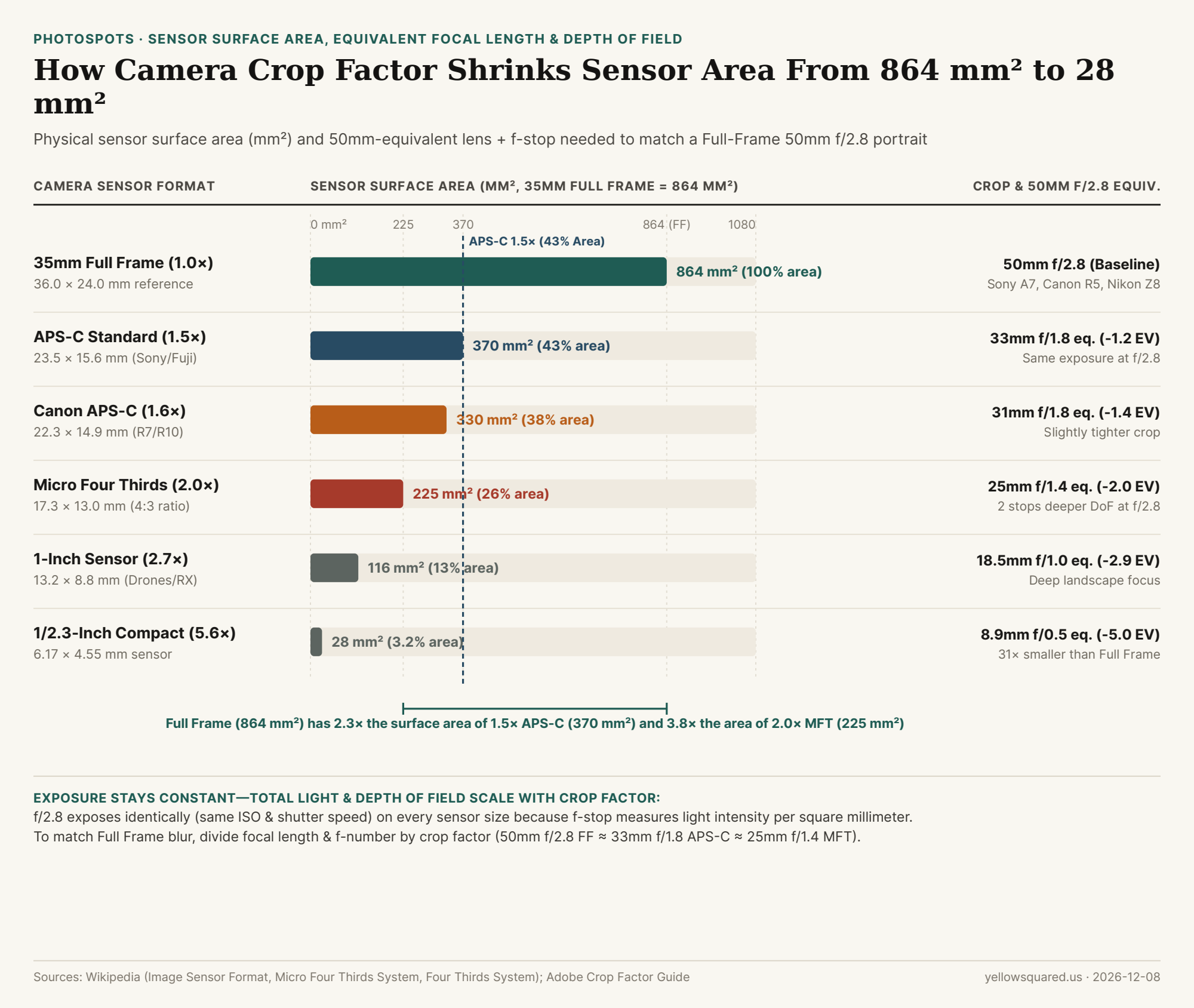
mm²) and 50mm f/2.8 equivalent focal length and aperture across six digital sensor formats. Sources: Image Sensor Format, Micro Four Thirds System, and Adobe Crop Factor Guide · Download CSV dataset.Rule 1: Why Exposure Brightness Does NOT Change (f/2.8 Is Always f/2.8)
An aperture setting like f/2.8 is a ratio (focal length ÷ entrance pupil diameter). It measures the illuminance (light intensity per square millimeter) hitting the sensor plane. Whether your sensor is a huge 36 × 24 mm full-frame chip (864 mm²) or a tiny 17.3 × 13.0 mm Micro Four Thirds chip (225 mm²), setting 1/250s, f/2.8, ISO 100 produces the exact same exposure brightness in your photo. Your handheld light meter never asks what sensor size you are shooting!
Rule 2: Why Field of View, Depth of Field & Total Light DO Scale
Where crop factor (k, defined as the diagonal of a 35mm full-frame sensor divided by the diagonal of your sensor) changes everything is when you try to frame the exact same composition from the exact same spot:
- Field of View (Multiply Focal Length by
k): Because a smaller sensor captures only the center rectangle of a lens's image circle, a33mmlens on a1.5×APS-C body (33 × 1.5 ≈ 50mm) or a25mmlens on a2.0×Micro Four Thirds body (25 × 2.0 = 50mm) frames the exact same scene as a50mmlens on Full Frame. - Depth of Field & Background Blur (Multiply
f-Number byk): Depth of field depends on physical entrance pupil diameter (f ÷ N). A25mm f/2.8lens has an entrance pupil of25 ÷ 2.8 = 8.9 mm—the exact same physical hole as a50mm f/5.6lens (50 ÷ 5.6 = 8.9 mm). Therefore, shooting25mm f/2.8on Micro Four Thirds produces the same framing and the same depth of field as50mm f/5.6on Full Frame (two stops deeper focus!). To match the shallow background blur of a Full-Frame50mm f/2.8portrait, you need a33mm f/1.8on APS-C or a25mm f/1.4on Micro Four Thirds. - Total Light & High-ISO Noise (Sensor Area Ratio): Because a Full-Frame sensor (
864 mm²) has2.3×the surface area of1.5×APS-C (370 mm²) and3.8×the surface area of2.0×MFT (225 mm²), it gathers1.2 stopsto2.0 stopsmore total photons during the same shutter speed—explaining Full Frame's roughly 1-to-2-stop low-light noise advantage at high ISO.
"f/2.8 on Micro Four Thirds gives you the exact same shutter speed and ISO exposure as f/2.8 on Full Frame—but the exact same background blur and total light collection as f/5.6 on Full Frame."
Sensor Size, Crop Factor & Equivalence Reference Table
The table below summarizes sensor dimensions, surface area, crop factor, and 50mm f/2.8 equivalent lenses across six common formats (download the raw CSV dataset):
| Camera Sensor Format | Dimensions (mm) |
Area (mm²) |
Crop Factor | 50mm FOV Lens | f/2.8 FF Equiv. DoF |
Practical Field Advantage |
|---|---|---|---|---|---|---|
| 35mm Full Frame | 36.0 × 24.0 |
864 mm² (100%) |
1.0× |
50mm |
f/2.8 (Baseline) |
Shallowest portrait bokeh & cleanest high-ISO files |
| APS-C (Nikon/Sony/Fuji) | 23.5 × 15.6 |
370 mm² (43%) |
1.5× |
33–35mm |
f/1.8–f/2.0 |
Compact travel bodies with strong dynamic range |
| Canon APS-C | 22.3 × 14.9 |
330 mm² (38%) |
1.6× |
31–32mm |
f/1.8 |
Extra telephoto reach for wildlife & sports |
| Micro Four Thirds (4:3) | 17.3 × 13.0 |
225 mm² (26%) |
2.0× |
25mm |
f/1.4 |
Half-size telephoto lenses & deep landscape DoF |
| 1-Inch Type (RX100/Drone) | 13.2 × 8.8 |
116 mm² (13%) |
2.7× |
18.5mm |
f/1.0 |
Pocketable zoom reach for daytime travel |
| 1/2.3-Inch Compact | 6.17 × 4.55 |
28 mm² (3.2%) |
5.6× |
8.9mm |
f/0.5 (N/A) |
Near-infinite depth of field; struggles in dim light |
When Smaller Sensors Are Actually an Advantage
Smaller sensors are not "worse"—they simply trade shallow portrait bokeh for compact reach and effortless depth of field. On a wildlife hike or macro shoot, a 2.0× Micro Four Thirds camera with a 300mm f/4 lens delivers a 600mm field of view at a fraction of the weight of a full-frame super-telephoto while keeping more of the bird or flower in sharp focus at f/4. Plan focal lengths and vantage points for any camera sensor in PhotoSpots to match your lens kit to each viewpoint.