
What Is Camera Flash Sync Speed (1/200s vs. 1/250s), and How Does High-Speed Sync (HSS) Work?
Every photographer who takes a speedlight or studio strobe outdoors eventually hits the same wall: you open your portrait lens to f/2 in bright afternoon sun, your camera sets a shutter speed of 1/2000s, and either the camera refuses to let you pass 1/200s or 1/250s, or—if you use a manual radio trigger—a solid black shadow band cuts across half of your frame. As explained in Flash synchronization, Focal-plane shutter, and field guides from PhotographyTalk and Camera Dojo, that 1/200s–1/250s ceiling is your camera's maximum X-sync speed, dictated by the physical travel time of two mechanical shutter curtains across the sensor.
Why does a focal-plane shutter block a single flash pop above 1/250s, how does High-Speed Sync (HSS / FP sync) bypass that limit up to 1/8000s, and why does switching on HSS immediately cost you 75% to 98% of your flash power? Plan flash sync speeds, HSS power loss, and ND filter exposures in Lumet before your next outdoor portrait session.
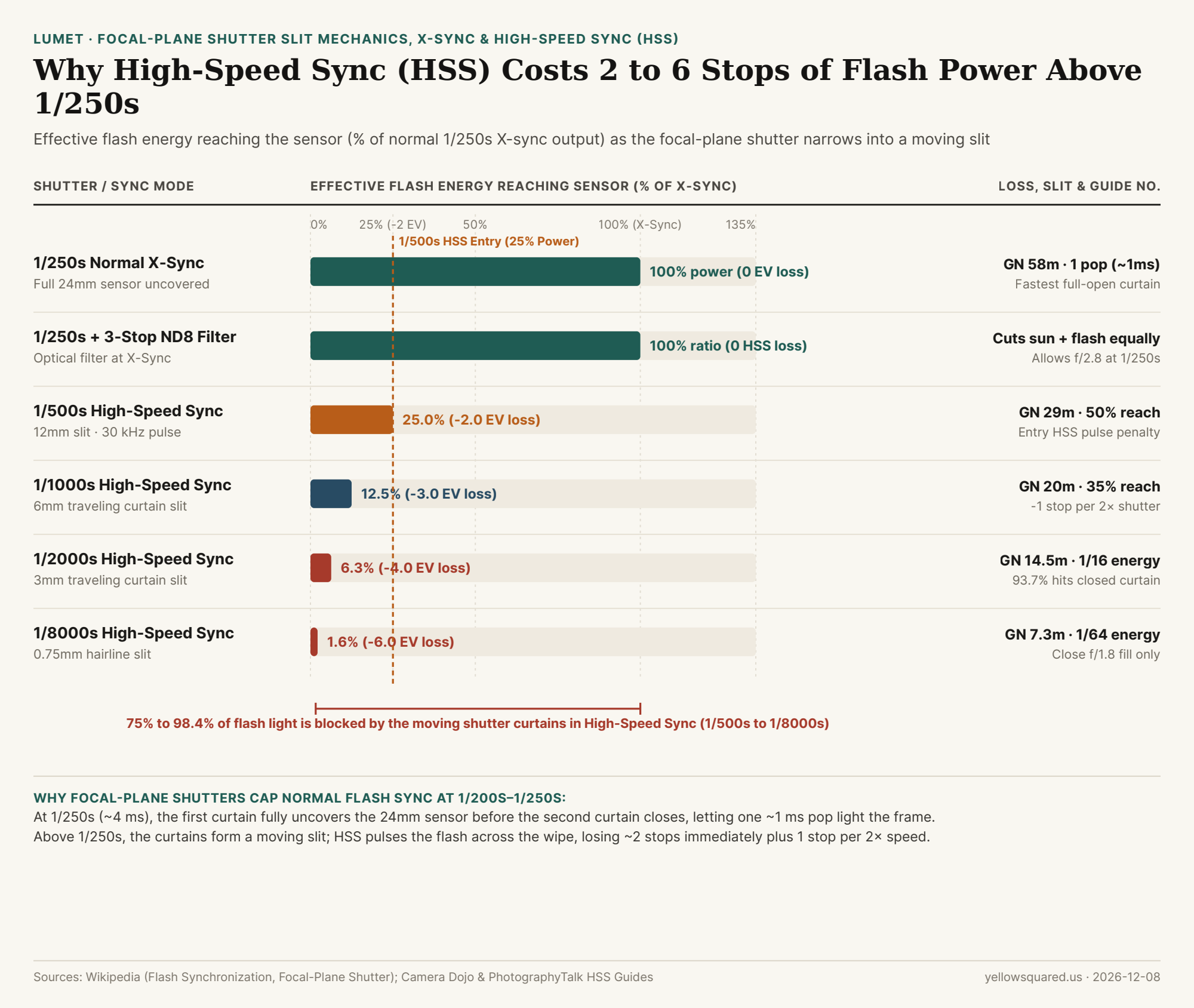
% of 1/250s X-sync output) and Guide Number reach as a focal-plane shutter narrows from a fully uncovered 24 mm frame into a traveling slit under High-Speed Sync (HSS). Sources: Flash Synchronization, Focal-Plane Shutter, PhotographyTalk, and Camera Dojo · Download CSV dataset.Two Curtains and a 4-Millisecond Window: Why X-Sync Tops Out at 1/250s
As detailed in Focal-plane shutter mechanics, almost all modern DSLR and mirrorless cameras use a vertical-travel focal-plane shutter made of two ultra-lightweight blade curtains placed immediately in front of the 24 mm-tall full-frame sensor (or 15 mm APS-C sensor). Regardless of whether you set your shutter dial to 1/60s or 1/8000s, the physical speed at which each curtain travels across the 24 mm frame is fixed by mechanical acceleration limits at roughly 3.0 to 4.0 milliseconds:
- At or Below Sync Speed (
1/250sor slower): The first curtain slides open (~3.5 ms), exposing 100% of the sensor at once. The instant the first curtain reaches the bottom, the camera's X-sync contact fires a single electronic flash pop (which lasts~1/1000sto1/10,000s, illuminating the entire uncovered sensor), and only then does the second curtain slide across to end the exposure. - Above Sync Speed (
1/500sto1/8000s): To achieve an exposure time shorter than the~3.5 mscurtain transit time, the camera cannot wait for the first curtain to finish opening. Instead, the second curtain starts closing while the first curtain is still moving, forming a narrow traveling slit that wipes across the sensor (about12 mmwide at1/500s,3 mmwide at1/2000s, and just0.75 mmwide at1/8000s). If a standard flash fires a single 1-millisecond pop while the curtains form a6 mmslit, three-quarters of your sensor is covered by metal shutter blades—leaving a black curtain band across the frame! (By contrast, as noted in Shutter (photography), cameras with in-lens leaf shutters open from the center outward and can sync a single flash pop at1/500sto1/2000swith zero slit loss.)
How High-Speed Sync (HSS) Works—and Why It Eats 2 to 6 Stops of Power
To use flash above 1/250s with a focal-plane shutter, High-Speed Sync (HSS)—originally introduced on film cameras as FP (Flat-Peak) sync—changes how the flash tube discharges. Instead of releasing all capacitor energy in one intense pop, the speedlight fires an ultra-rapid 20 kHz to 50 kHz pulsed strobe train for the entire 4-to-8 millisecond duration of the curtain wipe, acting like a continuous LED light while the slit travels across the sensor.
"When you switch from 1/250s normal X-sync to 1/500s High-Speed Sync, most of your flash's pulsed light lands on the closed metal shutter curtains rather than the sensor—costing roughly 2 full stops (75% of your flash energy) immediately, plus 1 additional stop every time you double the shutter speed."
As documented in Camera Dojo's Guide Number benchmarks, a speedlight rated at GN 58 (meters at ISO 100) in normal 1/250s sync drops to roughly GN 20–29 as soon as it enters HSS, and loses half of its remaining effective sensor exposure with each shutter doubling because the traveling slit narrows by half each stop.
X-Sync vs. ND Filter vs. High-Speed Sync Power Table
The table below compares curtain slit width, effective flash energy reaching the sensor, EV stop loss, and effective Guide Number reach across shutter speeds (download the raw CSV table):
| Shutter & Flash Sync Mode | Curtain Slit Geometry | Effective Flash Energy | EV Power Loss | Effective Guide No. (ISO 100) |
Outdoor Portrait & Fill-Flash Impact |
|---|---|---|---|---|---|
1/200s–1/250s Normal X-Sync |
Full 24 mm sensor open |
100.0% (1 pop) | 0.0 EV |
GN 58 m (100% reach) |
Maximum flash efficiency; freezes indoor motion |
1/250s + 3-Stop ND8 Filter |
Full 24 mm sensor open |
100.0% flash-to-sun ratio | 0.0 EV relative |
GN 58 m ratio |
Lets you shoot f/2.8 in sun at 1/250s without HSS |
1/500s High-Speed Sync (HSS) |
~12 mm traveling slit |
25.0% (1/4 energy) |
-2.0 EV |
GN 29 m (50% reach) |
Immediate 2-stop penalty entering pulsed HSS mode |
1/1000s High-Speed Sync (HSS) |
~6 mm traveling slit |
12.5% (1/8 energy) |
-3.0 EV |
GN 20 m (35% reach) |
Matches 3-stop ND filter ambient cut, but loses 87.5% flash |
1/2000s High-Speed Sync (HSS) |
~3 mm traveling slit |
6.3% (1/16 energy) |
-4.0 EV |
GN 14.5 m (25% reach) |
93.7% of flash light bounces off closed shutter blades |
1/8000s High-Speed Sync (HSS) |
~0.75 mm hairline slit |
1.6% (1/64 energy) |
-6.0 EV |
GN 7.3 m (12.5% reach) |
Matches f/1.8 in direct sun; flash must sit very close |
When to Use an ND Filter Instead of HSS Outdoors
If your subject is stationary or posing for a portrait in bright sunlight and you want to shoot wide open at f/2 or f/2.8 with a small speedlight, screw a 3-stop (ND8) or 6-stop (ND64) Neutral Density filter onto your lens and stay at 1/250s normal X-sync. While a 3-stop ND filter darkens both the sunlight and the flash by 3 stops, keeping your shutter at 1/250s avoids the 2-to-3-stop HSS pulsing efficiency loss—giving your flash twice the effective reach and faster recycle times than shooting bare-lens HSS at 1/2000s. Reserve High-Speed Sync for action portraits where you specifically need a fast 1/2000s–1/4000s shutter speed to freeze hair, water, or sports motion in bright ambient light. Plan flash sync speeds, HSS power loss, and ND filter exposures in Lumet to dial in your exact strobe-to-ambient balance.