
What Is Chromatic Aberration in Photography? Purple Bokeh Fringing vs. Corner Color Edges Explained
Shoot a portrait wide open at f/1.4 against sunlit tree branches—or photograph silver silverware, architectural edges, or water droplets—and zoom in to 200%. Almost immediately, you will spot two completely different types of phantom color halos: glowing magenta and green outlines around slightly out-of-focus foreground and background highlights right in the center of the frame, or sharp cyan-red and blue-yellow splits hugging high-contrast edges in the extreme corners. Both artifacts are called chromatic aberration (CA), yet they are caused by two different geometric pathways inside your lens, respond oppositely when you stop down your aperture, and require completely different fixes in post-processing. As documented in Wikipedia's optical reference on Chromatic Aberration, laboratory camera-testing standards from Image Engineering, Photography Life, and the VR & AR Optics Wiki, knowing whether you are looking at Longitudinal (Axial) CA or Lateral (Transverse) CA is one of the most practical diagnostic skills in photography.
1. Why Glass Splits White Light: Dispersion and the Abbe Number (Vd)
A camera lens focuses light by refraction—bending incoming light waves as they cross from air (refractive index n ≈ 1.0003) into curved optical glass (n ≈ 1.43 to 1.85). However, as explained in optical dispersion physics, the refractive index of every transparent solid varies with wavelength (λ): short-wavelength violet and blue light (400–480 nm) travels more slowly through glass and bends at a steeper angle than long-wavelength red light (620–700 nm).
Optical engineers quantify how severely a glass formula splits the visible spectrum using the Abbe number (Vd), named after German physicist Ernst Abbe, which compares the glass's refractive index at yellow helium light (587.6 nm) against its spread between blue hydrogen (486.1 nm) and red hydrogen (656.3 nm):
- Low Abbe Number (
Vd < 45) = High Dispersion (Severe Color Split): Dense flint glasses (Vd ≈ 28–37) and optical plastics like polycarbonate break white light into wide rainbow fringes. - Moderate Abbe Number (
Vd ≈ 55–65) = Standard Crown Glass: Classic borosilicate crown glass (such as SchottN-BK7,Vd = 64.2) has much lower dispersion than flint glass, which is why 18th-century telescope makers cemented a positive crown element to a negative flint element to create an achromatic doublet that brings two wavelengths (typically red and blue) to the same focus. - High Abbe Number (
Vd > 80) & Anomalous Partial Dispersion (ED,UD, Fluorite & Phase Fresnel): Even in an achromatic doublet, green light still focuses slightly ahead of red and blue—creating a purple/green residual halo called the secondary spectrum. As Wikipedia's lens engineering overview details, modern apochromatic lenses eliminate this residual fringe using Extra-Low Dispersion (ED,Vd ≈ 81.5) glass, Ultra-Low Dispersion (UD/ Super-ED,Vd ≈ 94.9) glass, monocrystalline Calcium Fluoride (CaF2Fluorite,Vd = 95.2), or Diffractive Optical / Phase Fresnel (PF/DO) elements—which possess a negative Abbe number ofVd = -3.5in visible light that directly cancels the positive dispersion of glass!
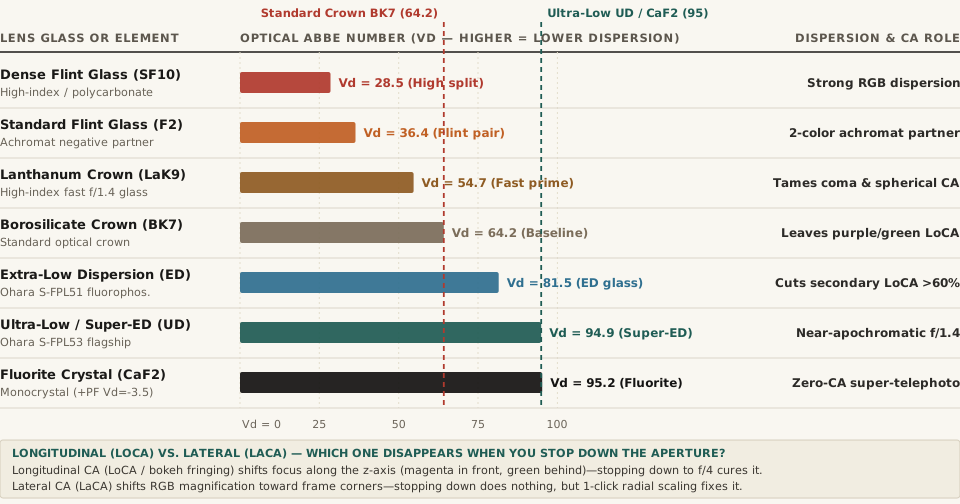
Vd) across seven camera lens glass tiers and their role in controlling axial and lateral dispersion (Wikipedia — Chromatic Aberration; Image Engineering; VR/AR Optics Wiki).2. Longitudinal (Axial) CA vs. Lateral (Transverse) CA: How to Tell Them Apart
When inspecting a photo or batch of images, you can tell the two types of chromatic aberration apart in three seconds by checking where in the frame the fringe appears, what colors it displays, and what happens when you stop down the aperture (Image Engineering; Photography Life):
- Longitudinal / Axial Chromatic Aberration (
LoCA— "Bokeh Fringing" Along the Z-Axis):- Physical Mechanism: Rays entering parallel to the optical axis focus at different distances in front of and behind the CMOS sensor plane. When green wavelengths are focused sharply on your subject's eyelashes, red and blue/violet wavelengths miss the focal plane along the depth (
z) axis. - Visual Signature: Appears everywhere in the frame, including dead center, around high-contrast out-of-focus edges and specular bokeh balls. Out-of-focus highlights in front of the focal plane glow magenta/purple, while out-of-focus highlights behind the focal plane glow green.
- How to Fix It: Because
LoCAis a depth-of-focus mismatch, stopping down your aperture fromf/1.4tof/2.8orf/4.0dramatically reduces or eliminates it by expanding depth of field so all three color channels land within the acceptable circle of confusion. Conversely, automated 1-click lens corrections in raw editors cannot fixLoCAwithout manual defringe sliders that risk desaturating real magenta lips or green foliage.
- Physical Mechanism: Rays entering parallel to the optical axis focus at different distances in front of and behind the CMOS sensor plane. When green wavelengths are focused sharply on your subject's eyelashes, red and blue/violet wavelengths miss the focal plane along the depth (
- Lateral / Transverse Chromatic Aberration (
LaCA/TCA— Radial Magnification Shift Across X/Y):- Physical Mechanism: When light enters the lens at a steep oblique angle away from the center, dispersion causes the effective focal length—and therefore the image magnification—to vary slightly between Red, Green, and Blue wavelengths on the exact same sensor plane.
- Visual Signature: Completely absent (zero) in the exact center of the frame and grows progressively wider toward the outer edges and extreme corners. Appears on in-focus edges oriented tangentially (perpendicular to a radius drawn from the center), with one side of the object rimmed in cyan/blue and the opposite side rimmed in red/yellow.
- How to Fix It: As Wikipedia and Image Engineering emphasize, stopping down the aperture has zero effect on Lateral CA because the magnification ratio between wavelengths does not change with aperture diameter. However, because the Red, Green, and Blue channels are all sharp and merely differ in radial scale by a fraction of a percent, checking "Remove Chromatic Aberration" in a raw converter fixes
LaCAcleanly in one click by radially rescaling the R and B channels to align with G!
"Axial CA can be reduced by stopping down, which increases depth of field... Transverse chromatic aberration (TCA) is not affected by stopping down, as it is caused by the magnification of each wavelength of light differing within the lens."
3. Complete Data Table: Optical Glass Tiers & Longitudinal vs. Lateral CA Behavior
The reproducible table below—matching the companion CSV (chromatic-aberration-longitudinal-vs-lateral-abbe-number-and-lens-glass-dispersion.csv)—summarizes the refractive index, Abbe number (Vd), and practical aberration behavior across seven optical glass tiers:
| Optical Glass / Element Tier | Material Designation | Refractive Index (nd) |
Abbe Number (Vd) |
Dispersion Class | Effect on Longitudinal CA (LoCA) |
Effect on Lateral CA (LaCA) |
|---|---|---|---|---|---|---|
| Dense Flint Glass | SF10 / Polycarbonate |
1.728 |
28.5 |
Very High Dispersion | Severe axial RGB focus shift if uncorrected | Wide corner RGB magnification split |
| Standard Flint Glass | F2 / N-F2 Flint |
1.620 |
36.4 |
High Dispersion | Negative element in 2-wavelength achromats | Leaves residual purple secondary spectrum |
| Lanthanum High-Index Crown | Rare-Earth LaK9 |
1.691 |
54.7 |
Moderate-Low Dispersion | Controls spherical & sagittal coma in f/1.4 primes |
Moderate corner TCA; fixed by raw profile |
| Borosilicate Crown Glass | Schott N-BK7 Crown |
1.517 |
64.2 |
Standard Crown Baseline | Positive partner in standard doublets | Needs ED/UD pairing on wide & tele zooms |
Extra-Low Dispersion (ED) |
Ohara S-FPL51 |
1.497 |
81.5 |
Extra-Low Dispersion | Cuts magenta/green bokeh fringing by >60% |
Aligns RGB focal lengths across zoom range |
Ultra-Low / Super-ED (UD) |
Ohara S-FPL53 |
1.439 |
94.9 |
Ultra-Low Dispersion | Near-apochromatic axial focus at f/1.4–f/2.8 |
Minimal raw corner fringing on full-frame |
| Fluorite Crystal + Phase Fresnel | Monocrystal CaF2 (+PF Vd=-3.5) |
1.434 |
95.2 |
Anomalous Dispersion | Eliminates axial color shift on 300–800mm primes |
Phase Fresnel (Vd = -3.5) cancels glass CA |
When you are culling a portrait session or building side-by-side multi-photo grids and want to make sure wide-open f/1.4 frames match stopped-down f/2.8 frames without purple edge cast, Compare multi-photo grids in BatchPad before exporting your final sequence.