
What Is Color Temperature (Kelvin) in Lighting? Why 2700K Bulbs Look Warm Orange While 5600K Daylight Looks Cool Blue
Walk down the lighting aisle at a hardware store or dial in a bi-color LED studio panel, and the numbers feel backward at first glance: a cozy, amber-orange living-room bulb is labeled with a low temperature (2700K), whereas a crisp, icy-blue overcast sky or hospital fluorescent tube is rated at a high temperature (6500K). Why do photographers call 2700K "warm" and 6500K "cool" when the Kelvin thermometer says the exact opposite? The answer lies in the collision between nineteenth-century psychological color theory and twentieth-century Planckian blackbody radiation physics—and understanding how Kelvin converts into micro-reciprocal degrees (mireds) is the key to matching mixed lights and choosing CTO / CTB gels on set.
Reader outcome: You will understand why heating an ideal blackbody radiator shifts light from red-orange (1850K) to blue-white (6500K+), why a 200K white-balance tweak looks 3.5 times stronger at 2800K than at 5600K, and how to use the mired formula (M = 1,000,000 / K) to pick exact Full, 1/2, or 1/4 CTO and CTB gels.
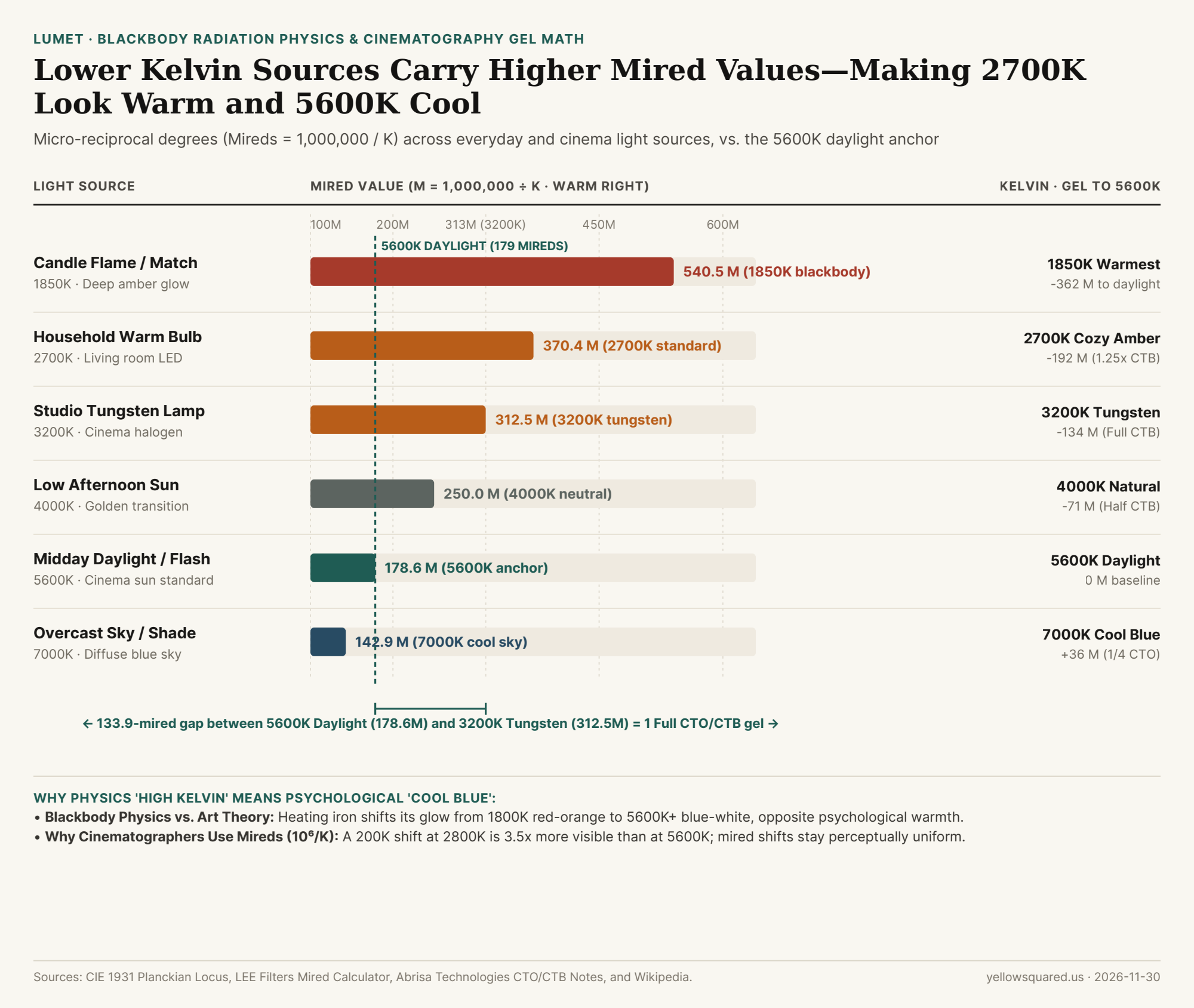
Why 'Higher Kelvin' Means 'Cooler Blue': Blackbody Physics vs. Psychological Warmth
In everyday life and visual art, we associate yellow, orange, and red with fire, embers, and sunlight ("warm colors"), and we associate cyan and blue with water, ice, and shade ("cool colors")—a perceptual link known in environmental psychology as the hue-heat hypothesis. In physics, however, color temperature measures the literal thermodynamic temperature in kelvins (K = °C + 273.15) of an idealized opaque, non-reflective object—a Planckian black-body radiator—heated until it incandesces.
Imagine heating a cast-iron poker in a forge. Governed by Planck's radiation law and Wien's displacement law (λ_peak = 2,898,000 nm·K / T), the peak wavelength of emitted electromagnetic radiation shifts toward shorter, higher-energy wavelengths as physical temperature rises:
1850K(Candle Flame) &2700K(Incandescent Filament): At1850K–2700K, the blackbody's spectral peak sits deep in the near-infrared (1,566 nmto1,073 nm). Within the human visible spectrum (380–700 nm), the curve slopes steeply upward toward red and orange while emitting almost zero blue photons—producing a warm golden-amber glow.3200K(Cinema Tungsten Halogen): Heating a quartz-halogen tungsten filament just below tungsten's melting point (3695K) shifts the curve toward amber-white, establishing the classic indoor motion-picture tungsten standard.5600K(Midday Sun) to7000K+(Overcast Sky / Shade): The sun's photosphere has an effective temperature near5778K(filtered through Earth's atmosphere to ~5500K–5600Kat midday, peaking near518 nmgreen-cyan with balanced red, green, and blue energy). When direct sunlight is blocked by clouds or open shade, Rayleigh scattering fills the sky with short-wavelength blue photons, pushing correlated color temperature (CCT) to6500K–8000K.
A 2700K bulb is physically cooler than a 5600K strobe—just as a dull orange ember is cooler than a white-hot welding arc—even though our eyes read orange light as psychologically warm.
Why Kelvin Steps Are Uneven—And How the Mired Scale (1,000,000 / K) Fixes It
If you adjust your camera's white balance by +200K from 2800K to 3000K, you see a dramatic shift in skin tones; if you adjust it by the same +200K from 5600K to 5800K, the change is barely perceptible. That happens because human color perception responds to the reciprocal of temperature (1/T) rather than linear kelvins. In 1933, physicist Irwin G. Priest introduced the mired (micro-reciprocal degree):
Mired (M) = 1,000,000 ÷ Color Temperature (K)
In mireds, a step of 20 mireds produces the exact same perceptual color shift at the warm end of the spectrum as it does at the cool end. Better yet, optical lighting gels from LEE Filters and Rosco—specifically CTO (Color Temperature Orange) and CTB (Color Temperature Blue)—are engineered to add or subtract a fixed number of mireds regardless of the fixture behind them:
| Light Source / Standard | Color Temp (K) | Mired Value (10⁶ / K) | Planckian Peak (λ) | Visual Hue Appearance | Mired Shift & Gel to Match 5600K |
|---|---|---|---|---|---|
| Candle Flame / Match | 1850K |
540.5 M |
1,566 nm (Near-IR) |
Deep orange-red glow | -361.9 M (Extreme blue shift) |
| Household Warm LED / Bulb | 2700K |
370.4 M |
1,073 nm (Near-IR) |
Warm cozy yellow-orange | -191.8 M (Full + 1/4 CTB) |
| Studio Tungsten Halogen | 3200K |
312.5 M |
906 nm (Amber-IR) |
Cinema tungsten baseline | -133.9 M (1x Full CTB filter) |
| Golden Hour / Late Afternoon | 4000K |
250.0 M |
725 nm (Warm Red) |
Soft warm natural sunlight | -71.4 M (1x Half CTB filter) |
| Midday Sun / Studio Strobe | 5600K |
178.6 M |
518 nm (Green-Cyan) |
Crisp neutral daylight | 0.0 M (Daylight anchor) |
| Overcast Sky / Open Shade | 6500K–7500K |
153.8–133.3 M |
446–386 nm (Blue) |
Cool pale blue daylight | +24.8 to +45.3 M (1/4 CTO) |
How to Balance Mixed Window Daylight and Indoor Lamps on Location
Suppose you are shooting an interview in a living room lit by 2700K practical table lamps (370.4 mireds) while 5600K daylight (178.6 mireds) pours through a side window. If you leave your key light at 5600K and set your camera white balance to 5600K, the background lamps will render deep orange; if you set your camera to 3200K, the window light turns radioactive Smurf blue. Using mired math, clipping a 1/2 CTO gel (+81 mireds) or dialing your bi-color key light to 3800K–4000K (250–263 mireds) splits the mired difference right down the middle—keeping skin tones natural while letting the practical lamp look gently warm (+110 mireds) and the window look gently cool (-71 mireds). Also watch the perpendicular axis to the Planckian locus—Tint (Green/Magenta, Δuv)—where cheap fluorescent or warehouse LEDs require 1/4 or 1/2 Minus Green gel. To read ambient lux, exposure values, and scene lighting ratios directly on your phone before setting up stands, Measure ambient and studio lighting in Lumet.