
What Is CRI vs. TLCI in LED Lights—And Why Do Cheap Bulbs Make Skin Look Pale or Green?
Walk down the lighting aisle at any hardware store—or browse budget ring lights online—and nearly every box boasts "High CRI 80+" or "90+ CRI Daylight." Yet the moment you turn on a standard household LED bulb over your desk and open a video call or mirrorless camera, your face looks waxy, pale, or faintly greenish-yellow. Why does a light source that passes an 80-point or 90-point color accuracy test make human skin look unwell? As documented in the International Commission on Illumination (CIE) Color Rendering Index specification and technical photometry analyses by UPRtek, CameraStuff, and Light Sky, the answer lies in a 50-year-old mathematical shortcut: standard headline CRI (Ra) averages only the first eight pastel test patches (R1 through R8) and completely excludes R9 (strong saturated red).
Here is how the CRI (Ra) formula works, why cheap blue-pump white LEDs deliberately sacrifice 620–680 nm red wavelengths to boost lumens-per-watt efficiency, and why cinematographers and lighting engineers rely on Extended R9, TLCI (Television Lighting Consistency Index), and IES TM-30 instead.
1. How CIE CRI (Ra) Works—And Why It Ignores R9 through R14
Introduced by the International Commission on Illumination (CIE) and refined into its modern form in 1974, the Color Rendering Index (CRI) measures how faithfully a test light source renders surface colors compared to an ideal reference illuminant of the exact same Correlated Color Temperature (CCT):
- The Reference Illuminant Split at
5,000 K: As specified in the CIE CRI method, if a lamp's correlated color temperature is under5,000 K(such as2700Kwarm household tungsten or3200Kstudio halogen), its spectrum is compared against an ideal Planckian black-body radiator. If its color temperature is5,000 Kor higher (such as5600Kor6500Kdaylight), it is compared against a mathematical CIE Standard Illuminant D (daylight) simulator. To even qualify for a valid comparison, the lamp's chromaticity distance from the Planckian locus must satisfyDC = Δuv < 5.4 × 10^-3on the CIE 1960 uniform chromaticity scale. - 14 Test Color Samples (
TCS01–TCS14), Only 8 Counted inRa: As detailed by UPRtek's photometry guide, the CIE defines 14 Munsell reference color swatches (often expanded to 15 in Asia withR15for Asian skin tone). However, when a manufacturer prints "CRI = 80" on a box, they are reporting General CRI (Ra), which is the unweighted arithmetic mean of only the first 8 moderately saturated pastel swatches (R1toR8):TCS01 (R1): Light greyish red;TCS02 (R2): Dark greyish yellow;TCS03 (R3): Strong yellow green;TCS04 (R4): Moderate yellowish green;TCS05 (R5): Light bluish green;TCS06 (R6): Light blue;TCS07 (R7): Light violet;TCS08 (R8): Light reddish purple.
- What Gets Left Out (
R9–R14): The remaining six swatches—TCS09 (R9: Strong Saturated Red),TCS10 (R10: Strong Yellow),TCS11 (R11: Strong Green),TCS12 (R12: Strong Blue),TCS13 (R13: Caucasian Skin Tone / Light Yellowish Pink), andTCS14 (R14: Olive Leaf Green)—are classified as Special CRI values and are completely excluded from the headlineRaaverage.
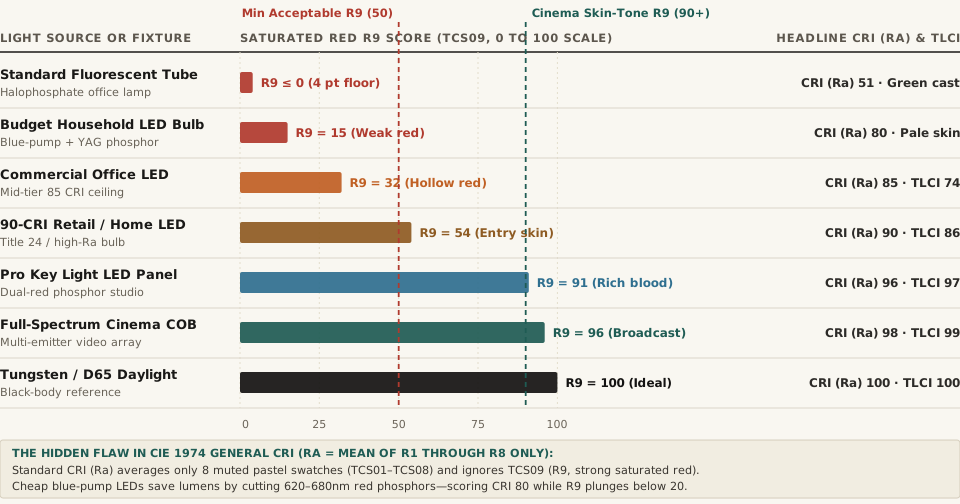
R9 (saturated red) score vs. headline CRI (Ra) and broadcast camera TLCI across seven lighting tiers (Wikipedia — Color Rendering Index; UPRtek; CameraStuff).2. The Physics of Cheap White LEDs: Why Blue-Pump Phosphors Starve Red Skin Tones
Why does omitting R9 cause such severe damage when evaluating modern LED bulbs? As explained in Light Sky's analysis of stage and studio CRI, a typical white LED is not natively white: it consists of a monochrome ~450 nm blue Indium Gallium Nitride (InGaN) semiconductor chip coated in a yellow cerium-doped yttrium aluminum garnet (YAG:Ce) phosphor.
- The Lumen-per-Watt Trade-Off at
620–680 nm: Human eyes are maximally sensitive to green-yellow light at555 nm(the photopic luminous efficacy peak) and rapidly lose sensitivity in the deep red spectrum above620 nm. If a bulb manufacturer adds deep-red nitride phosphors emitting at630–660 nm, a large share of the LED's electrical energy goes into red photons that barely register on a lumen meter—lowering the bulb's advertised lumens-per-watt efficacy. - Gaming the
R1–R8Pastel Average: By concentrating phosphor output in the yellow-green band (530–590 nm) and letting the spectrum cliff-dive above610 nm, a budget household LED easily achievesCRI (Ra) = 80–83on the eight muted pastel swatches while itsR9score sits between0and20(and cheap halophosphate fluorescent tubes actually score a negativeR9). - Why Low
R9Turns Faces Greenish-Grey: Beneath the outer melanin layer of the epidermis, human skin tone across all ethnicities is governed by the reflectance of oxygenated hemoglobin in capillary blood, which reflects strongly in the610–680 nmred band. Under a light source withR9 = 15, there are virtually no deep-red photons available to bounce off the skin—leaving only the blue spike (450 nm) and yellow-green phosphor hump (550 nm), which renders faces ashy, pale, or jaundiced.
"In lighting design, R9 value is typically used as a benchmark to assess whether a light source can accurately reproduce red tones... An R9 value above 50 is the minimum requirement for acceptable red rendering, while an R9 value of 90 or higher indicates excellent color reproduction."
3. Why Cameras Need TLCI, TM-30, and SSI Instead of CRI
Even if an LED fixture has a high CRI (Ra), a digital camera sensor does not see light the way the human eye does. As CameraStuff's comparison of CRI, TLCI, and TM-30 explains, human vision relies on three overlapping cone cell responses (LMS) processed by the brain's chromatic adaptation engine, whereas a mirrorless camera or webcam uses discrete Red, Green, and Blue Bayer color filters over a silicon CMOS sensor:
TLCI(Television Lighting Consistency Index,0–100): Developed by Alan Roberts for the European Broadcasting Union (EBU),TLCIreplaces the human eye observer with a mathematical model of a standard broadcast camera sensor and evaluates 24 Macbeth ColorChecker patches. A score ofTLCI 85–90means a colorist can fix the footage with minor white-balance tweaks; a score ofTLCI 95–100means the fixture produces broadcast-ready skin tones straight out of camera with zero color-grading rescue required.IES TM-30(RfFidelity +RgGamut Across 99 Color Samples): Because LED makers learned how to tune narrow phosphor peaks to flatter the 8 specific Munsell pastel swatches inCRI, the Illuminating Engineering Society introducedTM-30, which tests 99 real-world Color Evaluation Samples (CES) selected from nature, skin, textiles, and inks.TM-30reports bothRf(Fidelity Index,0–100) andRg(Gamut Index, centered on100), revealing whether a light source desaturates reds (Rg < 95) or oversaturates them.SSI(Spectral Similarity Index): Developed by the Academy of Motion Picture Arts and Sciences (AMPAS),SSIignores human vision and fixed color swatches entirely, comparing the continuous wavelength-by-wavelength curve of an LED directly against tungsten (3200K) or CIE D55/D65 daylight so any future camera sensor will respond identically.
4. Complete Data Table: Lighting Tiers by CRI (Ra), Extended R9, TLCI, and TM-30
The dataset below—included in the companion CSV (cri-ra-vs-r9-saturated-red-tlci-and-tm30-led-lighting-skin-tone-benchmarks.csv)—compares seven real-world lighting tiers across all four photometric standards:
| Light Source or Fixture Tier | Emitter Architecture | Headline CRI (Ra) |
Extended R9 (Red) |
Camera TLCI |
TM-30 (Rf / Rg) |
Skin-Tone & Camera Impact |
|---|---|---|---|---|---|---|
| Standard Fluorescent Tube | Mercury vapor lines + basic halophosphate | 51 |
≤ 4 (Often negative) |
38 |
Rf 54 / Rg 82 |
Severe green spike; sickly grey-green skin on webcam |
| Budget Household LED Bulb | 450nm blue pump + basic YAG:Ce yellow |
80 |
15 |
66 |
Rf 78 / Rg 94 |
Passes CRI 80 spec because R9 is omitted; pale/waxy skin |
| Commercial Office Troffer LED | Mid-power SMD array (85 CRI rated) |
85 |
32 |
74 |
Rf 83 / Rg 96 |
Hollow red hemoglobin response; needs magenta tint correction |
| 90-CRI Retail / Title 24 Home LED | Blue pump + nitride red phosphor boost | 90 |
54 (R9 ≥ 50 floor) |
86 |
Rf 89 / Rg 99 |
Acceptable residential warmth; minor CMOS grading required |
| Pro Video Key Light Panel | Dual-red phosphor studio SMD array | 96 |
91 |
97 |
Rf 94 / Rg 101 |
Natural blood warmth; zero post color correction (TLCI > 95) |
| Full-Spectrum Cinema COB LED | Multi-phosphor / continuous-spectrum COB | 98 |
96 |
99 |
Rf 96 / Rg 100 |
Matches natural window daylight and cinema LUTs seamlessly |
| Tungsten / D65 Daylight Reference | Continuous black-body / solar spectrum | 100 |
100 |
100 |
Rf 100 / Rg 100 |
Ideal 100-point reference across all 14 TCS & 99 CES patches |
If your desk is lit by overhead office LEDs or mixed window light and you want flattering, natural skin tones on video calls without buying a $600 cinema COB fixture, Calibrate video call lighting in Lumet to turn your monitor into a color-accurate, temperature-matched key light with custom warmth to compensate for low-R9 room bulbs.