
CRI vs. TLCI: Why High-CRI LED Lights Still Make Skin Tones Look Green on Camera
CRI vs. TLCI: Why High-CRI LED Lights Still Make Skin Tones Look Green on Camera
Because standard Color Rendering Index (CRI Ra) averages only eight unsaturated pastel swatches (R1–R8) and completely excludes saturated red (R9), a budget '95 CRI' LED with a low R9 score starves human skin of hemoglobin warmth and skews CMOS sensors green.
Buy an affordable LED key light for your home office or YouTube studio that proudly advertises "CRI 95+" on the box, switch it on in front of your webcam or mirrorless camera, and look at your face on the monitor: your skin looks strangely waxy and sallow, your lips look grayish-purple, and pushing the tint slider toward magenta in DaVinci Resolve or Premiere only makes the background walls turn pink.
How can a light with a near-perfect `95 out of 100` Color Rendering Index distort human skin tones on camera? The answer lies in a 60-year-old photometric loophole: **standard `CRI (Ra)` does not test a single saturated red swatch**, and it models human eyes rather than digital CMOS camera sensors.
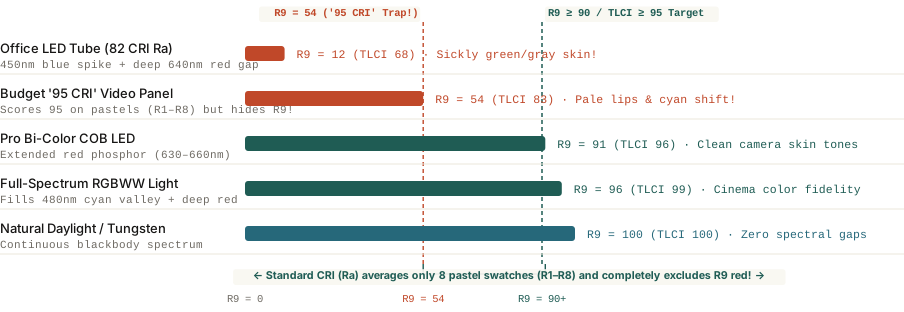
The R1–R8 Pastel Loophole: Why CRI Excludes Red (R9)
Created by the International Commission on Illumination (CIE) in 1965 to evaluate fluorescent shop tubes, the **Color Rendering Index (`CRI`)** contains 14 reference Munsell color swatches (`R1` through `R14`, plus `R15` added later for Asian skin tones). However, the headline **`CRI (Ra)`** number printed on product boxes is calculated by averaging **only the first eight swatches (`R1` through `R8`)**:
- `R1–R8` Are Muted Pastels: Dusty rose, mustard yellow, yellow-green, light green, sky blue, violet, and lilac.
- `R9` (Saturated Red) Is Excluded from `Ra`: The deep red swatch (`R9`), along with `R13` (Caucasian skin tone) and `R15` (Asian skin tone), sits in "Extended CRI" (`Re`) and is **completely left out of the standard `CRI Ra` average**.
- Why White-Phosphor LEDs Fail on `R9`: Most white LEDs generate light by firing a sharp `450 nm` royal-blue diode through a yellow phosphor coating. That spectrum drops off sharply above `620 nm` (deep red) and leaves a valley around `480 nm` (cyan). Because human skin gets its lifelike warmth from `620–660 nm` red wavelengths reflecting off subcutaneous **oxygenated hemoglobin (blood flow)**, an LED with `CRI 95` but `R9 = 54` makes skin look cadaverous and green-shifted.
Judging a video light by its general CRI (Ra) score alone is like judging a stereo speaker that has no subwoofer: the midrange pastels sound fine, but the red bass is missing.
Why Cameras Need TLCI ≥ 95 and R9 ≥ 90
Even if a light looks acceptable to your naked eye in the room, your brain performs automatic **chromatic adaptation** to fill in missing wavelengths. A digital camera's **CMOS sensor** has no brain: it slices incoming light through rigid red, green, and blue (`RGB`) Bayer color filters. To measure how a light actually records on a camera sensor, the European Broadcasting Union (EBU) introduced the Television Lighting Consistency Index (`TLCI`, scored `0–100`):
- `TLCI 95–100` (Zero Color Correction Required): Colors record accurately straight out of the camera (`SOOC`) with natural skin tones across all complexions.
- `TLCI 85–94` (Minor Grading Required): Slight green/magenta tint offset that a colorist can fix in post-production.
- The 3-Number Buying Rule (`CRI ≥ 95`, `R9 ≥ 90`, `TLCI ≥ 95`): Never buy a video or desk key light that lists only `CRI 95+`. Always check the photometric spec sheet for **`R9 ≥ 90`** and **`TLCI ≥ 95`** (or `TM-30 Rf ≥ 92 / Rg ≈ 100`).
To audit your studio or desk lighting setup for illuminance balance, color temperature consistency, and glare before hitting record, you can Measure workspace lux and glare in Lumet right from your browser.