
What Is CRI vs. TLCI in LED Lighting? Why Cheap Lights Turn Skin Green
What Is CRI vs. TLCI in LED Lighting? Why Cheap Lights Turn Skin Green
Because standard CRI (Ra) averages only 8 pastel color swatches (R1–R8) and excludes R9 saturated red (650 nm), a household LED can claim '90 CRI' while scoring below 45 on R9—starving human hemoglobin of red light and turning faces greenish-gray on camera.
Buy a $15 LED desk lamp or ring light advertised as "90+ CRI High Color Accuracy," switch on your webcam or mirrorless camera, and look closely at your skin tones on screen. Even after adjusting your camera's white balance Kelvin slider, your complexion looks strangely flat, chalky, or tinged with a subtle magenta-green cast that makes you look exhausted. Step over to a sunlit window, and your skin immediately regains its natural warmth.
The culprit is not your camera's sensor—it is a 60-year-old loophole in how the lighting industry calculates the Color Rendering Index (CRI), and the absence of 650-nanometer deep red light (`R9`) in consumer LED phosphors.
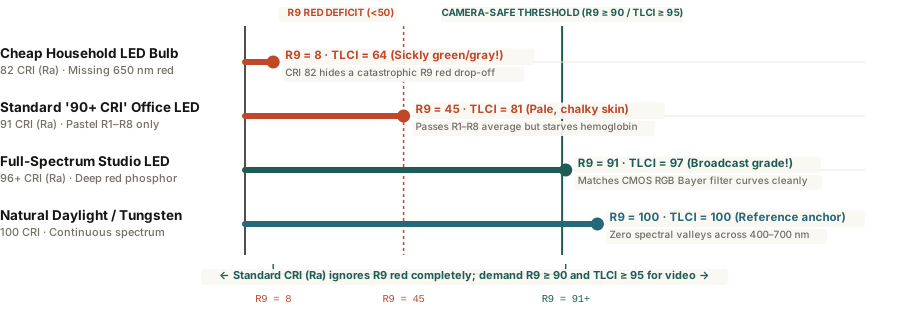
The "CRI Ra" Loophole: Why R1–R8 Ignores Red Blood
Developed by the International Commission on Illumination (CIE) in 1965 to test fluorescent office tubes, the standard Color Rendering Index (`CRI` or `Ra`) measures how accurately a light source renders eight muted, pastel Munsell color swatches labeled `R1` through `R8`. If a bulb reproduces those eight washed-out pastels reasonably well, it receives a headline score of `CRI 90`.
Crucially, there are six additional saturated test swatches—`R9` (saturated deep red), `R10` (yellow), `R11` (green), `R12` (blue), `R13` (Caucasian skin tone), and `R14` (foliage green)—that are completely excluded from the standard `CRI (Ra)` average. Why does skipping `R9` ruin video lighting?
- The 650 nm Hemoglobin Peak: Human skin is translucent. Warm, healthy skin tones across every complexion depend on light penetrating the epidermis and reflecting off oxygenated hemoglobin in subcutaneous capillaries—which reflects strongly in the 620 to 660 nanometer deep red (`R9`) band.
- Why Cheap LEDs Cut R9 on Purpose: Human eyes are relatively insensitive to deep 650 nm red light compared to 555 nm yellow-green light. To maximize energy-efficiency ratings (lumens per watt), consumer LED manufacturers cut off red phosphor emission above 625 nm—producing a bulb that scores `90 CRI` on `R1–R8` but plunges below `45` (or even negative numbers) on `R9`.
A headline '90 CRI' rating only tells you how a bulb illuminates pastel office walls; R9 and TLCI tell you how it illuminates a human face on camera.
Why Video Creators Use TLCI (`EBU R 137`) and `R9 >= 90`
When you stand in a room lit by a low-`R9` LED, your brain's visual cortex uses chromatic adaptation to mentally fill in the missing red wavelengths. A digital camera's CMOS sensor has no brain: it simply counts photons passing through fixed Red, Green, and Blue Bayer color filters. Without 650 nm photons hitting the Red pixel wells, the Green and Blue channels dominate, printing a sickly cyan-green cast into skin shadows that cannot be fixed with a simple white-balance tint slider.
To solve this for broadcast television and cinema, the European Broadcasting Union introduced TLCI (Television Lighting Consistency Index, `EBU R 137`). Instead of modeling human eye perception, TLCI runs the light's spectrum through a mathematical model of a standard digital video camera sensor and scores it from `0` to `100`:
- TLCI 95–100 (coupled with `R9 >= 90`): Colors record so accurately straight out of the camera that zero color-correction grading is required.
- TLCI 85–94: Minor color shifts visible on skin tones; a skilled colorist can correct them quickly in DaVinci Resolve or Premiere.
- TLCI < 80: Severe spectral gaps that distort skin tones and fabric colors simultaneously (fixing skin pushes backgrounds out of whack).
To turn your laptop or desktop monitor into a high-accuracy, flicker-free fill light with tunable Kelvin warmth for video calls, you can Calibrate video call lighting in Lumet directly in your browser.