
What Is Dual Native ISO? How Dual Conversion Gain Sensors Cut Low-Light Shadow Noise
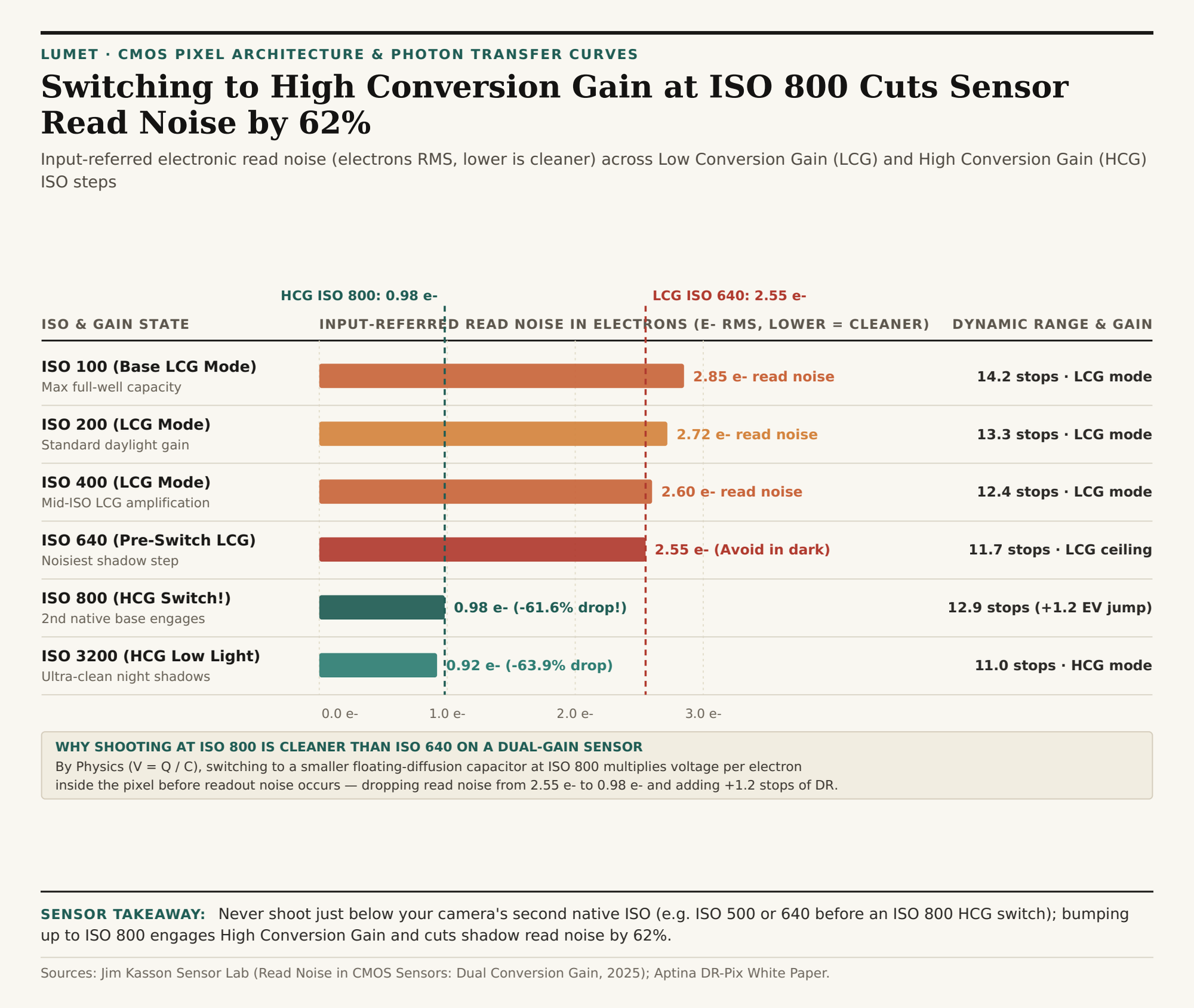
For decades, camera sensors followed a simple rule: base ISO (such as ISO 100) gave you the cleanest image and highest dynamic range, and every step up the ISO dial gradually degraded dynamic range while amplifying shadow noise. On modern full-frame and cinema CMOS sensors equipped with Dual Native ISO (technically called Dual Conversion Gain, or DCG), however, something remarkable happens as you raise the ISO dial in the dark: right as shadow noise reaches its worst point at ISO 640 (2.55 e- read noise), clicking one third-stop higher to ISO 800 causes input-referred read noise to plunge by 61.6% down to 0.98 e- — jumping dynamic range back up by +1.2 stops.
As demonstrated in Jim Kasson's Photon Transfer Curve (PTC) Laboratory Analysis of Dual Conversion Gain Sensors and the foundational Aptina DR-Pix Dual Conversion Gain White Paper (hosted on Photons to Photos), this sudden noise drop is not digital noise reduction — it is a physical hardware switch inside every individual pixel. Before shooting a high-contrast night or interior scene, Analyze low-light scene contrast in Lumet to map your shadow luminance zones against your sensor's second native gain threshold.
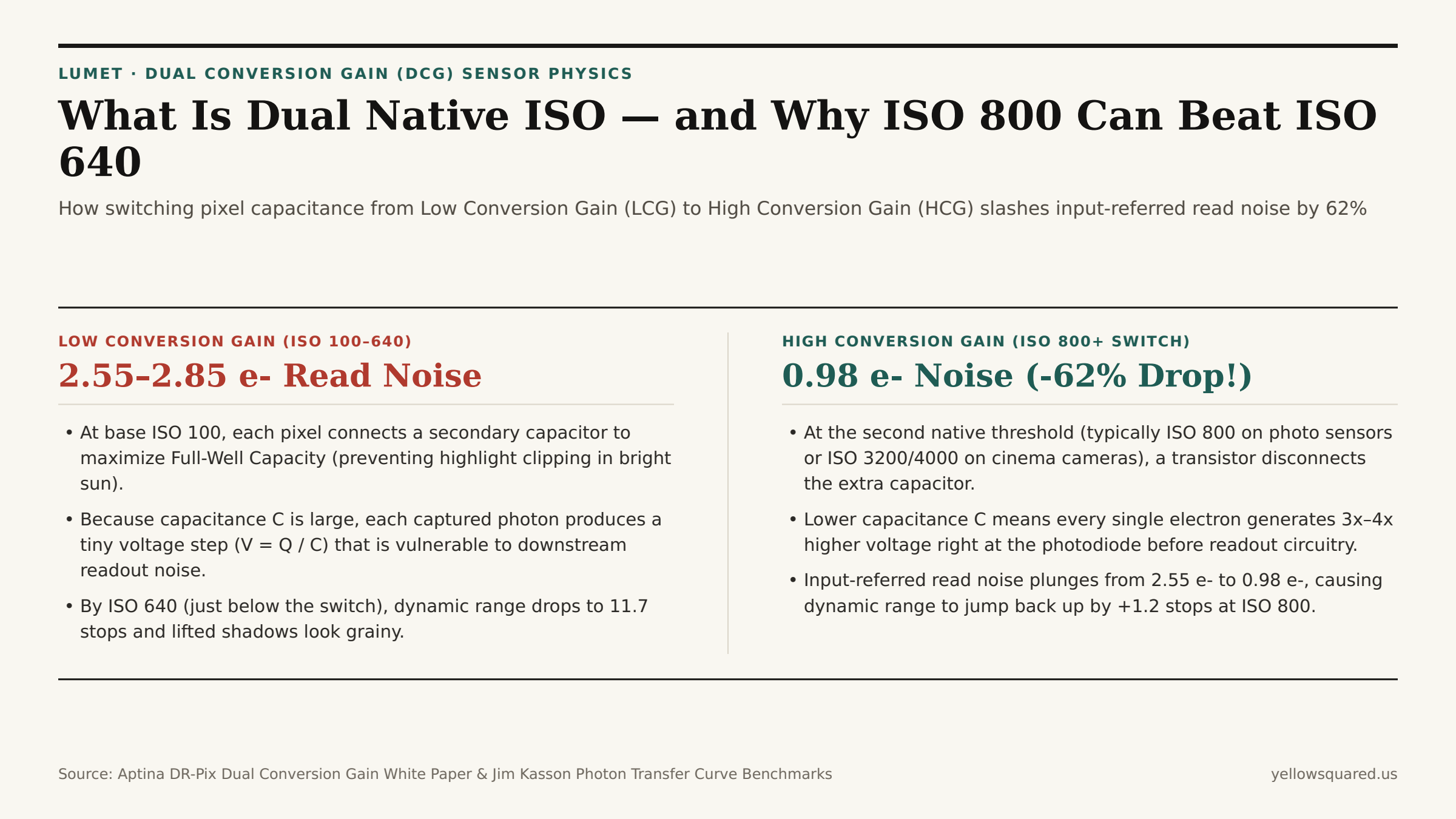
The Pixel-Level Physics: Why V = Q / C Controls Read Noise
Inside a CMOS active pixel sensor, photons striking the silicon photodiode liberate photoelectrons (charge Q). Before the camera's analog-to-digital converter (ADC) can measure those electrons, the charge must be transferred to a tiny node called the Floating Diffusion (FD) capacitor, which converts electron charge Q into a measurable voltage V according to the fundamental capacitance equation:
V = Q / C
Here lies the core engineering trade-off documented in the Aptina DR-Pix White Paper:
- In Bright Daylight (Low Conversion Gain — LCG, Large Capacitance
C): A single pixel might capture 40,000 to 80,000 electrons before saturating. To hold that massive bucket of charge without overflowing (clipping highlights), the pixel switches in an auxiliary capacitor so total capacitanceCis large. However, becauseCis in the denominator ofV = Q / C, each individual electron produces a very small voltage step (e.g.,~25 µV/e-), making deep shadows vulnerable to downstream source-follower and ADC readout noise (2.55 to 2.85 e- RMS). - In Low Light (High Conversion Gain — HCG, Small Capacitance
C): At night or indoors, the photodiode only captures a few dozen or a few hundred electrons, so you don't need a 60,000-electron bucket. When you cross the camera's second native ISO threshold (such as ISO 800 on many hybrid full-frame sensors, or ISO 3200 / 4000 on cinema sensors), the pixel opens its DCG transistor switch, disconnecting the extra capacitor. With a tiny floating-diffusion capacitanceC, every single electron now generates 3x to 4x more voltage (~85 to 100 µV/e-) right inside the pixel, overwhelming downstream readout noise and slashing input-referred read noise to 0.98 e- RMS.
The "Forbidden Zone" Just Below the Second Native ISO
As Jim Kasson's Photon Transfer Curve measurements illustrate, the sawtooth jump at the LCG-to-HCG transition creates a counterintuitive practical rule for photographers and cinematographers: the intermediate ISOs immediately below the HCG switch (such as ISO 500 and ISO 640 on an ISO 100 / 800 sensor) deliver the worst shadow signal-to-noise ratio on the entire dial.
"At ISO 640, you have already lost 2.6 stops of highlight headroom compared to ISO 100 while still suffering the high 2.55-electron read noise floor of Low Conversion Gain. Clicking up one third-stop to ISO 800 drops read noise by 62% and restores 1.2 stops of dynamic range."
| ISO & Gain Mode | Pixel Capacitance State | Read Noise (e- RMS) | Noise vs. ISO 640 | Dynamic Range | Optimal Shooting Scenario |
|---|---|---|---|---|---|
| ISO 100 (Base LCG) | LCG (Large capacitor) | 2.85 e- | +11.8% | 14.2 stops | Bright sun & high-key studio strobes |
| ISO 200 (LCG Mode) | LCG (Large capacitor) | 2.72 e- | +6.7% | 13.3 stops | Overcast daylight & golden hour |
| ISO 400 (LCG Mode) | LCG (Large capacitor) | 2.60 e- | +2.0% | 12.4 stops | Bright interiors & window light |
| ISO 640 (LCG Ceiling) | LCG (Pre-switch floor) | 2.55 e- | 0.0% (Reference) | 11.7 stops | Avoid in dim light; jump to ISO 800 |
| ISO 800 (HCG Switch!) | HCG (Small capacitor) | 0.98 e- | -61.6% drop! | 12.9 stops (+1.2 EV) | Blue hour, night street & dim interiors |
| ISO 3200 (HCG Mode) | HCG (Small capacitor) | 0.92 e- | -63.9% drop | 11.0 stops | Astrophotography & concert stages |
How to Map Your Camera's HCG Switch Point in the Field
Look up the exact HCG switch ISO for your camera body (commonly ISO 800 on Sony a7 IV / a7S III photo profiles / Nikon Z6 III / Z8 / Panasonic S5 II standard profiles, or ISO 3200 / 4000 / 12800 in S-Log3 / V-Log cinema modes) and treat that number as a second base ISO: shoot at ISO 100 in daylight, and the moment your scene requires ISO 500 or higher, jump straight to the HCG switch point so your shadows stay clean. To evaluate shadow-to-highlight luminance ratios on your own test frames, Analyze low-light scene contrast in Lumet and download the Dual Conversion Gain read-noise CSV dataset.