
What Is Habit Stacking? How to Anchor New Routines That Stick
What Is Habit Stacking? How to Anchor New Routines That Stick
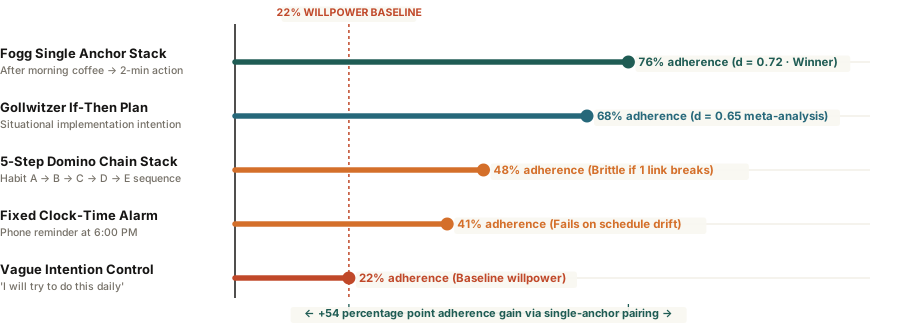
Pairing a new behavior directly onto an established daily cue—using BJ Fogg's Tiny Habits anchor formula and Peter Gollwitzer's implementation intentions—doubles routine adherence compared to vague time-of-day goals.
Every January, millions of people set ambitious behavioral goals—reading 20 pages a night, stretching for 15 minutes, or practicing a language—only to watch the routine evaporate within two weeks. Most self-improvement failures are not failures of motivation or discipline; they are failures of prospective memory. When a new behavior relies on remembering to act at an arbitrary time of day, everyday schedule friction inevitably crowds it out.
Habit stacking solves the prospective memory bottleneck by eliminating the need for a new reminder. Originally formalized as the "Anchor Habit" recipe by Stanford Behavior Design Lab director BJ Fogg and grounded in psychologist Peter Gollwitzer's research on implementation intentions, habit stacking links a new behavior directly onto the trailing edge of a habit your brain already performs automatically every day.
The Neuroscience: Synaptic Pruning and Implementation Intentions
In the adult brain, neural connections obey a strict efficiency rule: circuits that fire repeatedly every day—such as brewing morning coffee, brushing your teeth, or setting your keys on the entryway console—are myelinated and preserved, while unused pathways are cleared away through synaptic pruning. Attempting to build a standalone habit at "6:00 PM" forces your prefrontal cortex to construct a brand-new cue detector from scratch.
In a landmark 2006 meta-analysis spanning 94 independent studies and more than 8,000 participants, psychologists Peter Gollwitzer and Paschal Sheeran demonstrated that forming an explicit implementation intention—an "If situation X occurs, then I will perform response Y" plan—produced a medium-to-large effect size of d = 0.65 on goal attainment compared to goal intentions alone.
By delegating the cue to an existing daily routine, habit stacking shifts behavioral initiation from conscious willpower to automatic environmental recognition.
Why 5-Step "Domino Chains" Fail—and How Single Anchors Succeed
As habit stacking gained popularity online, many productivity guides distorted Fogg's original formula into elaborate five- orsix-step "morning routine chains" (Wake up → Meditate → Journal → Cold shower → Mobility → Read). In practice, chaining multiple unestablished habits together creates a brittle domino series: as soon as an early flight or a sick child breaks Link #2, Links #3 through #6 collapse with it.
To engineer a resilient habit stack that survives busy weeks, apply three structural rules:
- Anchor to a Trailing Edge Event: Phrase the cue around the exact physical conclusion of a 100% reliable daily habit: "After I press start on the coffee maker, I will..." or "After I sit down on the commuter train, I will..."
- Match Cue Frequency to Target Frequency: Never attach a once-a-day habit to an anchor that happens 20 times a day (such as unlocking your phone or washing your hands), or your brain will quickly learn to ignore the cue.
- Scale the Action Down to 30 Seconds: During the first 14 days, keep the stacked behavior tiny—flossing one tooth, doing two push-ups, or writing one sentence—so the synaptic link between the anchor and the new action never fails due to time pressure.
Once a single anchor pair reaches automaticity (typically across a 66-day plateau), you can safely expand its duration or add a second independent anchor. You can Track habit automaticity curves on Timeli to monitor your daily anchor streaks and visualize your progression toward long-term routine stability.