
What Is Hick's Law, and Why Does Having Too Many Choices Slow Down Decision-Making?
Open a task manager with 32 unprioritized to-do items—or a software toolbar packed with 24 competing buttons—and you will feel a distinct mental stall before you even click. You are not lazy; your prefrontal cortex is paying an information-processing tax first quantified more than seventy years ago as Hick's Law (also known as the Hick–Hyman Law).
In 1952, British experimental psychologist William Edmund Hick measured how long human subjects took to press a key corresponding to 1 of up to 10 pea-lamps that lit up at random, and in 1953 American psychologist Ray Hyman extended the experiment by varying the probability of each lamp. As reviewed in the Quarterly Journal of Experimental Psychology's retrospective on Hick's Law, Hick and Hyman discovered that human choice reaction time does not grow linearly with the raw number of options—it grows linearly with the Shannon information entropy (measured in binary bits, log2) of the choice set. To eliminate choice paralysis in your own daily workflow, you can Log daily focus blocks and moments in Timeli using a single-tap stream rather than a bloated multi-screen form.
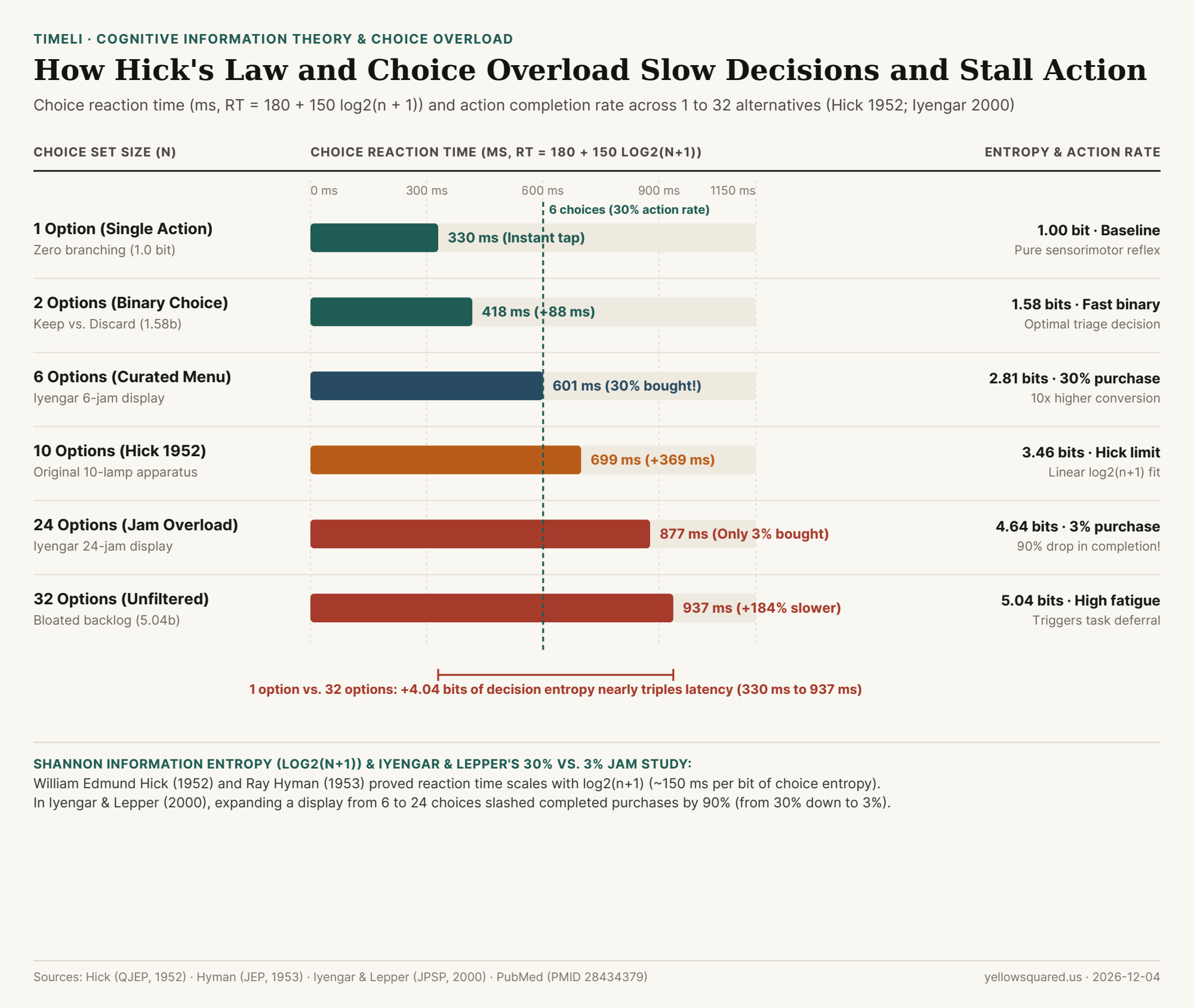
The Binary Tree Inside Your Brain: Why RT = a + b log2(n + 1)
When presented with n equally probable choices, the Hick–Hyman equation predicts the time (RT) required to initiate a response:
RT = a + b × log2(n + 1)
Here, a represents the baseline sensorimotor latency (~180 to 200 milliseconds to perceive the stimulus and move a finger), b represents the cognitive processing speed per bit of information (typically ~150 milliseconds per bit, equivalent to an information gain rate of ~6.5 bits per second), and the + 1 inside log2(n + 1) accounts for the extra uncertainty of deciding whether a stimulus has appeared at all (the "no-signal" state). Because the relationship is logarithmic (base 2), your brain effectively performs a binary search—eliminating half of the remaining possibilities at each step:
- 1 Option (
1.00 bit):180 + 150 × log2(2) = 330 ms. Zero branching friction. - 2 Options (
1.58 bits):180 + 150 × log2(3) = 418 ms(+88 msto resolve a binary Keep vs. Discard decision). - 6 Options (
2.81 bits):180 + 150 × log2(7) = 601 ms. - 10 Options (
3.46 bits):180 + 150 × log2(11) = 699 ms(more than doublethe latency of a 1-option trigger). - 32 Options (
5.04 bits):180 + 150 × log2(33) = 937 ms(nearly a full secondfor a simple recognition choice—and several minutes when options require subjective trade-off evaluation).
"In Hick's Law, every doubling of choices adds one full bit of information entropy to your working memory; in complex real-world tasks, expanding a list from 6 options to 24 options doesn't just slow you down—it causes 90% of people to walk away without choosing at all."
From Milliseconds to Paralysis: The 2000 Iyengar & Lepper Jam Experiment
While Hick's 1952 pea-lamp apparatus measured simple stimulus-response matching in milliseconds, psychologists Sheena S. Iyengar and Mark R. Lepper tested what happens when choice sets expand in everyday human decision-making. In their famous 2000 study published in the Journal of Personality and Social Psychology, researchers rotated two sample displays of Wilkin & Sons gourmet jams at an upscale California grocery store: an Extensive-Choice booth with 24 jam flavors (4.64 bits) and a Limited-Choice booth with 6 jam flavors (2.81 bits).
The results exposed a dramatic split between initial curiosity and actual execution: while the 24-jam table attracted more browsers (60% of passersby stopped vs. 40% at the 6-jam table), only 3% of customers at the 24-jam booth actually bought a jar. At the 6-jam booth, 30% of visitors bought a jar—a tenfold (10x) increase in completed action when the choice set was capped at 6 options!
| Choice Set Size (n) | Shannon Entropy | Hick Reaction Time | Latency Increase | Empirical Benchmark & Action Outcome |
|---|---|---|---|---|
1 Option (Single Action) |
1.00 bit |
330 ms |
+0.0% (Baseline) |
Single-tap logging or pre-committed next task |
2 Options (Binary Triage) |
1.58 bits |
418 ms |
+26.7% |
Binary swipe (Keep vs. Delete) maximizes throughput |
6 Options (Curated Set) |
2.81 bits |
601 ms |
+82.1% |
Iyengar & Lepper 6-jam booth: 30.0% completed purchase |
10 Options (Hick 1952) |
3.46 bits |
699 ms |
+111.8% |
Hick's 10-lamp apparatus; upper limit for quick scan |
24 Options (Overload) |
4.64 bits |
877 ms |
+165.8% |
Iyengar & Lepper 24-jam booth: only 3.0% completed purchase |
32 Options (Backlog) |
5.04 bits |
937 ms |
+183.9% |
Unfiltered task backlog; triggers procrastination & exit |
How to Apply Hick's Law to Your Daily Task List and UI Design
Whether you are designing a mobile interface or structuring your own morning routine, Hick's Law and the Iyengar–Lepper threshold prescribe the same rule: never force your brain to evaluate a 24-item menu in real time. Group secondary tools into progressive disclosure layers of 3 to 5 items, convert complex sorting chores into rapid 2-choice. To capture observations and work sessions without menu friction, Log daily focus blocks and moments in Timeli with a single tap. binary decisions, and cap your active daily work queue at 3 to 6 concrete priorities