
What Is Hyperfocal Distance? Where to Focus for Front-to-Back Sharp Landscapes
What Is Hyperfocal Distance? Where to Focus for Front-to-Back Sharp Landscapes
Focusing a lens directly on the distant horizon wastes the rear half of your depth of field beyond infinity—whereas focusing at the hyperfocal distance (H = f² ÷ [N × c] + f) keeps everything acceptably sharp from half that distance (H ÷ 2) to infinity.
Stand on a rocky coastline at sunrise with a wide-angle lens (`24mm`), set your aperture to `f/8`, tap your autofocus point on the distant mountain peaks on the horizon, and take the shot. On the back of your camera's small LCD screen, everything looks sharp. Open that file on a 27-inch monitor at home, however, and the wet cobblestones and tide pools five feet in front of your tripod are noticeably soft and blurry.
To fix the blurry foreground, many photographers crank their aperture down to `f/16` or `f/22`—unaware that tiny aperture pinholes cause light waves to bend and interfere with one another (`optical diffraction`), softening the entire image from edge to edge. Instead of stopping down into diffraction, landscape photographers achieve tack-sharp front-to-back images at `f/8` or `f/11` by focusing at a specific mathematical sweet spot in the foreground: the hyperfocal distance (`H`).
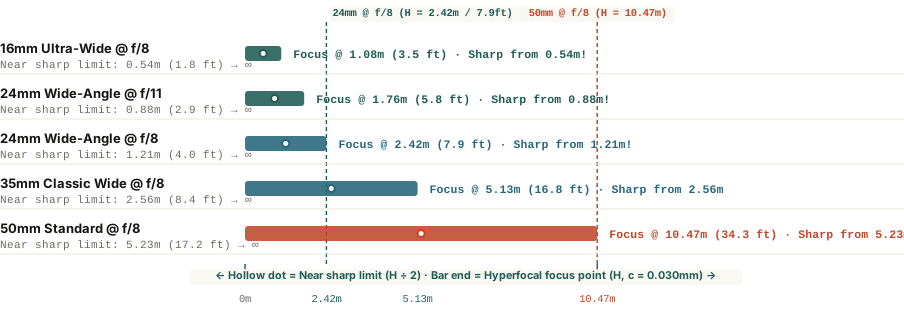
The Optical Math: Why Focusing at H Gives You H ÷ 2 to Infinity
In geometrical optics, a lens can only focus light rays from a single exact plane into a theoretical point; everything closer or farther forms a tiny blurred disc called the circle of confusion (`c`). As long as that disc stays smaller than your sensor's perceptual threshold (`c = 0.029–0.030 mm` for standard full-frame viewing, or `0.018–0.020 mm` for high-acuity pixel peeping), the human eye perceives the zone as "in focus."
The **hyperfocal distance (`H`)** is the closest distance at which you can focus a lens while keeping the far boundary of acceptable sharpness just touching infinity (`∞`):
`H = f² ÷ (N × c) + f`
- What Happens When You Focus at Infinity (`∞`): Your near limit of acceptable sharpness stops at exactly `H`. For a `24mm` lens at `f/8` (`c = 0.030 mm`), `H = 24² ÷ (8 × 0.030) + 24 = 2,424 mm` (`2.42 meters` or `7.9 feet`). Everything closer than `7.9 feet` goes blurry, and the entire rear half of your depth of field is wasted "beyond infinity."
- What Happens When You Focus at `H` (`2.42m / 7.9 ft`): The far edge of your depth-of-field zone pulls back so it just kisses the horizon (`∞`), while the near edge of acceptable sharpness advances to `H ÷ 2 = 1.21 meters` (`4.0 feet`)—doubling your close-up foreground reach without changing your aperture!
- Why Focal Length Squared (`f²`) Dominates: Because focal length `f` is squared in the numerator, switching from a `24mm` lens (`H = 2.42m`) to a `50mm` lens (`H = 10.47m`) at `f/8` pushes the hyperfocal distance more than four times farther away (`34.3 feet`).
Focusing on the horizon throws away half of your depth of field behind the mountains; focusing at the hyperfocal distance brings that sharpness into your foreground.
The 'Double-the-Distance' Field Shortcut (No Calculator Required)
You do not need to memorize tables or pull out a smartphone app in freezing dawn wind. Because focusing at the hyperfocal distance `H` always places the near limit of sharpness at exactly half that distance (`H ÷ 2`), you can invert the relationship using the Double-the-Distance Rule:
- Find Your Closest Foreground Element: Look at the bottom of your frame and estimate the distance to the closest rock, flower, or tide pool that must be sharp (say, `4 feet` away).
- Focus at Twice That Distance (`2 × 4 ft = 8 feet`): Place your autofocus point on an object roughly `8 feet` away (about one-third of the way into the scene) at `f/8` or `f/11`.
- When to Focus-Stack Instead: On modern `45MP–61MP` cameras (`c ≈ 0.018 mm`) or when your foreground flower is just `12 inches` from the front element, no single aperture can span `1 foot` to `infinity` without `f/22` diffraction blur. Instead, shoot two frames at your lens's sharpest aperture (`f/8`)—one focused on the foreground and one focused on the midground/horizon—and blend them in post.
To plan exact golden-hour sun azimuths, twilight elevation angles, and terrain sightlines for your next landscape shoot, you can Track lighting ephemeris in PhotoSpots before setting up your tripod.