
Why Are Photos Blurry at f/22? Finding Your Lens's Sharpest Aperture Sweet Spot
Why Are Photos Blurry at f/22? Finding Your Lens's Sharpest Aperture Sweet Spot
Almost every landscape photographer runs into the same baffling disappointment early on: you mount your camera on a sturdy tripod at golden hour, dial the aperture all the way down to f/22 to maximize depth of field from the foreground rocks to the distant horizon, and open the file on your monitor—only to find that the entire image looks muddy and slightly out of focus. Camera shake wasn't the culprit, and your autofocus didn't miss. You hit optical wave diffraction, a fundamental physical limit where squeezing light through a tiny aperture iris spreads every point of light into a soft circular blur known as an Airy disk.
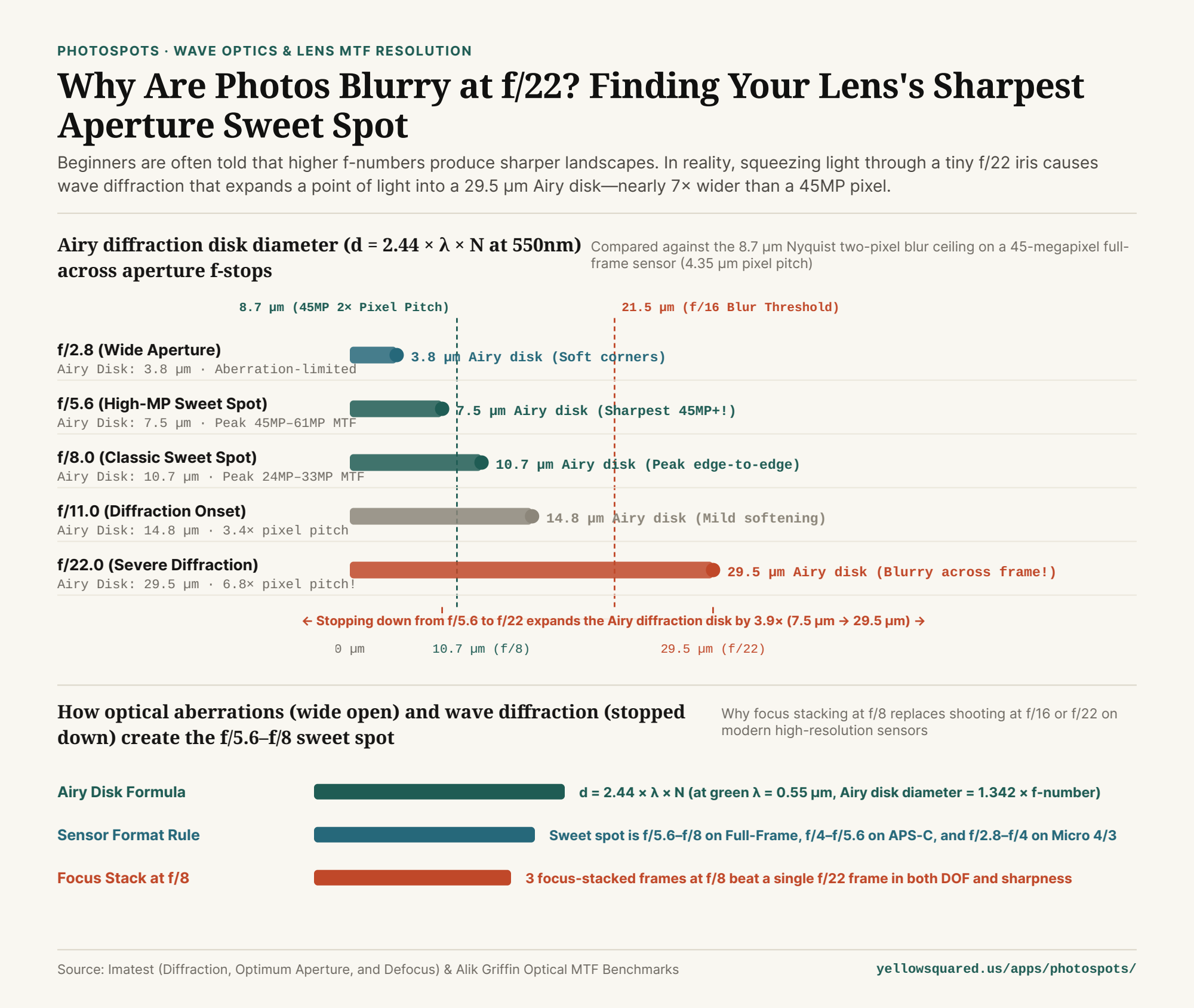
λ = 550 nm green light) across aperture stops from f/2.8 to f/22, plotted against the 8.7 µm two-pixel Nyquist blur threshold of a 45-megapixel full-frame sensor. Reproducible dataset: what-is-lens-diffraction-sharpest-aperture-sweet-spot-f8-vs-f22.csv.1. The Physics of the Airy Disk: d = 2.44 × λ × N
When light waves pass through a circular opening, waves skimming the edge of the aperture blades bend outward and interfere with one another, creating a bright central spot surrounded by faint concentric rings. As derived in Imatest's optical engineering documentation on diffraction and optimum aperture, the diameter of that first dark ring—the Airy disk diameter (dairy)—depends strictly on the wavelength of light (λ) and the lens f-number (N):
dairy = 2.44 × λ × N
For green light in the middle of the visible human spectrum (λ = 0.55 µm, or 550 nm), this simplifies to dairy ≈ 1.342 × N micrometers. Notice what is missing from the equation: focal length and lens price do not appear anywhere. Whether you are shooting on a $200 kit lens or a $3,000 prime lens, a given f-stop produces the exact same physical diffraction spot size on your sensor:
- At
f/2.8:dairy = 3.8 µm(smaller than a single pixel on a 24MP full-frame sensor). - At
f/5.6:dairy = 7.5 µm(matches the two-pixel Nyquist limit of a 45MP–50MP full-frame sensor). - At
f/8.0:dairy = 10.7 µm(the classic equilibrium sweet spot for 24MP–33MP full-frame sensors). - At
f/16.0:dairy = 21.5 µm(visibly softens fine foliage, feathers, and architectural brickwork). - At
f/22.0:dairy = 29.5 µm(nearly 7 times wider than a4.35 µmpixel on a 45MP sensor, smearing every fine detail across a 7×7 grid of pixels).
"No matter how expensive your glass is, an f/22 aperture projects a 29.5-micrometer diffraction blur circle onto your sensor—erasing over half of your camera's resolving power."
2. Why Lenses Have a Sweet Spot Between f/5.6 and f/8
If wider apertures produce smaller Airy disks, why isn't a lens sharpest wide open at f/1.4 or f/2.0? As shown in empirical MTF50 lens resolution benchmarks, wide-open apertures suffer from the opposite physical problem: optical lens aberrations (spherical aberration, coma, astigmatism, and field curvature) caused by light rays refracting through the thick outer perimeter of the glass elements.
Stopping a lens down by 2 to 3 stops from wide open physically blocks those outer peripheral light rays, causing optical aberrations to plummet while the Airy diffraction disk is still tiny. The intersection of those two curves is your lens's sharpest aperture sweet spot: typically f/5.6 to f/8 on Full-Frame, f/4 to f/5.6 on APS-C, and f/2.8 to f/4 on Micro Four Thirds (because smaller sensors pack smaller pixels into the same physical area).
3. Aperture Diffraction vs. Optical Aberration Table
Use this reference table to balance depth of field, optical aberrations, and Airy diffraction across f-stops on a modern full-frame camera (available in what-is-lens-diffraction-sharpest-aperture-sweet-spot-f8-vs-f22.csv):
| Aperture f-Stop (N) | Airy Disk (550nm) | Optical Aberration Blur | Combined Blur Spot | 45MP Full-Frame Status | Recommended Field Use Case |
|---|---|---|---|---|---|
| f/1.4 (Wide Open) | 1.9 µm | 14.5 µm | 14.6 µm | Soft corners & spherical glow | Astrophotography & low-light isolation |
| f/4.0 | 5.4 µm | 4.8 µm | 7.2 µm | Tack-sharp center; clean edges | Handheld travel & environmental portraits |
| f/5.6 to f/8.0 (Sweet Spot) | 7.5 to 10.7 µm | 2.2 µm | 7.8 to 10.9 µm | Peak MTF50 edge-to-edge! | Landscapes, architecture & focus stacks |
| f/11.0 | 14.8 µm | 1.5 µm | 14.9 µm | Diffraction limit threshold | Single-frame deep DOF landscapes |
| f/16.0 | 21.5 µm | 1.1 µm | 21.5 µm | Visible micro-contrast loss | Sunstars & waterfall motion blur |
| f/22.0 | 29.5 µm | 0.9 µm | 29.5 µm | Severe global softening (6.8× px) | Avoid except extreme sunstar bursts |
4. Plan Golden Hour Angles and Sweet-Spot Shoots in PhotoSpots
Instead of stopping down to f/22 when shooting a close foreground wildflower against a distant mountain peak, lock your aperture at f/8 and capture 2 or 3 frames focused at progressive distances (foreground, midground, infinity) to blend in post-processing. You get infinite depth of field with peak f/8 optical acuity. To time your tripod sessions for golden hour, blue hour, and exact sun azimuth angles, Track lighting ephemeris in PhotoSpots before heading to your trailhead.
Verified Primary Sources
- Imatest LLC — Diffraction, Optimum Aperture, and Defocus (Airy Disk Formula & Sensor Pixel Pitch Limits) (Retrieved 2026-10-31).
- Alik Griffin — What Is Diffraction in Photography? (Empirical Lens MTF50 Sweet Spot Benchmarks) (Retrieved 2026-10-31).