
What Is Moiré in Digital Photography? Why Fine Fabric Patterns and Screens Create Wavy Rainbow Stripes
You are photographing a groom in a fine wool sharkskin suit, a bride behind a tulle veil, a model wearing a ribbed knit sweater, or a corporate speaker standing in front of an LED wall. Everything looks razor-sharp through the viewfinder—until you open the files on your computer and discover swirling, topographical rainbow oil-slick waves rippled across the fabric. That psychedelic pattern does not exist anywhere on the real clothing: it is moiré (accompanied by its chromatic twin, false color). Why does a $3,500 modern mirrorless camera invent rainbow stripes on a plain grey suit when older 12-megapixel DSLRs rarely did? As explained in optical engineering analyses by Telycam, Photography Life, Webiano, Spéos, and Tucsen Scientific Imaging, moiré is the direct consequence of two design choices in modern cameras: Nyquist spatial aliasing on a discrete Bayer pixel grid, and the industry-wide removal of Optical Low-Pass Filters (OLPF).
1. The Nyquist-Shannon Sampling Limit (fN = 1 / 2p): What Happens When Detail Beats the Grid
Your camera's CMOS sensor is a rigid two-dimensional checkerboard of square photosites spaced at a fixed center-to-center distance called the pixel pitch (p)—for example, 5.94 μm on a 24-megapixel full-frame camera (6000 × 4000 pixels across 36 × 24 mm), 4.35 μm on a 45-megapixel camera (like the Nikon Z8 or Canon EOS R5), and 3.76 μm on a 61-megapixel camera (like the Sony a7R V).
According to the Nyquist-Shannon sampling theorem (Telycam; Tucsen), to record a repeating wave pattern (such as alternating dark and light threads in a woven shirt) without distortion, your sensor must sample at least two pixels per cycle (one pixel for the light thread, one pixel for the dark gap). That sets an absolute mathematical ceiling called the Nyquist frequency:
- Luminance Nyquist Formula:
f_Nyquist = 1,000 / (2 × p_micrometers)line pairs per millimeter (lp/mm). On a 45MP full-frame sensor (p = 4.35 μm), the luminance Nyquist limit is1,000 / 8.70 = 114.9 lp/mm. - Frequency Fold-Back (Aliasing): What happens when a razor-sharp prime lens projects a fabric weave onto the sensor at
125 lp/mm—just above the114.9 lp/mmNyquist ceiling? As Telycam explains, the excess spatial frequency does not vanish: it folds back across the Nyquist boundary as a low-frequency beat pattern (125 - 114.9 = 10.1 lp/mm), creating giant, slow-moving wavy bands across the garment!
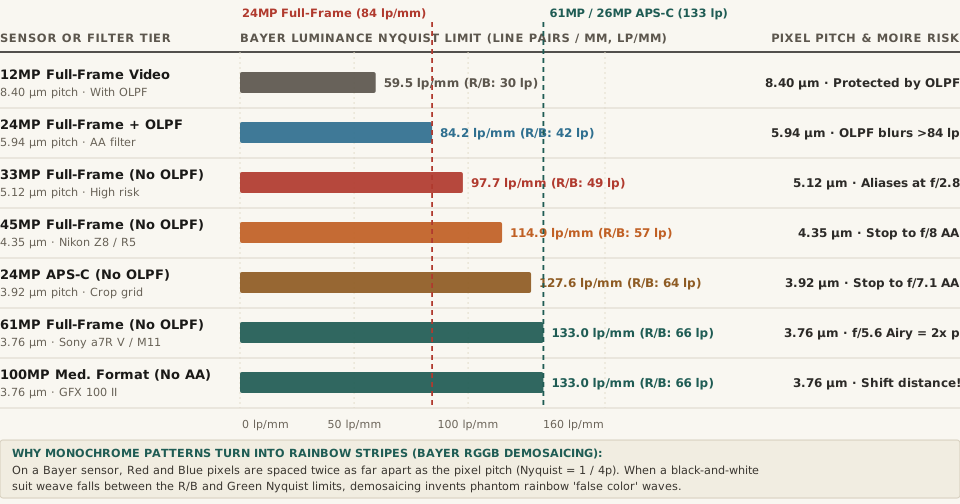
lp/mm) and Optical Low-Pass Filter status across seven digital camera tiers (Telycam; Photography Life; Tucsen).2. Why Grey Pinstripes Turn Into Rainbow Mazes: Bayer Demosaicing & OLPF Removal
If moiré is just a geometric beat pattern between two grids, why does a neutral black-and-white or charcoal-grey suit jacket erupt in magenta, cyan, yellow, and green rainbows?
- The Bayer
RGGBSub-Sampling Trap: As detailed by Webiano and Telycam, a standard color CMOS sensor does not measure Red, Green, and Blue at every pixel. Instead, a Bayer Color Filter Array (CFA) covers50%of the pixels with Green filters,25%with Red filters, and25%with Blue filters. Because same-color Red or Blue photosites are separated by twice the pixel pitch (2p), the Nyquist limit for Red and Blue is half the luminance Nyquist limit (f_RB = 1 / 4p)! When a fine black-and-white thread pattern lands on a Red photosite on row 1, a Green photosite on row 3, and a Blue photosite on row 5, the camera's demosaicing algorithm mistakenly concludes that the suit is changing color every few millimeters—inventing chromatic false color. - Why Camera Makers Removed the Optical Low-Pass Filter (
OLPF): For decades, camera manufacturers placed a two-layer birefringent quartz or lithium niobate crystal—an Optical Low-Pass Filter (OLPF/ Anti-Aliasing filter)—in front of the sensor to split every incoming point of light across adjacent pixels, blurring out spatial frequencies above Nyquist before they could alias (Photography Life). Starting in the 2010s (with the Nikon D800E, D810, Z7, Z8, and Sony a7R series), manufacturers omitted the OLPF on nearly all 24MP+ APS-C and 36MP+ full-frame cameras (Spéos) to deliver biting pixel-level sharpness on landscapes and eyelashes—leaving photographers exposed to moiré whenever a sharp lens encounters a fine repeating textile.
"An anti-aliasing filter — the OLPF — intervenes before aliasing can occur, removing the spatial frequencies that would exceed the sensor's Nyquist limit before they ever reach the photosite array... Today, most modern high-resolution APS-C (24 MP and higher) and full-frame cameras (36 MP and higher) have no blur filters in them."
3. Four Field Techniques to Stop Moiré Before It Hits Your RAW File
Because baked-in luminance moiré alters the underlying texture values in your RAW file, Webiano and Spéos emphasize that preventing moiré at capture is far cleaner than painting over it with a post-processing brush:
- Rule 1 — Always Zoom to
100% (1:1)Before Panicking ("Display Moiré"): When you view a 45-megapixel photo zoomed out to fit a 2-megapixel camera LCD or laptop screen, the downsampling grid of your monitor clashes with the fabric and creates display moiré. Zoom in to100% (1:1): if the rainbow waves vanish at 100% zoom, your RAW file is completely clean! - Rule 2 — Step 6 to 12 Inches Closer or Farther (or Zoom
2–3mm): Moiré only occurs when the projected size of the fabric weave on the sensor closely matches a harmonic of your pixel pitch. Taking half a step forward or backward immediately shifts the spatial frequency out of the danger zone (Spéos). - Rule 3 — Rotate the Camera Angle by
5° to 15°: Because sensor pixels sit in a strict0°/90°horizontal-vertical grid, tilting your composition slightly diagonal breaks the parallel alignment with vertical pinstripes or window screens. - Rule 4 — Stop Down to
f/8orf/11to Use Natural Diffraction as an OLPF: Atf/2.8orf/4, a modern prime lens projects an Airy diffraction disk smaller than a single pixel. If you stop down tof/8orf/11(Airy disk = 10.7 µm to 14.8 µm, or2.5× to 3.4×a 45MP pixel), wave diffraction naturally softens frequencies above Nyquist—acting as a free, built-in Optical Low-Pass Filter (Webiano)!
4. Complete Data Table: Sensor Nyquist Limits, OLPF Status & Natural Diffraction Cutoffs
The reproducible table below—matching the companion CSV (digital-camera-nyquist-frequency-pixel-pitch-olpf-and-diffraction-moire-thresholds.csv)—lists the pixel pitch, luminance and Red/Blue Nyquist limits, and natural diffraction anti-aliasing apertures across seven sensor tiers:
| Sensor & Filter Tier | Pixel Pitch (p) |
Luminance Nyquist (1/2p) |
Red/Blue Nyquist (1/4p) |
OLPF Status | Natural Diffraction AA Aperture (Airy ≥ 2p) |
|---|---|---|---|---|---|
| 12MP Full-Frame (a7S III / FX3) | 8.40 μm |
59.5 lp/mm |
29.8 lp/mm |
OLPF Present | f/13.0 (17.4 μm Airy disk) |
| 24MP Full-Frame + OLPF (R6 II / Z6 III) | 5.94 μm |
84.2 lp/mm |
42.1 lp/mm |
Birefringent OLPF | f/9.0 (12.1 μm Airy disk) |
| 33MP Full-Frame (Sony a7 IV) | 5.12 μm |
97.7 lp/mm |
48.8 lp/mm |
Weak / No Blur Filter | f/7.6 (10.2 μm Airy disk) |
| 45MP Full-Frame (Nikon Z8 / Zf / R5) | 4.35 μm |
114.9 lp/mm |
57.5 lp/mm |
No OLPF | f/6.5 (8.7 μm Airy disk; use f/8) |
| 24MP APS-C (No OLPF) | 3.92 μm |
127.6 lp/mm |
63.8 lp/mm |
No OLPF | f/5.8 (7.8 μm Airy disk; use f/7.1) |
| 61MP Full-Frame (Sony a7R V / M11) | 3.76 μm |
133.0 lp/mm |
66.5 lp/mm |
No OLPF | f/5.6 (7.5 μm Airy disk; use f/8) |
| 100MP Medium Format (GFX 100 II) | 3.76 μm |
133.0 lp/mm |
66.5 lp/mm |
No OLPF | f/5.6 (7.5 μm Airy disk; use f/8) |
When you are exporting multi-image carousels or side-by-side portrait grids and want to verify that downscaled images do not introduce resizing moiré on social feeds, Compare multi-photo grids in BatchPad before publishing.