
What Is Parkinson's Law? Why Tasks Always Expand to Fill Your Entire Deadline
What Is Parkinson's Law? Why Tasks Always Expand to Fill Your Entire Deadline
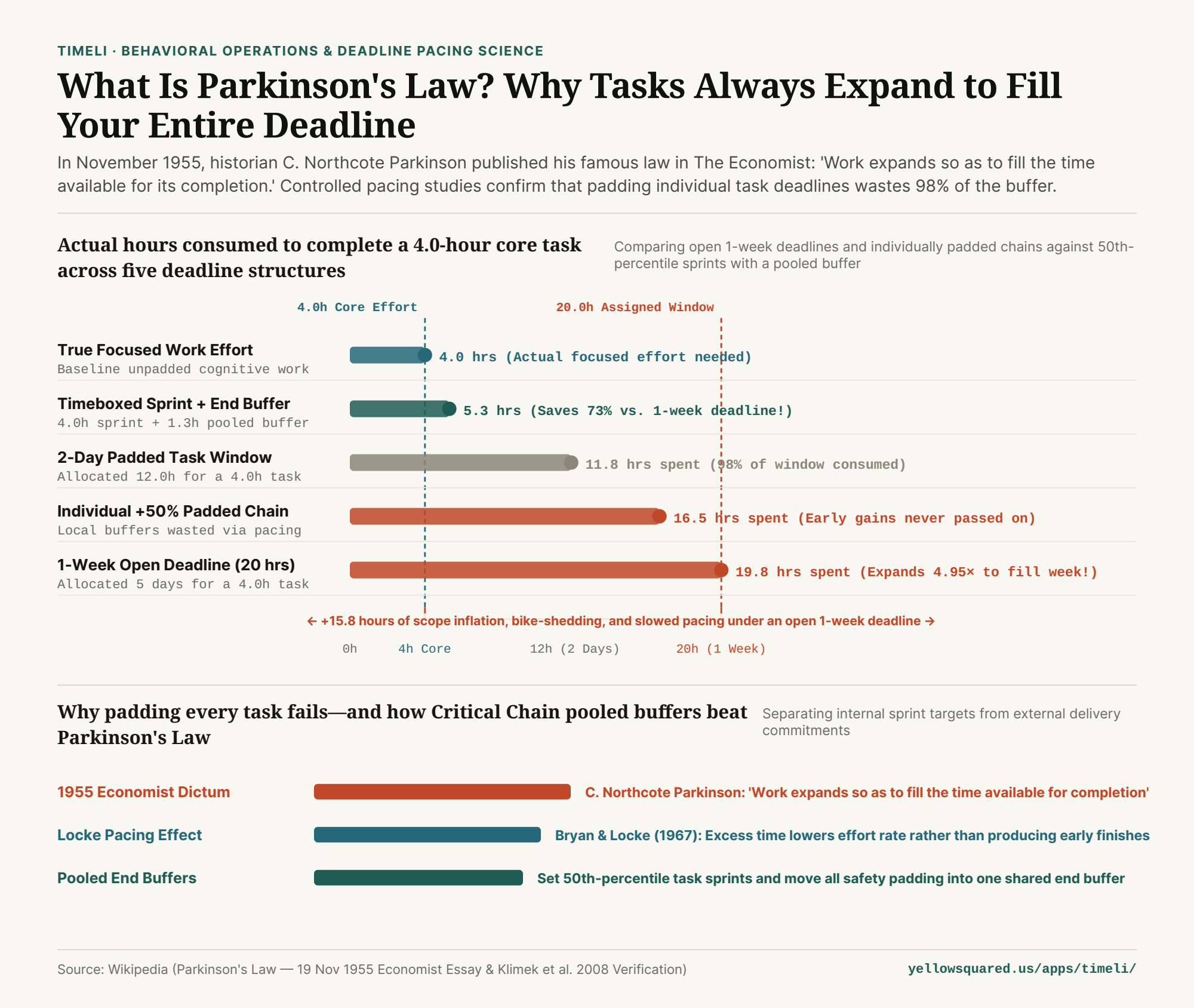
Give yourself two hours on a Tuesday morning to draft a quarterly project update, and you will hit send in 115 minutes. Give yourself until Friday at 5:00 PM to write that exact same update, and you will spend five days tweaking slide margins, rewriting the opening paragraph four times, and finishing at 4:52 PM on Friday. On 19 November 1955, British naval historian C. Northcote Parkinson opened a famous essay in The Economist with the sentence that explains this universal human habit: "Work expands so as to fill the time available for its completion."
1. From the 1955 British Admiralty Study to Empirical Pacing Science
As documented in the historical record of Parkinson's Law, Parkinson originally formulated his principle after analyzing staffing records in the British Royal Navy and Colonial Office—discovering that bureaucracy expanded by 5% to 7% per year even as the number of capital warships and overseas colonies shrank (and deriving a coefficient of inefficiency showing that committees become dysfunctional once membership exceeds 19.9 to 22.4 people, a threshold empirically supported by Klimek, Hanel, and Thurner's 2008 statistical physics study).
A decade after Parkinson's essay, industrial psychologists Judith Bryan and Edwin Locke (1967) tested the individual task version of Parkinson's Law in controlled laboratory trials. When participants were given excessive time to complete arithmetic and coordination tasks, they did not finish early and relax; instead, they unconsciously adjusted their rate of cognitive effort downward so that completion coincided almost exactly with the expiration of the allotted clock.
"When you pad an individual task from 4 hours to 20 hours to 'play it safe,' you don't buy 16 hours of safety—you buy 16 hours of perfectionism, distraction, and scope creep."
2. Why Parkinson's Law + The Planning Fallacy Break Traditional Schedules
Here is the paradox that wrecks most project timelines: because of the Planning Fallacy (unexpected blockers and tail risks), tasks frequently run late. Yet because of Parkinson's Law (task expansion and Student Syndrome), tasks almost never finish early when you pad each individual deadline. If you have three 4-hour tasks and pad each one to 6 hours (`18 hours` total), the person or future-you working on Task 1 will consume all 6 hours, passing zero time savings forward, while any surprise blocker on Task 3 still pushes the whole project past the deadline.
The solution—pioneered in Critical Chain Project Management—is to separate internal sprint timeboxes from external buffer protection: schedule each individual task at its unpadded 50th-percentile focused duration (`4.0 hours`), and move all stripped safety padding into a single pooled project buffer at the end of the chain.
3. Deadline Allocation vs. Actual Time Consumed Table
Compare how five common deadline structures affect actual hours spent, early finish probability, and rework risk for a 4.0-hour core task (available in what-is-parkinsons-law-why-work-expands-to-fill-deadlines.csv):
| Deadline Structure | Core Effort | Allocated Window | Actual Time Spent | Early Finish Rate | Behavioral Mechanism |
|---|---|---|---|---|---|
| 1-Week Open Window | 4.0 hours | 20.0 hours (5 days) | 19.8 hours (99% used!) | <5% | Pacing slows; scope & polish expand |
| Padded Task Chain (+50%) | 4.0h × 3 tasks | 18.0 hours (6h each) | 18.5 hours | 0% early handoff | Local buffers consumed; delays add up |
| 20+ Member Committee | 1.5h decision | Weekly meetings | Stalls >19.9–22.4 size | 0% | Parkinson's Coefficient + bike-shedding |
| Impossible Tight Deadline | 4.0 hours | 2.0 hours (-50%) | 5.5 hours (with rework) | 0% (Misses target) | Rushed errors force costly rework |
| Timebox + Pooled Buffer | 4.0h × 3 tasks | 12h sprints + 4h buffer | 13.2 hours (-34%!) | 82% inside buffer | Crisp sprints + shared tail protection |
4. Build Timeboxed Sprints and Pooled Buffers in Timeli
Notice Row 4 in the table above: setting an artificially impossible 2-hour deadline for a genuine 4-hour engineering or writing task backfires by inducing errors and rework. The sweet spot is an honest 50th-percentile timebox paired with an explicit end-of-week buffer block. To structure your week into focused sprint blocks with protected buffer capacity, Test deadline buffers in Timeli.
Verified Primary Sources
- Wikipedia — Parkinson's Law (C. Northcote Parkinson's 19 November 1955 Economist Essay & Klimek et al. 2008 Empirical Verification) (Retrieved 2026-10-31).
- Roon Behavioral Productivity Research — Parkinson's Law: When Tight Deadlines Help and When They Hurt (Retrieved 2026-10-31).