
What Is Parkinson's Law? Why Work Expands to Fill the Time Allotted — and How Timeboxing Stops It
Give a software team, writer, or analyst two full weeks to produce a deliverable that requires four hours of focused work, and the deliverable will almost never be finished on Day 1. Instead, the task will expand across all ten business days — accumulating extra meetings, exploratory tangents, and eleventh-hour stress. First formulated by British naval historian C. Northcote Parkinson in a famous satirical essay in The Economist in November 1955, Parkinson's Law states a deceptively simple observation: "Work expands so as to fill the time available for its completion."
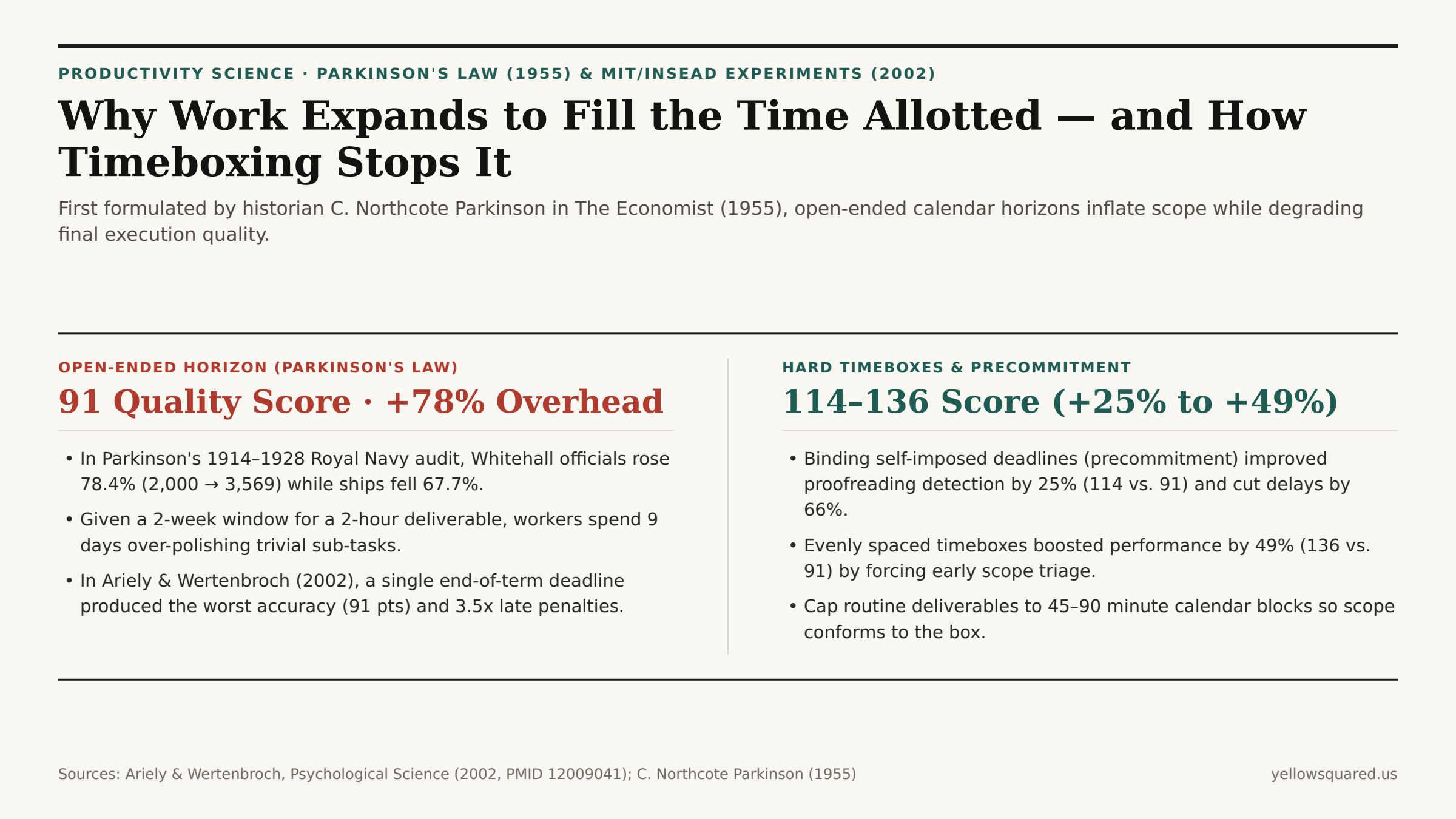
While Parkinson backed his original essay with empirical audits of the British Royal Navy and Colonial Office bureaucracy, modern behavioral economics proves that open-ended calendar horizons don't just waste time — they actively degrade quality. In a landmark experimental study published in Psychological Science by MIT and INSEAD researchers Dan Ariely and Klaus Wertenbroch (Procrastination, Deadlines, and Performance: Self-Control by Precommitment, 2002, PMID 12009041), participants working under evenly spaced timeboxes detected 49% more errors (136 vs. 91) and suffered 88% fewer late-submission delays than participants given a single generous end-of-term deadline. To replace open-ended tasks with structured daily timeboxes right now, Timebox your daily schedule in Timeli.
1. Parkinson's 1914–1928 Royal Navy Audit: +78.4% Staff for 67.7% Fewer Ships
In his 1955 essay (later expanded into the 1957 book Parkinson's Law: The Pursuit of Progress), C. Northcote Parkinson demonstrated that organizational time and headcount bloat follow mathematical regularities completely detached from actual output. Examining official British Admiralty records between 1914 and 1928, Parkinson uncovered a striking divergence:
- Capital Warships in Commission: Dropped by 67.7% (from
62capital ships in 1914 to20in 1928). - Active Royal Navy Officers & Seamen: Dropped by 31.5% (from
146,000to100,000). - Admiralty Headquarters Officials in Whitehall: Increased by 78.4% (from
2,000officials in 1914 to3,569in 1928 — an automatic growth rate of5.6% to 5.75% per year).
Parkinson identified two structural drivers that apply equally to solo knowledge workers and large teams: (1) Multiplication of Sub-Tasks (when a deadline is distant, workers subdivide a simple decision into preliminary research memos, formatting passes, and review loops) and (2) Reciprocal Work Creation (polishing low-leverage details creates review work for colleagues, filling the entire calendar block).
2. The MIT / INSEAD Experiment: Why Spaced Timeboxes Beat One Big Deadline by 49%
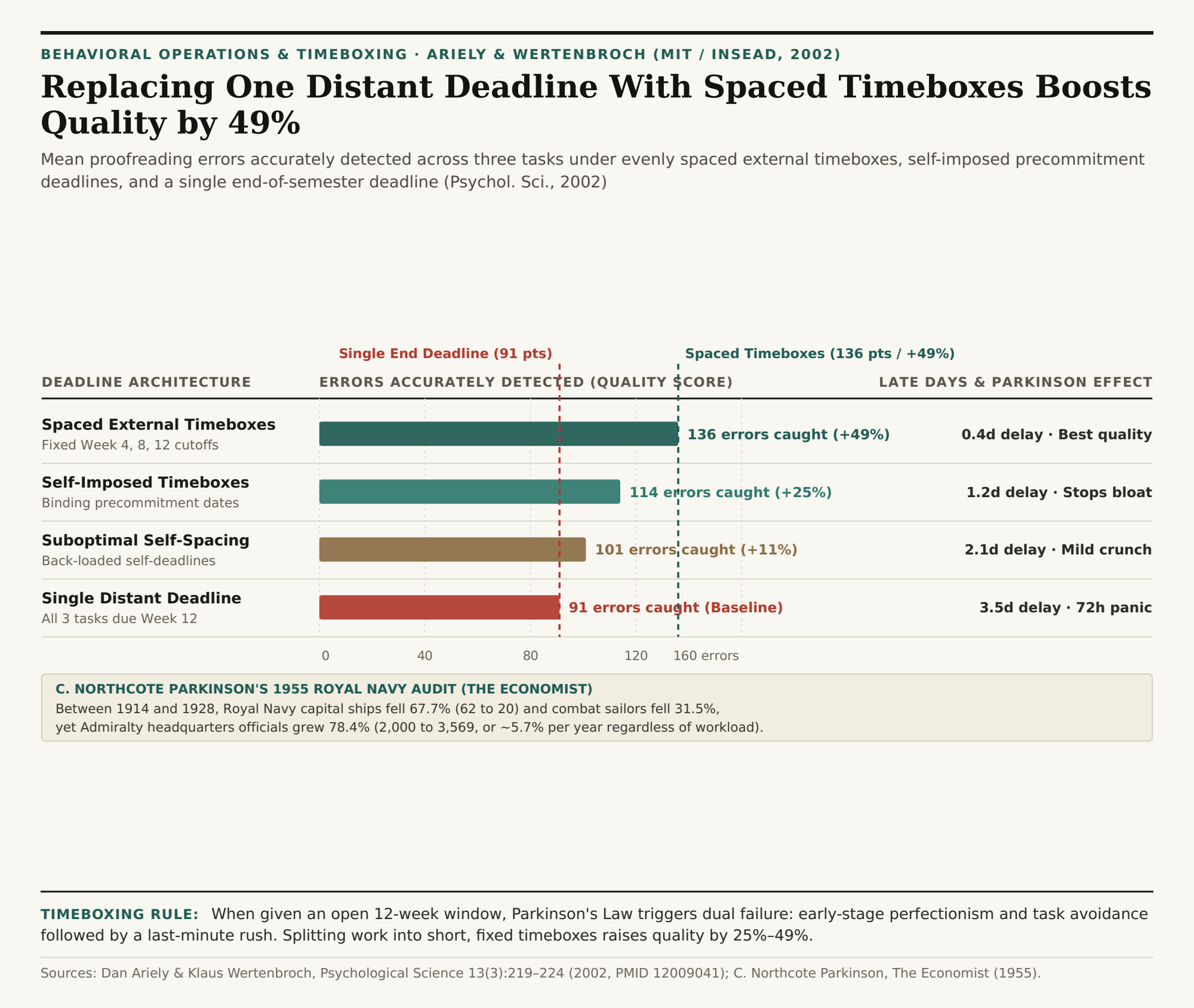
A common myth is that giving yourself a long, unconstrained deadline leads to deeper, higher-quality work. In Ariely and Wertenbroch's 2002 study (PMID 12009041), researchers tested three deadline architectures on participants tasked with completing three proofreading assignments over a 12-week term (with a hard penalty of 1% grade deduction per day late):
- The Single End-of-Term Deadline (Maximal Flexibility / Parkinson's Law Group): All three assignments were due on the final day of Week 12. Rather than using the 84-day runway to do careful work, participants delayed action until the final 72 hours, suffered the worst error-detection score (
91 errors caught), and averaged3.5 daysof late-submission penalties. - Self-Imposed Binding Timeboxes (Precommitment Group): Participants were allowed to choose their own three intermediate deadline dates at the start of the term, but once declared, those dates carried the exact same 1%/day late penalty. Voluntary precommitment raised accuracy by 25% (
114 errors caughtvs.91) and slashed late delays by 66% (1.2 days). - Evenly Spaced External Timeboxes (Fixed Week 4, 8, and 12 Cutoffs): Participants assigned evenly spaced 4-week timeboxes achieved the highest accuracy —
136 errors caught(+49%above the single-deadline group) — with almost zero late penalties (0.4 days).
"When a deadline is far away, Parkinson's Law operates in two phases: during the first 80% of the window, scope expands into low-value tinkering; during the final 20%, panic compresses the core work into a rushed sprint."
| Deadline Structure | Empirical Source / Condition | Allowed Horizon | Mean Delay | Quality Score | Parkinson's Law / Timebox Effect |
|---|---|---|---|---|---|
| Evenly Spaced Timeboxes | Ariely & Wertenbroch (2002) Fixed | 28d per task | 0.4 days | 136 (+49%) | Highest quality; eliminates last-week crunch |
| Self-Imposed Timeboxes | Ariely & Wertenbroch Precommitment | Chosen upfront | 1.2 days | 114 (+25%) | Voluntary binding cutoffs curb procrastination |
| Single Distant Deadline | Ariely & Wertenbroch Open Horizon | 84d open window | 3.5 days | 91 (Baseline) | Work delayed to final 72h; 33% fewer errors caught |
| Royal Navy Admiralty | Parkinson (1955) 1914–1928 Audit | 14-year peace | N/A | -67.7% ships | Headquarters staff grew +78.4% (+5.7%/yr) |
How to Apply Hard Timeboxes to Your Daily Schedule
To defeat Parkinson's Law on your own calendar, never schedule a task by asking "When is this due?" — schedule it by asking "How many focused 45-minute blocks is this deliverable actually worth?" Split multi-week projects into evenly spaced milestones with explicit scope ceilings, Timebox your daily schedule in Timeli to lock those blocks onto your calendar, and download the Parkinson's Law & deadline performance CSV dataset.