
What Is Primary vs. Secondary Credit Card Rental Car Insurance, and How Does Collision Damage Waiver (CDW) Work?
Step up to an airport rental car counter after a long flight and the agent will inevitably slide a tablet across the desk asking whether you want the optional Collision Damage Waiver (CDW) or Loss Damage Waiver (LDW) for $25 to $35 per day. Over a seven-day trip, saying yes adds $175 to $245 to a rental that may have only cost $250 in the first place. Yet declining that waiver with the wrong credit card in your wallet can cost you over a thousand dollars in personal auto insurance surcharges if someone scrapes your bumper in a hotel parking lot.
As detailed in cardholder benefit guides analyzed by NerdWallet, CNBC Select, and The Points Guy, credit card rental car protections are split into two radically different tiers: Primary CDW and Secondary CDW. Before paying for your next rental reservation or booking with points, you can Compare airline transfer ratios and point valuations in Pointsuno alongside your travel card portfolio.
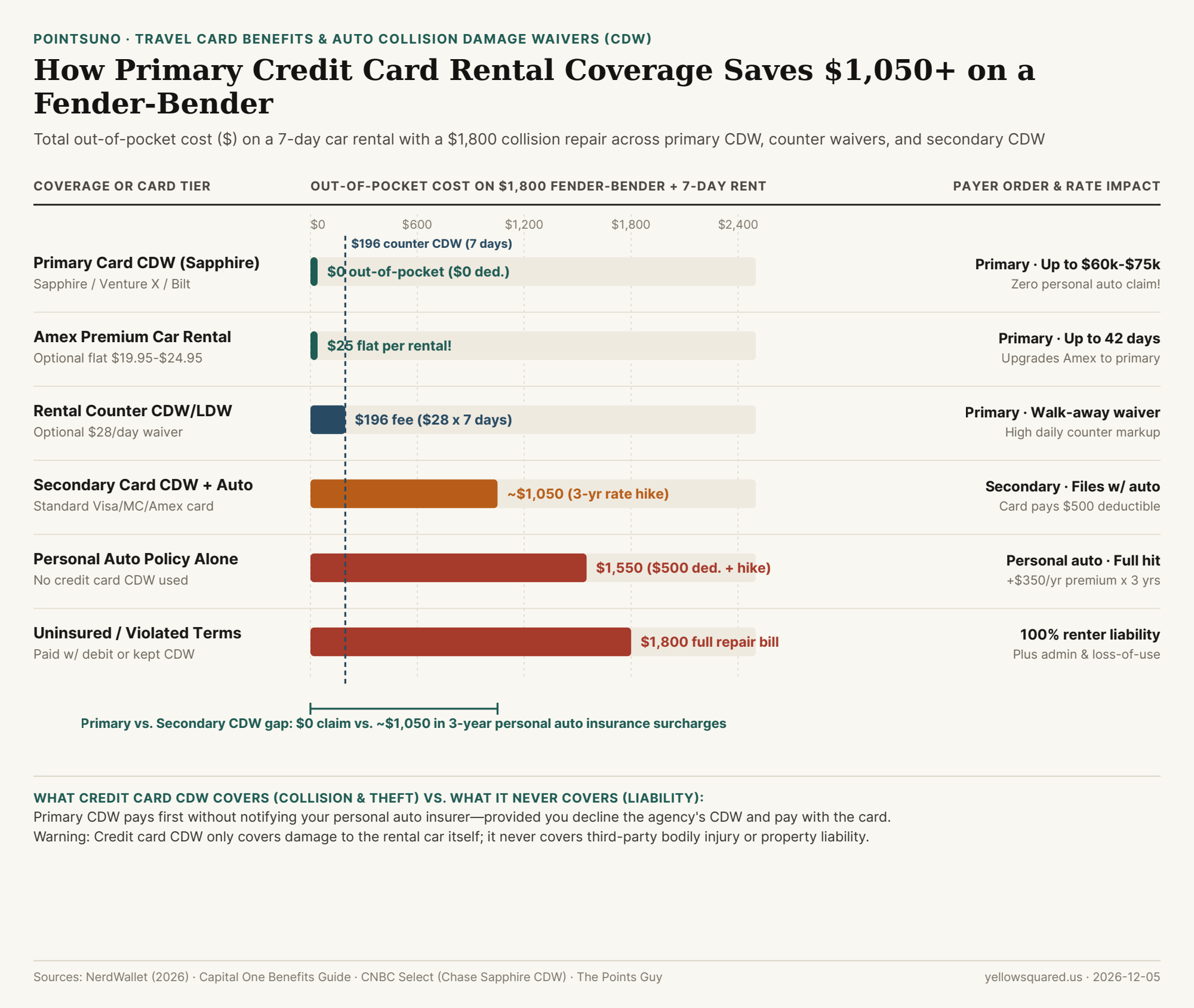
Primary CDW vs. Secondary CDW: Why Payment Order Matters
When a credit card provides an Auto Rental Collision Damage Waiver (CDW), the word Primary or Secondary dictates whether your personal auto insurance company is dragged into the claim:
- Secondary Credit Card CDW (Most Standard Travel Cards): As explained by Capital One's rental insurance guide, secondary coverage only kicks in after your personal auto insurance policy pays out. If a rock cracks your windshield or you back into a bollard causing
$1,800in bodywork damage, you must file a comprehensive or collision claim with your own GEICO, State Farm, or Progressive policy. The credit card benefit administrator then reimburses your$500or$1,000deductible—but because your personal insurer paid a$1,300claim, your personal auto premium typically jumps by20% to 35%(~$300 to $400/year) for the next three years (~$1,050hidden cost)! (Note: If you rent outside the United States where your U.S. personal auto policy does not apply, or if you do not own a car and have no personal auto policy, secondary card coverage automatically becomes primary.) - Primary Credit Card CDW (Select Travel & Visa Infinite Cards): With primary coverage, the credit card benefit administrator stands first in line. You file the claim directly with the card benefit administrator, pay
$0deductible up to the policy cap (typically $60,000 on Chase Sapphire Preferred and up to $75,000 on Chase Sapphire Reserve and Capital One Venture X), and never notify or file a claim with your personal auto insurance company.
"Secondary credit card CDW reimburses your $500 deductible after you file a claim with your personal auto insurer—leaving you with three years of higher auto premiums; Primary credit card CDW pays the rental agency from dollar one so your personal insurer never even hears about the dent."
Which Major Cards Offer Built-In Primary CDW (and the Amex $24.95 Workaround)
Only a select roster of personal consumer credit cards include built-in primary rental car CDW inside the United States (alongside most small-business cards when renting for business purposes):
- Chase Sapphire Preferred (
$95/yr) & Chase Sapphire Reserve ($550/yr): As documented by CNBC Select, both Sapphire cards provide built-in primary CDW worldwide (up to $60,000 vehicle value on Preferred and $75,000 on Reserve) for rentals up to 31 consecutive days. - Capital One Venture X Rewards (
$395/yr): Includes Visa Infinite primary Auto Rental CDW covering physical damage and theft up to$75,000for rentals up to 15 days domestically and 31 days internationally. - Bilt Mastercard (
$0/yr, outside New York residents) & United Club / Explorer Cards: Provide primary CDW on eligible rentals up to$50,000–$60,000. - The American Express "Premium Car Rental Protection" Workaround (
$19.95–$24.95per rental): Standard Amex cards (including Amex Gold, Amex Green, and Amex Platinum) only include secondary CDW by default. However, any Amex cardholder can enroll online in Amex Premium Car Rental Protection: once enrolled, every time you charge a rental car to that Amex card, Amex automatically bills a single flat fee of$19.95 to $24.95for the entire rental period (up to 42 consecutive days, not per day!), upgrading your coverage to Primary CDW up to$75,000or$100,000with zero deductible.
| Coverage Path / Card Tier | Payer Priority | Cost on 7-Day Rental | Out-of-Pocket on $1,800 Claim | Impacts Personal Auto Rate? |
|---|---|---|---|---|
| Primary Card CDW (Sapphire / Venture X / Bilt) | Primary (1st Payer) | $0.00 (Included) |
$0.00 ($0 deductible) |
No (Zero auto insurer contact) |
| Amex Premium Protection (Enrolled) | Primary (1st Payer) | $19.95 – $24.95 flat |
$24.95 (Flat fee only) |
No (Covers up to 42 days) |
| Rental Agency Counter CDW/LDW | Primary Waiver | ~$196.00 ($28/day) |
$196.00 (Waiver fee only) |
No (Walk-away counter waiver) |
| Secondary Card CDW + Personal Auto | Secondary (2nd Payer) | $0.00 (Included) |
~$1,050.00 (3-yr rate hike) |
Yes (Card only pays deductible) |
| Personal Auto Policy Alone | Personal Insurer | $0.00 upfront |
~$1,550.00 ($500 ded. + hike) |
Yes (Full claim on CLUE report) |
| Uninsured / Violated Terms | Renter Liable | $0.00 upfront |
$1,800.00+ (Full bill + fees) |
100% out-of-pocket liability |
Three Traps That Void Credit Card CDW Instantly
To keep your credit card's primary CDW valid, follow three strict underwriting rules: (1) explicitly decline the rental company's CDW/LDW at the counter (accepting the agency's waiver voids your credit card coverage); (2) pay for the entire rental transaction with that exact credit card (and list all additional drivers on the rental agreement); and (3) remember that CDW is not liability insurance—credit card CDW covers damage or theft of the rental vehicle itself (plus valid loss-of-use and towing fees), but it never covers third-party bodily injury or damage you cause to another driver's car, which remains covered by your personal auto liability policy or a non-owner liability policy. To optimize which card in your wallet earns the highest points multiplier on travel and car rentals, Compare airline transfer ratios and point valuations in Pointsuno.