
What Is Shutter Angle (180-Degree Rule) in Video, and Why Does 1/48s Look More Cinematic Than 1/500s?
If you have ever filmed a sunlit outdoor scene on a mirrorless camera and wondered why walking people look oddly jittery or hyper-sharp, the culprit is almost always shutter speed. Raising shutter speed to 1/500s to tame bright daylight freezes every frame crisp—whereas cinema cameras shoot at 1/48s (or 1/50s) at 24 fps under the 180-degree shutter rule.
As explained in PhotoHangout's 180-degree rule guide, Surfaced Studio's shutter angle tutorial, and CinemaShock's motion-blur analysis, shutter angle comes from mechanical rotary disc shutters that spin once per frame. Dial in 180-degree shutter speed and ND stops in Lumet to keep natural motion blur intact even in bright noon sun.
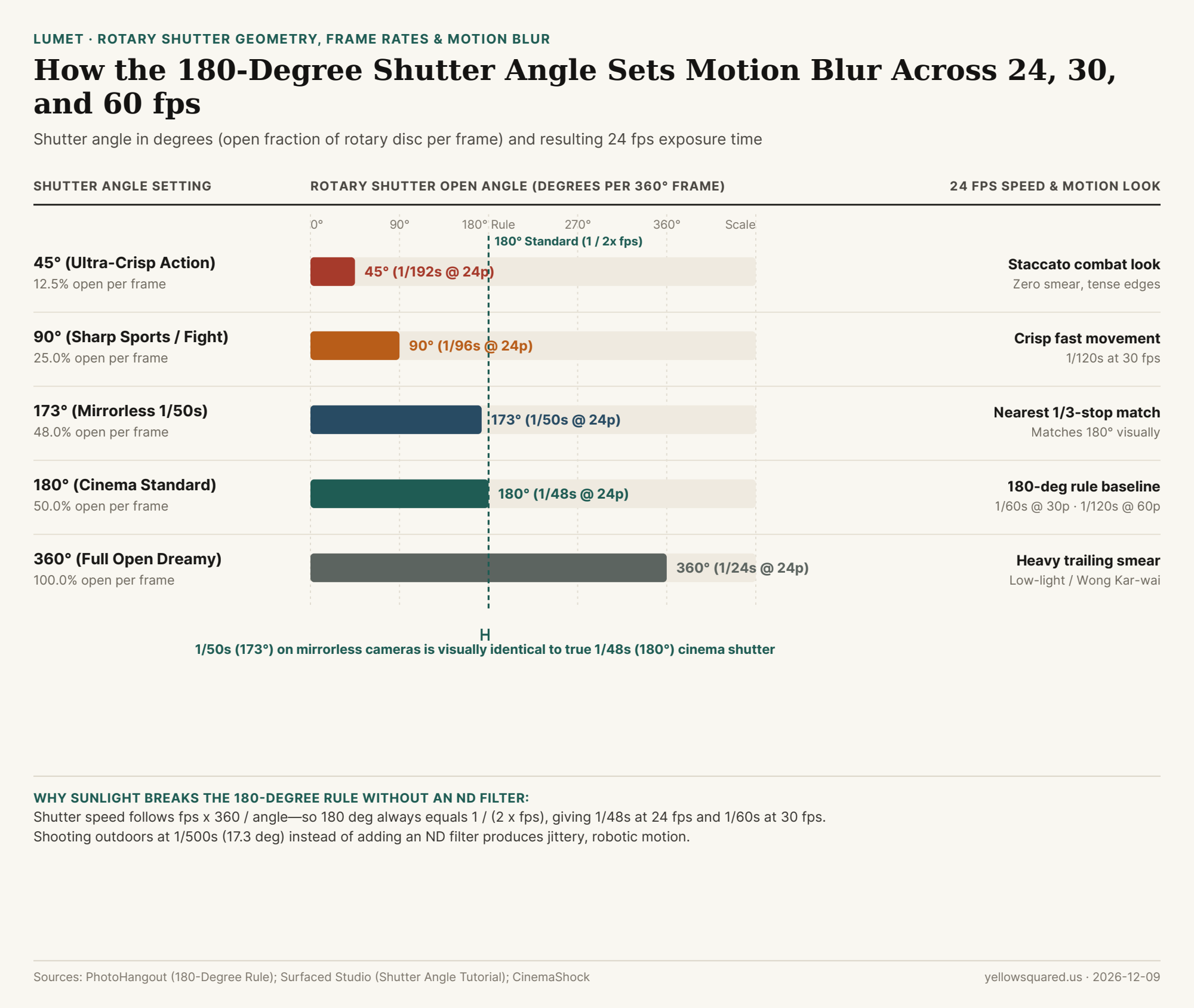
45° to 360°) and resulting 24 fps exposure times. Sources: PhotoHangout and Surfaced Studio · Download CSV dataset.The Rotary Shutter Formula: fps × 360 / angle
In a film camera, a circular metal disc with a wedge cut out rotates 360° for every single frame. When the cutout is 180°, the film is exposed for exactly 50% of the frame duration and blocked for the other 50% while the film advances:
- At
24 fps:24 × 360 / 180 = 48→1/48s(or1/50son mirrorless cameras, which equals173°—visually indistinguishable). - At
30 fps:30 × 360 / 180 = 60→1/60s. - At
60 fps(slow motion):60 × 360 / 180 = 120→1/120s.
"A 180-degree shutter exposes each frame for half its duration (1 / 2x fps), producing the smooth motion blur our eyes expect—while 1/500s drops the effective shutter angle to 17.3 degrees and makes motion look robotic."
When Directors Break the 180-Degree Rule Intentionally
Cinematographers narrow or widen the shutter angle for emotional effect: 45° to 90° (1/192s to 1/96s at 24 fps) strips away blur for crisp, adrenaline-heavy combat or sports footage, while 360° (1/24s) creates dreamy, trailing smear in low-light sequences. Outdoors, however, you should control brightness with a Neutral Density (ND) filter rather than raising shutter speed.
Shutter Angle & Frame Rate Exposure Table
Reference the equivalent shutter speeds across 24, 30, and 60 fps (download the raw CSV dataset):
| Shutter Angle | Open Fraction | 24 fps Speed | 30 fps Speed | 60 fps Speed | Visual Motion Character |
|---|---|---|---|---|---|
45° |
12.5% | 1/192s |
1/240s |
1/480s |
Ultra-crisp staccato action |
90° |
25.0% | 1/96s |
1/120s |
1/240s |
Tight, sharp fight/sports edges |
173° |
48.0% | 1/50s |
1/60s |
1/125s |
Mirrorless nearest match to 180° |
180° (Standard) |
50.0% | 1/48s |
1/60s |
1/120s |
Natural cinematic motion blur |
360° |
100.0% | 1/24s |
1/30s |
1/60s |
Heavy trailing smear / dreamy |