
What Is Skiplagging (Hidden-City Ticketing) and Why Do Airlines Ban It?
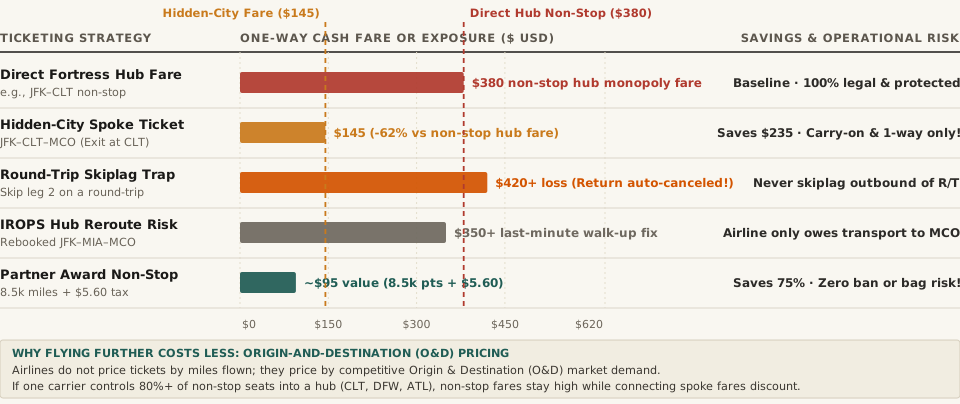
Search for a one-way non-stop flight from New York (JFK) to a major airline fortress hub like Charlotte (CLT), Dallas/Fort Worth (DFW), or Atlanta (ATL) on two weeks' notice, and the airline may quote you $380 in economy. Then search the exact same airline on the exact same morning for a flight from New York to Orlando (MCO) with a layover in Charlotte—putting you in the exact same seat on the exact same New York-to-Charlotte airplane, plus a second flight to Florida—and the total price drops to $145.
That counterintuitive pricing inversion is the economic engine behind hidden-city ticketing, widely known as skiplagging (after the metasearch engine Skiplagged founded by Aktarer Zaman in 2013): buying a cheaper connecting itinerary where your real destination is the layover city, walking out of the airport at the connection with a backpack, and throwing away the final segment. Here is why airlines price longer connecting flights cheaper than shorter non-stop flights, what U.S. and European courts have ruled in airline lawsuits, and the five operational traps that can turn a $235 savings into a $500 travel disaster.
1. Why Flying Further Costs Less: Fortress Hubs vs. O&D Competition
To a first-time traveler, charging $145 for two flights (JFK → CLT → MCO) while charging $380 for just the first flight (JFK → CLT) looks like a computer glitch. In reality, it is a deliberate cornerstone of airline revenue management known as Origin-and-Destination (O&D) pricing.
Airlines do not price tickets on a cost-plus basis per mile flown; they price each city pair according to willingness to pay and competitive alternatives:
- The Non-Stop Fortress Hub Monopoly (
JFK → CLT): At a “fortress hub” where a single legacy carrier controls 75% to 90% of all gates and takeoffs, corporate travelers flying into the hub for banking, legal, or consulting meetings strongly prefer a fast non-stop flight and have few competing airlines to choose from. Revenue-management algorithms hold those non-stop seats in higher fare buckets ($300–$500+). - The Competitive Spoke-to-Spoke Leisure Market (
JFK → MCO): Between New York and Orlando, half a dozen airlines (including low-cost carriers JetBlue, Spirit, Frontier, and Southwest) fly non-stop for $110 to $150. If the legacy carrier wants to fill empty seats on its Charlotte flights with price-sensitive leisure passengers heading to Florida—who actually face the inconvenience of a layover compared to a non-stop flight—it must discount the connectingJFK → CLT → MCOitinerary to $145 to match the market!
2. Is Skiplagging Illegal? What Courts Ruled in United and Lufthansa Lawsuits
Airlines often use ominous language to deter hidden-city ticketing, leading many passengers to wonder if walking out of an airport at a layover is against the law. As documented in Wikipedia's legal review of airline booking ploys and aviation consumer law analyses, the distinction between criminal/statutory law and private contract law is crystal clear:
- Not a Crime or Federal Offense: In the United States and Europe, deciding not to board the second leg of a domestic flight is completely lawful under criminal and aviation safety statutes.
- A Civil Breach of the Airline's Contract of Carriage: Almost every major airline explicitly prohibits hidden-city ticketing in its Contract of Carriage (the terms and conditions you click “Agree” to at checkout), classifying it as purchasing a ticket for a city you have no intention of flying to in order to circumvent the carrier's fare structure.
- What Happened When Airlines Sued: In November 2014, United Airlines and Orbitz sued Skiplagged founder Aktarer Zaman in federal court in Chicago seeking $75,000 in lost revenue; the court dismissed the case on jurisdictional grounds in 2015 (and in 2023–2024, American Airlines pursued trademark and contract claims against Skiplagged in Texas). Even more notably, in 2019 Lufthansa sued an individual passenger in Germany for €2,112 after he skipped the final Oslo–Frankfurt–Seattle return leg to Berlin; as noted on Wikipedia, Germany's Federal Court of Justice ruled in 2025 that Lufthansa's surcharge clause lacked transparency under consumer law, while confirming that airlines have the contractual right to refuse further carriage and penalize repeat violators.
“Skiplagging is not a crime, but it violates almost every airline's Contract of Carriage—giving carriers the contractual power to cancel your remaining itinerary, confiscate your frequent-flyer miles, and ban repeat offenders.”
3. The Five Operational Traps That Catch Skiplaggers—and the Legal Award Alternative
Before you ever consider booking a hidden-city ticket, look at the five ways the tactic backfires in real life—and compare it with the 100% legal frequent-flyer alternative:
| Ticketing Route or Scenario | Sample One-Way Cost | Savings vs. Direct Hub | Baggage & Return Ticket Outcome | Contract of Carriage & Operational Risk |
|---|---|---|---|---|
Direct Fortress Hub Fare (JFK → CLT) |
$380 one-way | 0% (Baseline) | Full checked bag & PNR protection | 100% compliant; zero reroute or account risk |
Hidden-City Spoke Ticket (JFK → CLT → MCO) |
$145 one-way | 61.8% (−$235) | Personal item / backpack ONLY | Breaches Contract of Carriage; never attach your frequent-flyer number |
| Round-Trip Outbound Skiplag Trap | $420+ loss | 0% (Return voided!) | Entire return ticket auto-canceled! | Skipping any segment triggers automatic cancellation of all remaining flights |
| Gate-Checked Roller Bag Trap | $145 + lost bag | 0% usable | Bag flies to Orlando (MCO)! | If overhead bins fill up in Boarding Group 7, your bag is tagged to the final city |
| Weather / IROPS Hub Reroute | $350+ rebook | 0% arrival in CLT | Rebooked via Miami (JFK → MIA → MCO) |
Airline's legal contract is to get you from JFK to MCO, not via Charlotte! |
Partner Award Ticket (JFK → CLT) |
~$95 (8.5k pts + $5.60) | ~75% savings | Full checked bag & IROPS rights | 100% legal: partner award charts price by distance, bypassing hub cash gouging |
Why Partner Award Tickets Beat Skiplagging Without Breaking a Single Rule
Notice the bottom row of the table: if an airline wants $380 cash for a short 540-mile non-stop flight into its fortress hub, you don't need to risk having your roller bag sent to Florida or your frequent-flyer account shut down. Because alliance partner award charts (such as booking an American Airlines non-stop flight using British Airways Avios or Qantas points, or booking a United hub flight using Air Canada Aeroplan or Avianca LifeMiles) often price short-haul flights by distance band (7,500 to 10,000 points + $5.60 in september 11 security fees) whenever saver space is open, you can fly the exact non-stop hub flight legally with a checked bag and full irregular-operations protection.
Compare Cash Hub Fares Against Partner Award Sweet Spots on Pointsuno
When a non-stop cash ticket into a hub spikes above $350, checking whether your transferable bank points unlock a low-tax non-stop award seat is always safer than rolling the dice on a hidden-city connection. Compare award tax valuations on Pointsuno to calculate exact cents-per-point returns and out-of-pocket taxes across airline loyalty programs.