
How Long Can You Expose the Milky Way Before Stars Trail? (500 Rule vs. NPF Rule)
How Long Can You Expose the Milky Way Before Stars Trail? (500 Rule vs. NPF Rule)
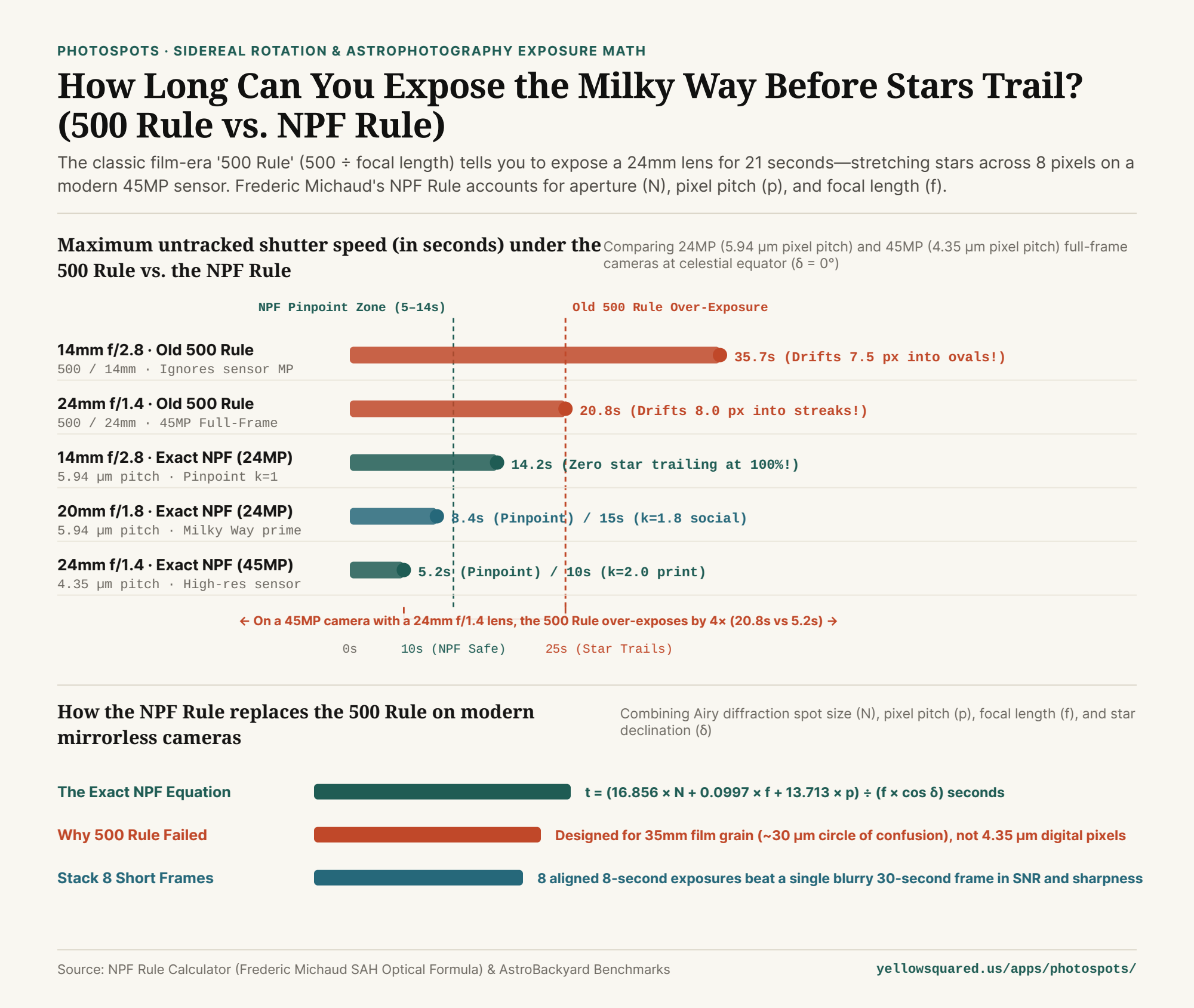
Every beginner Milky Way guide repeats the same back-of-the-napkin formula: divide 500 by your lens focal length to find the longest shutter speed before Earth's rotation turns stars into streaks (the 500 Rule). Under that formula, a 24mm lens can stay open for 21 seconds and a 14mm lens for 35 seconds. Yet if you actually shoot a 21-second exposure at 24mm on a modern 24-megapixel or 45-megapixel mirrorless camera and zoom in, every star looks like a stretched white pill. That is why modern astrophotographers have retired the 500 Rule in favor of the NPF Rule.
1. Why the Film-Era 500 Rule Fails on Digital Sensors
Earth completes a 360° sidereal rotation in 23 hours, 56 minutes, and 4 seconds—meaning stars near the celestial equator (declination δ = 0°, just north of the Galactic Center in Sagittarius) drift across the sky at an angular velocity of 15.04 arcseconds per second of time.
As documented in AstroBackyard's empirical exposure tests, the 500 Rule was created decades ago for 35mm color negative film, where dye clouds and print enlargements tolerated a generous 30-micrometer (µm) blur circle. Today, a 24MP full-frame sensor has a pixel pitch of 5.94 µm, and a 45MP–61MP full-frame sensor has a pixel pitch of 3.76 µm to 4.35 µm—nearly 7 times finer than the 500 Rule's assumptions. At 24mm on a 45MP sensor, each pixel subtends just 37.4 arcseconds of sky, so a star crosses an entire pixel every 2.5 seconds!
"On a 45-megapixel full-frame camera with a 24mm f/1.4 lens, a '500 Rule' 21-second exposure drags every star across 8 consecutive pixels."
2. How the NPF Rule Works: Aperture (N), Pixel Pitch (p), and Focal Length (f)
Derived by French astronomer Frédéric Michaud (Société Astronomique de France) and detailed in the NPF Rule Calculator documentation, the NPF Rule computes the exact exposure time t (in seconds) required for a star's optical blur spot (combining lens diffraction and pixel sampling) to drift by at most k times its own radius at declination δ:
t = k × (16.856 × N + 0.0997 × f + 13.713 × p) ÷ (f × cos δ)
N(Aperture f-number): Wider apertures likef/1.4produce a smaller Airy diffraction spot thanf/2.8, which paradoxically makes star elongation visible slightly sooner at 100% zoom.p(Pixel pitch in micrometersµm): Smaller pixels (`4.35 µm` on 45MP vs. `5.94 µm` on 24MP) require proportionally shorter exposures.f(Focal length in millimetersmm): Longer focal lengths magnify angular star motion directly.k(Tolerance factor): Settingk = 1.0yields strict pinpoint stars at 100% pixel inspection; settingk = 2.0(the simplified(35×N + 30×p)/fformula) allows slight sub-print elongation while doubling light collection.
3. 500 Rule vs. NPF Rule Shutter Speed Lookup Table
Use this field reference table to dial your untracked Milky Way shutter speed across five popular wide-angle lenses and sensors (available in what-is-the-500-rule-and-npf-rule-for-milky-way-astrophotography.csv):
| Lens & Sensor Combo | Old 500 Rule | Exact NPF (k=1 Pinpoint) | Relaxed NPF (k=2) | 500 Rule Trail Drift | Recommended Field Setting |
|---|---|---|---|---|---|
| 14mm f/2.8 on 24MP FF | 35.7 sec | 14.2 sec | 28.4 sec | 7.5 pixels (Ovals) | 15 to 20 sec |
| 20mm f/1.8 on 24MP FF | 25.0 sec | 8.4 sec | 16.8 sec | 6.0 pixels | 10 to 15 sec |
| 24mm f/1.4 on 45MP FF | 20.8 sec | 5.2 sec | 10.4 sec | 8.0 pixels (Streaks!) | 6 to 10 sec |
| 35mm f/1.4 on 45MP FF | 14.3 sec | 3.6 sec | 7.2 sec | 7.9 pixels | 4 to 6 sec |
| 16mm f/2.8 on 26MP APS-C | 20.8 sec | 7.9 sec | 15.8 sec | 5.3 pixels | 8 to 13 sec |
4. Check Astronomical Twilight and Galactic Core Rise Times in PhotoSpots
Worried that dropping your shutter speed from 20 seconds down to 8 seconds will make your Milky Way frame too noisy? Capture 8 to 12 consecutive 8-second exposures at `ISO 3200` and median-stack them in software: stacking `N` frames reduces random read and shot noise by √N (nearly `3×` cleaner with 9 frames) while keeping every star razor-sharp. Before driving out to a dark-sky site, Track lighting ephemeris in PhotoSpots to verify exact astronomical twilight end times and moonless windows.
Verified Primary Sources
- NPF Rule Calculator / Société Astronomique de France — NPF Rule Astrophotography Exposure Formula (Aperture N, Pixel Pitch p, Focal Length f & Declination δ) (Retrieved 2026-10-31).
- AstroBackyard — 500 Rule vs. NPF Rule for Astrophotography: Exposure Time Guide (Retrieved 2026-10-31).