
What Is the '500 Rule' (and NPF Rule) for Photographing Stars Without Blur Trails?
Every beginner tutorial on photographing the Milky Way from a fixed tripod teaches the same piece of dark-sky folklore: the “500 Rule.” Divide 500 by your lens focal length in millimeters (for example, 500 / 24mm = 20.8 seconds, or 500 / 14mm = 35.7 seconds), set your shutter to that number, and your stars will allegedly come out as crisp, round pinpoints without motion blur from the Earth's rotation. Then you get home, open your RAW files on a laptop monitor, and discover that every single star in the sky has stretched into a pill-shaped dash 8 to 12 pixels long.
Why does the 500 Rule systematically fail on modern mirrorless and DSLR cameras—and why did astrophotographers replace it with the NPF Rule (developed by French amateur astronomer Frédéric Michaud of the Société Astronomique du Havre)? Here is the exact angular velocity math of star trails, why a rule invented for 1970s 35mm film grain breaks down on 24-to-61-megapixel digital sensors, and a side-by-side shutter speed lookup table for every popular wide-angle lens.
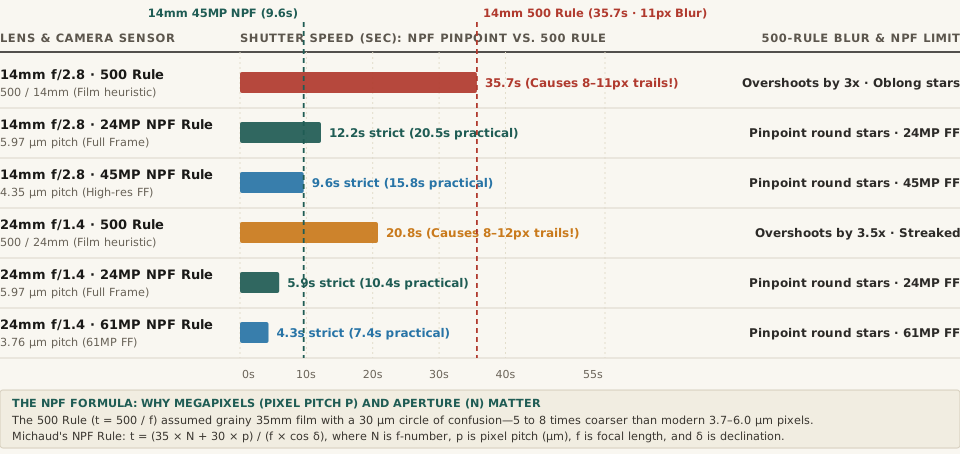
δ = 0°) comparing the classic 500 Rule against the strict and practical NPF Rule on 24MP, 45MP, and 61MP full-frame cameras. Download the full dataset: astrophotography-500-rule-vs-npf-rule-shutter-speeds-and-star-trail-blur.csv.1. Why Stars Trail: Earth's Sidereal Rotation (15.04 Arcseconds per Second)
Relative to the distant stars, the Earth completes one full 360° sidereal rotation in 23 hours, 56 minutes, and 4.09 seconds (86,164.09 seconds). Divide 360 degrees (1,296,000 arcseconds) by 86,164.09 seconds, and you get the fundamental angular velocity of the night sky at the celestial equator (declination δ = 0°):
ω = 15.041 arcseconds per second (or 15.04° per hour)
As explained in optical analyses of fixed-tripod star trail blur, the apparent linear speed at which a star image creeps across your camera sensor depends on two geometric factors: your lens's real focal length (f) and the star's celestial declination (δ):
Linear Trail Length on Sensor (mm) = f × ω × t × cos(δ) = f × (0.00007292 rad/sec) × t × cos(δ)
Notice the cosine of declination (cos δ) term: stars near the celestial equator (such as Orion's Belt at δ ≈ 0°, where cos 0° = 1.0) move across your frame at the maximum possible speed, while stars near the north or south celestial pole (such as Polaris at δ = +89.26°, where cos 89.26° = 0.013) barely move at all.
2. Why the 1970s “500 Rule” Produces 8-to-12-Pixel Trails on Digital Sensors
Where did the number 500 come from? On a 35mm film camera (36 × 24 mm frame), optical engineers defined the standard acceptable Circle of Confusion (CoC) for an 8×10-inch print viewed at arm's length as 0.030 mm to 0.035 mm (30 to 35 micrometers, μm). If you plug a 0.036 mm maximum tolerable trail length at the celestial equator (cos δ = 1) into the sidereal drift formula above:
t = 0.03646 mm / (f × 0.00007292 rad/s) = 500 / f
That worked fine on grainy ISO 400 color negative film where the dye clouds themselves were 15 to 25 μm wide. However, modern digital full-frame sensors pack vastly smaller photoreceptors (pixel pitch p):
- 24-Megapixel Full Frame (6000×4000 px): Pixel pitch is 5.97 μm (0.00597 mm)—meaning a
0.0365 mmtrail from the 500 Rule smears every star across 6.1 to 7.7 consecutive pixels! - 45-Megapixel Full Frame (8192×5464 px): Pixel pitch shrinks to 4.35 μm—stretching a 500-Rule exposure across 8.4 to 10.6 pixels.
- 61-Megapixel Full Frame (9504×6336 px, or 26MP APS-C): Pixel pitch drops to 3.76 μm—turning a 500-Rule exposure into a 10-to-12-pixel streak.
“The 500 Rule was mathematically derived for a 30-to-36-micrometer film circle of confusion. On a modern 24MP to 61MP sensor with 3.8-to-6.0-micrometer pixels, a 500-Rule exposure drags every equatorial star across 8 to 12 pixels.”
3. How the NPF Rule Works—and the Complete Lens Lookup Table
To replace the outdated 500 Rule with a physics-based formula for digital sensors, French astronomer Frédéric Michaud formulated the NPF Rule—named after its three optical inputs: N (aperture f-number, which sets the size of the optical Airy diffraction disk), P (sensor pixel pitch in micrometers, μm), and F (focal length in millimeters):
tNPF (seconds) = k × (16.856 × N + 0.0997 × f + 13.713 × p) / (f × cos δ) ≈ (35 × N + 30 × p) / (f × cos δ)
Here, the strict factor (k = 1.0, or the standard simplified formula divided by ~1.7) keeps star elongation completely imperceptible at 100% pixel-peeping zoom, while a practical tolerance factor (k ≈ 1.7, the standard simplified (35N + 30p) / f formula) limits trail elongation to barely noticeable levels for full-screen and print viewing. Compare the exact shutter times across popular astrophotography lenses at the celestial equator (δ = 0°):
| Lens Focal Length & Sensor Resolution | Classic 500 Rule (500 / f) |
500-Rule Trail Blur (Pixels) | Strict NPF Shutter (100% Zoom Pinpoint) | Practical NPF Shutter (Clean Print / Web) | Pixel Pitch & Optical Behavior |
|---|---|---|---|---|---|
| 14mm f/2.8 on 24MP Full Frame | 35.7 sec (~30s) | 7.7 px blur | 12.2 sec | 20.5 sec | 5.97 μm pitch; 20s gives clean stars without tracker |
| 14mm f/2.8 on 45MP Full Frame | 35.7 sec (~30s) | 10.6 px blur | 9.6 sec | 15.8 sec | 4.35 μm pitch resolves finer angular drift |
| 20mm f/1.8 on 24MP Full Frame | 25.0 sec | 7.7 px blur | 7.5 sec | 13.1 sec | 5.97 μm pitch; fast f/1.8 gathers 2.4× more light than f/2.8 |
| 24mm f/1.4 on 24MP Full Frame | 20.8 sec (~20s) | 7.7 px blur | 5.9 sec | 10.4 sec | Classic fast prime; 10s at f/1.4 matches 40s at f/2.8 in light! |
| 24mm f/1.4 on 61MP Full Frame | 20.8 sec (~20s) | 12.2 px blur | 4.3 sec | 7.4 sec | 3.76 μm pitch; 500 Rule overshoots strict NPF by nearly 5× |
| 50mm f/1.8 on 24MP Full Frame | 10.0 sec | 7.7 px blur | 3.0 sec | 5.2 sec | Normal focal length magnifies sky rotation; stack 15–20 frames |
Why Cutting Shutter Speed From 20s to 10s Doesn't Ruin Your Image
Beginners often worry that dropping from a 20-second 500-Rule exposure to a 10-second NPF exposure at 24mm loses one full stop of light. In practice, two techniques make the 10-second NPF shot dramatically superior: first, a 24mm f/1.4 lens shooting for 10 seconds at f/1.4 collects twice as many total photons as a 14mm f/2.8 lens shooting for 20 seconds at f/2.8 (because f/1.4 lets in 4× the light per second of f/2.8). Second, taking 8 to 12 consecutive 10-second NPF exposures and aligning/median-stacking the sky in software (such as Sequator or Starry Landscape Stacker) yields the low-noise equivalent of an 80-to-120-second tracked exposure while keeping every star a razor-sharp 1-to-2-pixel sphere.
Plan Dark-Sky Windows, Moonless Nights, and Ephemeris Angles in PhotoSpots
Before you pack your tripod and wide-angle prime, knowing the exact minute astronomical twilight ends, when the Moon sets below the horizon, and at what azimuth and elevation the Milky Way Galactic Core rises makes all the difference in the field. Track lighting ephemeris in PhotoSpots to plan moonless dark-sky windows, solar and lunar angles, and golden-hour transitions for any location.