
What Is the 500 Rule in Astrophotography? How to Shoot Sharp Stars Without Trails
What Is the 500 Rule in Astrophotography? How to Shoot Sharp Stars Without Trails
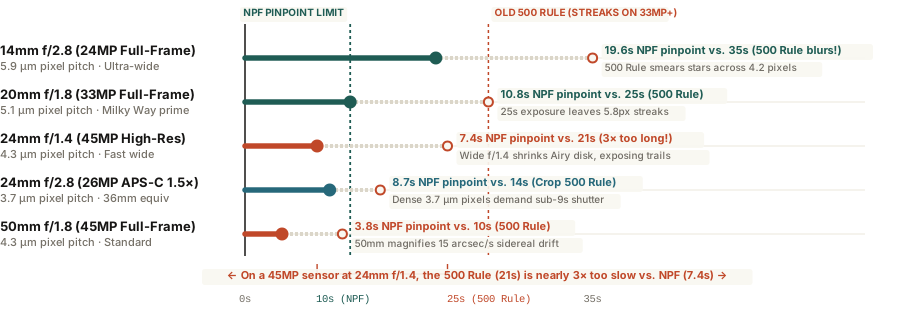
While the classic 500 Rule (500 ÷ Focal Length) worked for 35mm film prints, Earth's 15-arcsecond-per-second sidereal rotation smears stars across 4 to 8 pixels on modern 24MP–45MP sensors—requiring the pixel-pitch-aware NPF Rule.
Every beginner learning how to photograph the Milky Way or constellations on a fixed tripod is taught the same classic formula on day one: the 500 Rule. Divide 500 by your lens's focal length in millimeters (for example, `500 / 24mm = 20.8 seconds`), set your shutter speed to 20 seconds, and your stars will supposedly remain pinpoint dots rather than blurring into trails.
Then you get home, open your 20-second RAW files on a laptop monitor at 100% zoom, and discover that every single star is stretched into an oblong pill or short streak. The stars did not speed up—your camera's sensor resolution outgrew a rule of thumb invented for grainy 4×6-inch film prints. Understanding the angular speed of Earth's sidereal rotation and how to apply the modern NPF Rule (or field-ready 300 Rule) lets you nail tack-sharp pinpoint stars on any camera body.
The Sidereal Math: 15 Arcseconds of Sky Drift Every Second
Earth completes one full `360°` sidereal rotation relative to the fixed stars in 23 hours, 56 minutes, and 4 seconds (`86,164 seconds`). Dividing `360°` (`1,296,000 arcseconds`) by `86,164 seconds` reveals that stars near the celestial equator (where the core of the Milky Way rises) drift across your frame at 15.04 arcseconds per second of exposure—or roughly the apparent diameter of the full moon every two minutes.
In the 1970s and 1980s, when 35mm film grain had a resolving circle of confusion around `30 micrometers (µm)`, a star could drift across `100 µm` of film emulsion before looking stretched on a small paper print. Today's mirrorless cameras pack 24 to 61 megapixels onto the exact same 36×24mm sensor area, shrinking individual photoreceptor pixels down to 3.7 to 5.9 micrometers (`µm`). On a `45MP` full-frame sensor (`4.3 µm` pixel pitch) with a `24mm` lens, a 20-second exposure allows a star image to march across 7.5 consecutive pixels.
The 500 Rule asks only one question—what is your focal length? The NPF Rule asks the three questions that actually govern digital star trails: focal length, aperture, and pixel size.
How to Use the NPF Rule (and the 300 Rule Field Shortcut)
Developed in 2010 by French amateur astronomer Frédéric Michaud for the Société Astronomique du Havre, the NPF Rule calculates the exact exposure duration before a star's diffraction Airy disk smears beyond an acceptable pixel threshold, combining three variables—`N` (Aperture f-number), `P` (Pixel pitch in micrometers `µm`), and `F` (Focal length in millimeters `mm`):
`Max Pinpoint Seconds = (35 × Aperture + 30 × Pixel Pitch µm) ÷ Focal Length mm`
- Example — 24mm f/1.4 on a 45MP Full-Frame (`4.3 µm` pixels): `(35 × 1.4 + 30 × 4.3) ÷ 24 = (49 + 129) ÷ 24 = 7.4 seconds` (compared to `21 seconds` under the 500 Rule!). Why does a faster `f/1.4` aperture require a shorter shutter speed than `f/2.8`? Because a wider aperture produces a smaller, sharper optical diffraction spot (Airy disk), making even a 2-pixel smear immediately visible.
- Example — 14mm f/2.8 on a 24MP Full-Frame (`5.9 µm` pixels): `(35 × 2.8 + 30 × 5.9) ÷ 14 = (98 + 177) ÷ 14 = 19.6 seconds` (rounded to `15–20 seconds`).
- The 300 Rule Field Shortcut: If you do not want to look up your camera's pixel pitch in the dark, divide 300 (instead of 500) by your effective focal length (`300 ÷ 24mm = 12.5 seconds` on full-frame; `300 ÷ (24mm × 1.5) = 8.3 seconds` on APS-C) and raise your ISO one stop (e.g., from ISO 1600 to ISO 3200) to recover brightness without losing dynamic range on modern dual-native-ISO sensors.
To check exact astronomical twilight windows, moonless dark-sky hours, and Galactic Center elevation angles before heading out, you can Track lighting ephemeris in PhotoSpots for your exact shooting coordinates.