
What Is the Belt of Venus, and Why Does the Opposite Horizon Turn Pink and Blue at Sunset?
Most landscape and portrait photographers spend sunset facing west toward the setting Sun. Yet on any cloud-free evening, turning 180° around toward the antisolar point in the east reveals one of atmospheric optics' most striking two-tone gradients: a glowing rose-pink band—known since Victorian astronomy as the Belt of Venus (or anti-twilight arch)—floating 10° to 20° above a rising slate-blue wedge that is literally Earth's shadow projected onto the lower atmosphere.
As quantified in radiative-transfer field studies of twilight's Belt of Venus in Applied Optics, this pastel pink-and-blue separation only exists during civil twilight—the brief 25- to 40-minute window when the geometric center of the Sun sits between 0° and -6° below the horizon. Before heading out for an evening shoot, you can Scout golden hour and blue hour angles in PhotoSpots to align mountain ridges, city skylines, or coastal headlands with the exact azimuth of the antisolar horizon.
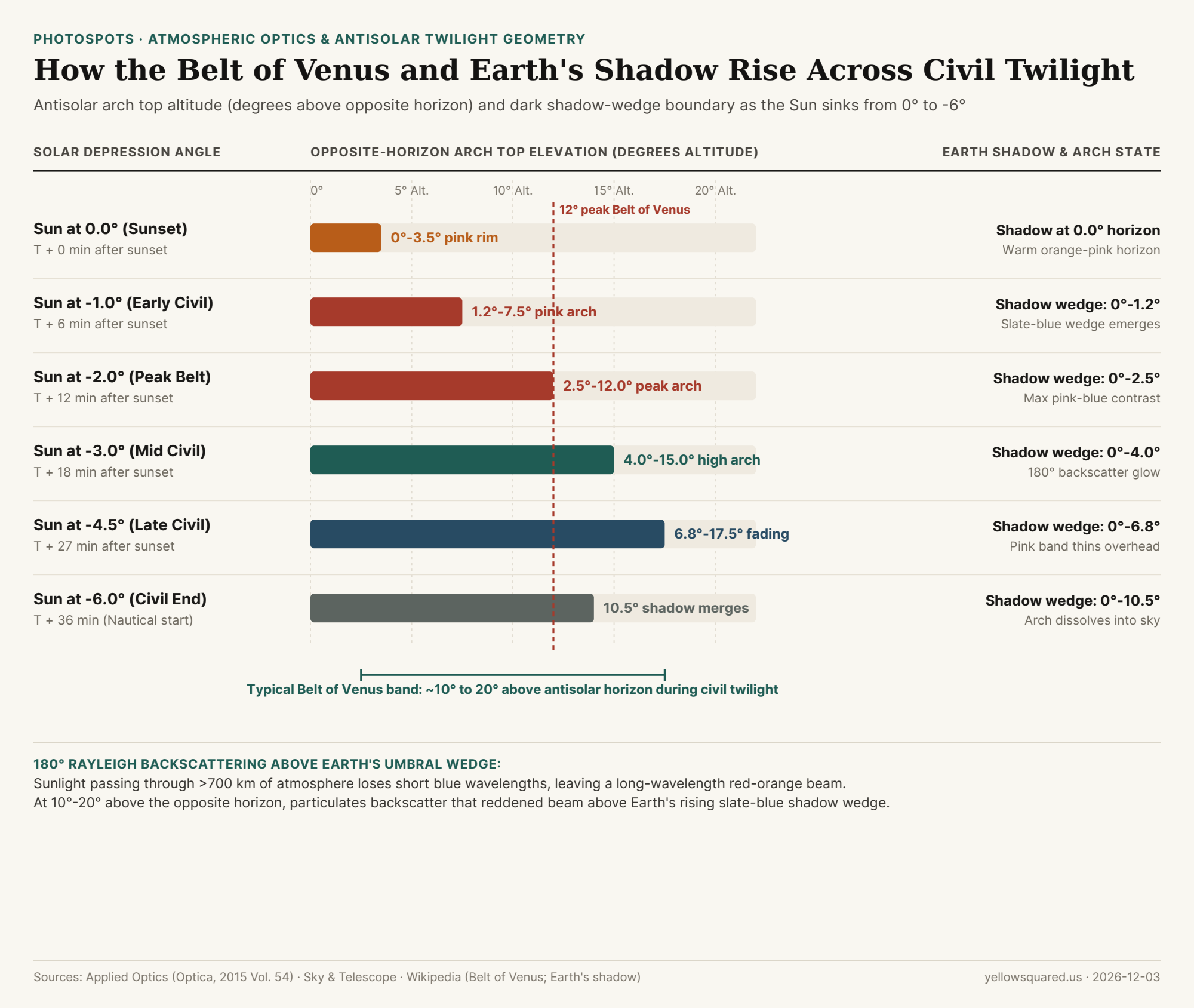
The Two Stacked Layers: Earth's Shadow Wedge vs. Backscattered Alpenglow
When the Sun drops below the western horizon (`solar elevation < 0°`), the solid curvature of the Earth blocks direct sunlight from illuminating the lowest kilometers of air in the east. Looking east, your line of sight passes through two distinct optical regimes stacked vertically above the horizon:
- The Lower Dark Segment (Earth's Shadow Wedge,
0° to ~10°altitude): Below the shadow boundary, air molecules and aerosols receive zero direct solar beams. They are lit only by diffuse multiple scattering from the overhead blue sky, producing a cool, dense slate-blue or steel-gray band hugging the horizon. Because atmospheric refraction bends grazing sunlight downward by roughly0.5° to 1.0°, the visible top of Earth's shadow rises slightly faster than the geometric solar depression angle (`reaching ~2.5° altitude when the Sun is at -2.0°, and ~10.5° when the Sun hits -6.0°`). - The Upper Rose-Pink Arch (Belt of Venus,
~2.5° to 17.5°altitude): Immediately above the shadow line, upper-tropospheric air and fine aerosols (`3 to 12 km` altitude) are still in direct line of sight of the setting Sun. Because those grazing solar rays have traveled through more than700 kmof dense lower atmosphere, Rayleigh scattering (`proportional to wavelength^-4`) has stripped out nearly all short blue and green wavelengths (`400–530 nm`). The surviving long-wavelength orange-red beam (`600–700 nm`) strikes particulates in the eastern sky and backscatters by180°back toward the observer, mixing with diffuse overhead blue sky light to create a luminous rose-pink and magenta arch.
"Unlike a rainbow—which owes its 42-degree geometry to internal refraction inside liquid raindrops—the Belt of Venus requires dry air: it is pure 180-degree Rayleigh and aerosol backscattering of reddened sunset light grazing the top of Earth's umbral shadow wedge."
Minute-by-Minute Twilight Progression (0° to -6° Solar Depression)
As noted by astronomy observers at Sky & Telescope, the Belt of Venus is most vivid when the Sun sits between -1.5° and -3.5° below the horizon—typically 10 to 20 minutes after upper-limb sunset (or before sunrise) at mid-latitudes (`35°N–50°N`). During this prime window, the dark blue shadow wedge is tall enough (`2.0° to 4.5°` above the horizon) to clearly separate the pink arch from terrain clutter, yet the pink arch has not yet attenuated into the stratosphere.
| Solar Depression Angle | Mid-Latitude Post-Sunset Time | Earth's Shadow Top Altitude | Belt of Venus Arch Span | Visual Appearance & Photographic Application |
|---|---|---|---|---|
0.0° (Upper-limb sunset) |
T + 0 min |
0.0° (At horizon) |
0.0° – 3.5° |
Warm peach-orange rim hugs the eastern horizon; shadow not yet detached |
-1.0° (Early civil) |
T + 6 min |
1.2° |
1.2° – 7.5° |
Thin slate-blue shadow wedge separates from horizon beneath rose-pink band |
-2.0° (Peak Belt window) |
T + 12 min |
2.5° |
2.5° – 12.0° |
Peak pastel saturation; ideal for portraits and alpine peak alpenglow |
-3.0° (Mid civil) |
T + 18 min |
4.0° |
4.0° – 15.0° |
Dark blue wedge climbs behind city skylines while pink arch widens overhead |
-4.5° (Late civil) |
T + 27 min |
6.8° |
6.8° – 17.5° |
Pink arch pales into lavender as sunlit beam retreats into rarefied air |
-6.0° (Civil twilight end) |
T + 36 min |
10.5° |
Dissolves (>10.5°) |
Earth's shadow merges into overhead sky, initiating true nautical blue hour |
How to Expose for the Belt of Venus Without Clipping Highlights
Because the antisolar eastern sky is roughly 2.5 to 3.5 stops darker than the western sunset horizon, shooting toward the Belt of Venus solves the biggest dynamic-range headache of golden hour photography: foreground subjects facing west are lit by soft, warm wrap-around light from the setting Sun while the background sky behind them displays pastel pink and slate-blue bands within a single 5-stop dynamic range. Use a 35mm to 85mm lens to compress the 0°–15° vertical band above the horizon, set white balance to a fixed Daylight (`5200K–5500K`) preset so auto white balance does not neutralize the magenta-pink tint, and Scout golden hour and blue hour angles in PhotoSpots to verify that the western horizon is unobstructed so clouds do not block the grazing solar beam at the source.