
What Is the Chase 5/24 Rule, and Which Credit Cards Count Toward Your 5-Card Limit?
If you collect transferable travel points, the single most important application constraint in the U.S. banking system is the Chase 5/24 rule: Chase's automated underwriting algorithm will automatically deny your application for virtually any Chase consumer or small-business credit card if your personal credit report shows 5 or more revolving credit card accounts opened across any issuing bank within the previous 24 months (Chase 5/24 Rule: What to Know - NerdWallet; Chase's 5/24 rule: Everything you need to know - The Points Guy).
Because the 5/24 counter is driven strictly by what appears on your personal credit bureau report (Experian, Equifax, and TransUnion) rather than an internal multi-bank database, understanding which accounts report to personal bureaus versus commercial bureaus lets you sequence applications without locking yourself out of Chase Ultimate Rewards—and maximize your portfolio when you Compare credit card point valuations and transfer partners in Pointsuno.
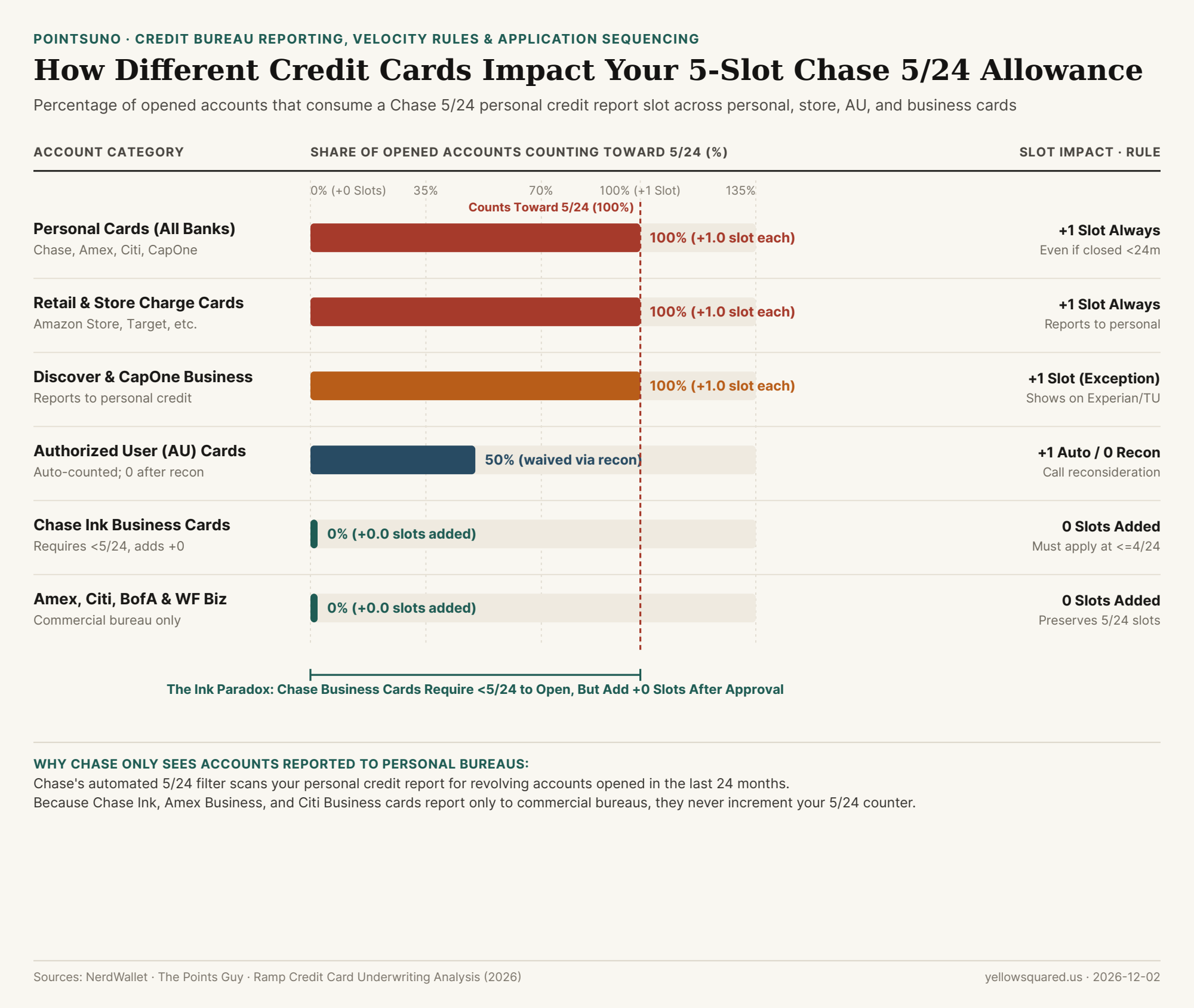
How Chase's Automated 5/24 Algorithm Evaluates Your Credit Report
When you submit an application for a Chase Sapphire Preferred, Freedom Unlimited, World of Hyatt, or Ink Business card, Chase pulls your personal credit report and counts every revolving credit card tradeline with an Account Opened Date within the last 24 months (Chase 5/24 Rule Explained - Ramp):
- Every Issuer Counts Toward the 5-Slot Cap: The limit is not 5 Chase cards in 24 months; opening 3 American Express personal cards and 2 Citi personal cards puts you at
5/24and blocks new Chase approvals (Ramp). - Closing an Account Does Not Erase Its Slot: Because the filter checks the
Date Openedfield on your report, closing a card opened 10 months ago leaves it in your5/24count for the remaining 14 months (Ramp). - The 1st-of-the-25th-Month Aging Rule: Credit bureaus report account opening dates by month and year, so Chase's system resets a slot on the first day of the 25th calendar month after opening (for example, a card opened on November 18, 2024 ages off your
5/24count on December 1, 2026) (The Points Guy). - Non-Revolving Loans Never Count: Mortgages, auto loans, student loans, and personal installment loans do not count toward
5/24.
"The Chase Ink paradox: you must be under 5/24 (at 4/24 or below) to be approved for a Chase Ink Business card, but once approved, that Ink card adds +0 to your 5/24 count."
Which Cards Count (+1 Slot) vs. Which Business Cards Add +0 Slots
The golden rule of 5/24 is simple: if a revolving card reports to your personal credit report, it adds +1 to your 5/24 count; if it reports only to commercial bureaus (Dun & Bradstreet, Experian Business, Equifax Business), it adds +0 (NerdWallet):
- Chase, Amex, Citi, BofA & Wells Fargo Business Cards (+0 Slots): Business cards issued by Chase (
Ink Business Preferred,Ink Business Cash,Ink Business Unlimited), American Express (Business Platinum,Business Gold,Blue Business Plus), Citi (AAdvantage Business), Bank of America, and Wells Fargo do not appear on your personal credit report as long as the account remains in good standing. Thus, someone sitting at4/24can open a Chase Ink card and an Amex Business Gold card and remain at4/24(NerdWallet; The Points Guy). - Discover & Select Capital One Business Cards (+1 Slot Exception): Unlike other issuers, Discover business cards and several Capital One small-business cards (
Sparkconsumer-reporting tiers) report directly to personal credit bureaus and therefore consume a5/24slot (Ramp). - Retail Store Charge Cards (+1 Slot): Store-only cards (such as Target or Amazon store cards) and deferred-interest financing lines opened as revolving credit accounts appear on personal credit reports and count as
+1slot. - Authorized User (AU) Cards (+1 Automated, 0 After Reconsideration): If a spouse or parent adds you as an Authorized User on a card opened within the past 24 months, the tradeline appears on your personal report and triggers an automated
5/24denial. However, you can call Chase's reconsideration line and ask the analyst to exclude the AU account because you are not financially responsible for the debt—or ask the primary cardholder to remove you and dispute the AU tradeline off your bureau report (Ramp).
| Credit Card Category | Personal Bureau Report? | 5/24 Slot Impact | Requires <5/24 to Open? | Examples & Strategy Note |
|---|---|---|---|---|
| 1. All Personal Credit Cards | Yes (100%) | +1.0 slot | Yes (for Chase) | Sapphire, Freedom, Amex Gold, Venture X |
| 2. Retail Store Charge Cards | Yes (100%) | +1.0 slot | No (non-Chase) | Amazon Store Card, Target, department stores |
| 3. Discover & CapOne Business | Yes (Select tiers) | +1.0 slot | No (non-Chase) | Exceptions that report to personal bureaus |
| 4. Authorized User (AU) Cards | Yes (Removable) | +1 auto / 0 recon |
Waivable via phone | Call Chase reconsideration to exclude AU |
| 5. Chase Ink Business Cards | No (Commercial only) | 0.0 slots (+0) | Yes (<=4/24 required) | Ink Preferred, Ink Cash, Ink Unlimited |
| 6. Amex, Citi, BofA & WF Biz | No (Commercial only) | 0.0 slots (+0) | No (Exempt) | Amex Biz Gold/Plat/BBP, Citi AAdvantage Biz |
Optimal Application Sequencing Before and After Hitting 5/24
If you are currently below 5/24 (at 0/24 through 4/24), prioritize Chase Ink Business cards and core Chase personal cards (such as Sapphire Preferred/Reserve or co-branded Hyatt/United/Southwest cards) before filling your remaining personal slots with American Express, Citi, or Capital One personal cards (NerdWallet). To calculate exact cents-per-point transfer values and compare airline and hotel partners across Chase Ultimate Rewards, Amex Membership Rewards, Citi ThankYou, and Bilt, Compare credit card point valuations and transfer partners in Pointsuno.