
What Is the Difference Between a Codeshare Flight and an Interline Flight for Bags, Miles, and Delays?
When you book a multi-leg itinerary that combines two different airlines on a single confirmation code (a single Passenger Name Record, or PNR), your ticket falls into one of three commercial aviation cooperation tiers: a basic interline agreement, a codeshare agreement, or an immunized joint venture. As documented across carrier network histories for American Airlines, China Southern Airlines, JetBlue, and Southwest Airlines' historical interline partnerships, confusing an interline ticket with a codeshare ticket—or misunderstanding how alliances credit codeshares—can cost you thousands of redeemable miles and elite status credits.
What actually changes between an interline connection and a codeshare flight when it comes to checked bags, missed connections, and frequent-flyer miles? Compare airline alliance earning rules and transfer partners in Pointsuno before you book a partner itinerary.
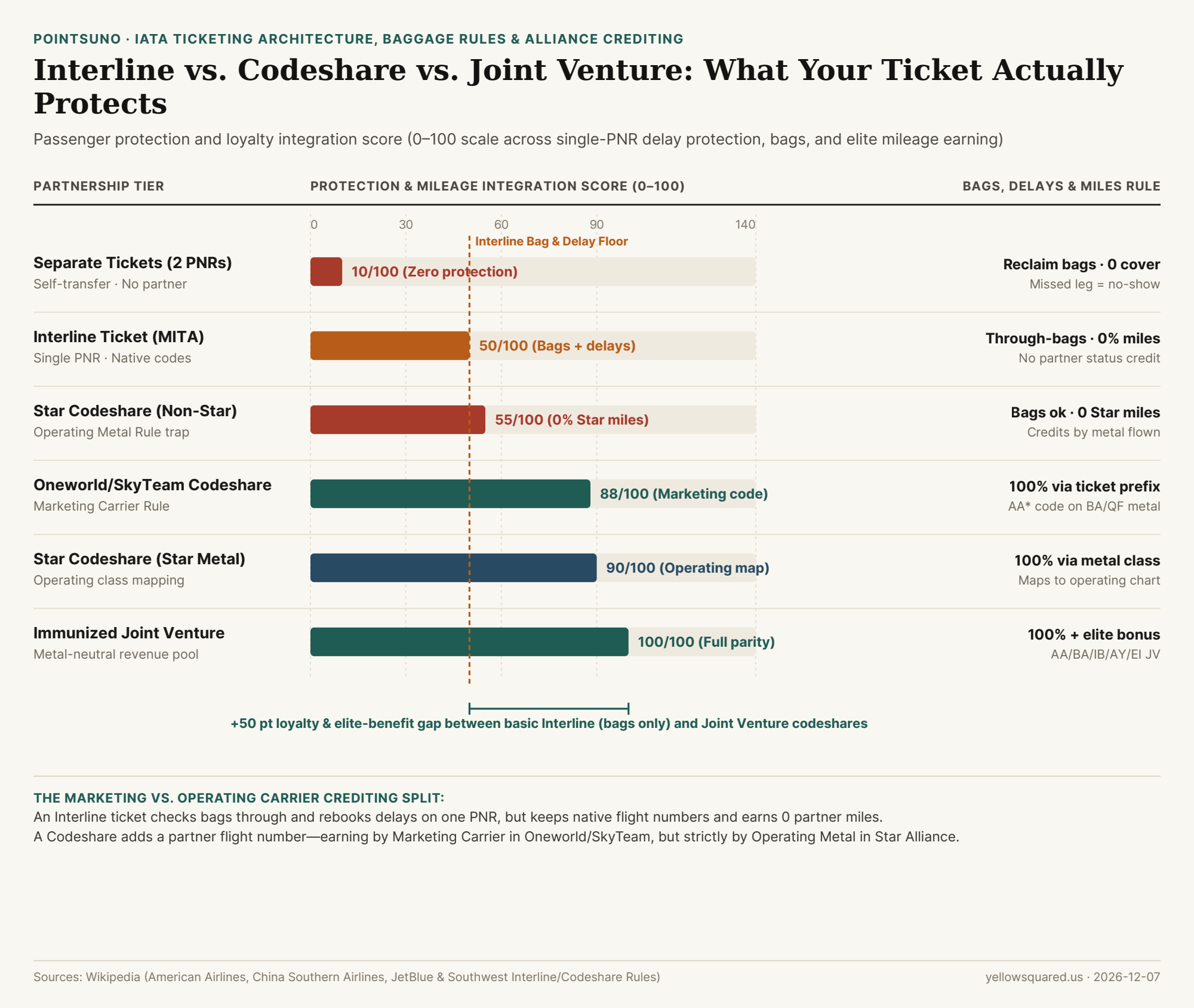
0–100 composite across single-PNR delay protection, through-checked baggage, and elite mileage earning) across six multi-carrier ticketing structures. Sources: American Airlines, China Southern Airlines, JetBlue, and Southwest Airlines History · Download CSV dataset.Tier 1: Interline Agreements (Bags & Delays, Zero Partner Miles)
An interline agreement (governed globally by the IATA Multilateral Interline Traffic Agreement, or MITA) is the foundational commercial treaty between two airlines. For example, JetBlue maintains dozens of interline agreements (such as with South African Airways and Virgin Atlantic), and as recorded in the History of Southwest Airlines, Southwest's first international interline pact with Icelandair in 1997 explicitly linked ticketing, baggage handling, and gate transfers in Baltimore while excluding reciprocal frequent-flyer earning:
- What Interline Gives You: Both flights are issued on a single ticket (single PNR), your checked bags are tagged and transferred end-to-end to your final destination (
through-checked baggage), and if the first airline is delayed and causes you to miss your connection, the carriers are contractually obligated to rebook you at no extra fare during irregular operations (IRROPs). - What Interline Does NOT Give You: Each segment displays its own native operating carrier flight number (e.g., a
B6flight connecting to anSAflight), and you earn0%partner miles or elite status credits on the interline partner leg unless the two airlines also have a separate frequent-flyer agreement.
Tier 2: Codeshare Agreements & The Alliance "Metal Trap"
In a codeshare agreement (such as American Airlines' codeshares with British Airways, Qantas, and China Southern Airlines), the airline that physically flies the airplane and crew (the Operating Carrier, or "metal") lets a partner airline (the Marketing Carrier) put its own two-letter IATA code and flight number on that seat (shown on your receipt as "Flight AA 6180 operated by British Airways").
"In Oneworld and SkyTeam, the flight number printed on your ticket (the Marketing Carrier) dictates how many miles you earn. In Star Alliance, the physical airplane you board (the Operating Carrier 'metal') dictates your miles—and booking a Star Alliance codeshare operated by a non-alliance carrier can earn zero miles."
This creates the single most important rule divide in frequent-flyer strategy:
- Oneworld & SkyTeam ("Marketing Carrier Rule"): Mileage and status earning follow the 2-letter prefix on your ticket. If you buy an American Airlines (
AA) codeshare flight number operated by British Airways or Qantas, your AAdvantage miles and Loyalty Points are calculated using American's chart (provided both carriers are Oneworld members or eligible partners). - Star Alliance ("Operating Carrier / Metal Rule"): Star Alliance credits miles strictly according to the Operating Carrier that physically flies the plane, translating your marketing fare class into an internal booking class on the operating carrier's chart. Worse yet, if you buy a Lufthansa (
LH) codeshare flight number that is physically operated by a non-Star Alliance airline, third-party Star Alliance programs like United MileagePlus or Air Canada Aeroplan will award0 milesand0 status points!
Tier 3: Immunized Joint Ventures (Metal-Neutral Parity)
At the top of the pyramid sit antitrust-immunized joint ventures (JVs)—such as the Atlantic Joint Business between American Airlines, British Airways, Iberia, Finnair, and Aer Lingus. Inside a joint venture, the airlines pool revenue and share profits "metal-neutrally" on transoceanic routes, meaning they do not care whose airplane you board. As a result, JV partners align their fare classes, elite status bonuses, and proactive delay rebooking so that booking either the marketing or operating flight number yields near-identical earning and lounge privileges.
Complete Comparison: Separate Tickets vs. Interline vs. Codeshare vs. Joint Venture
Use the reference table below to audit any multi-airline itinerary before ticketing (download the raw CSV dataset):
| Ticketing & Partnership Tier | Flight Number on Ticket | Through-Checked Bags & IRROPs | Alliance Crediting Rule | Miles & Status Earned | Real-World Carrier Example |
|---|---|---|---|---|---|
| Separate Tickets (Self-Transfer) | 2 separate native PNRs | No (Reclaim bags; 0 delay protection) | Separate native charts | 0% connection protection |
Booking a standalone budget flight to meet an international long-haul |
Standard Interline (IATA MITA) |
Operating carrier native code | Yes (Single PNR + bag transfer) | No reciprocal loyalty credit | 0% partner miles |
Southwest + Icelandair (1997) or JetBlue + SAA single-ticket interline |
| Star Alliance Codeshare (Non-Star Metal) | Marketing code (e.g., LH*) |
Yes (Single PNR + bag transfer) | Operating Carrier (Metal) Rule | 0% in 3rd-party Star programs |
Lufthansa (LH) codeshare operated by non-Star partner earns 0 UA/AC miles |
| Oneworld / SkyTeam Codeshare | Marketing code (e.g., AA*, DL*) |
Yes (Single PNR + priority tags) | Marketing Carrier Prefix Rule | 100% per marketing chart |
American (AA) flight number operated by British Airways or Qantas |
| Star Alliance Codeshare (Star Metal) | Marketing or operating Star code | Yes (Single PNR + Star Gold bags) | Operating Carrier Class Map | 100% per operating chart |
United (UA) codeshare operated by ANA or Lufthansa (maps fare class) |
| Immunized Joint Venture (JV) | Either JV partner code | Yes (Seamless rebooking + lounges) | Aligned metal-neutral table | 100% + full elite bonus |
Atlantic Joint Business (AA, BA, IB, AY, EI) |
How to Audit Your Ticket Before the 24-Hour Cancellation Window Closes
Whenever you book a partner flight, check the fine print right beneath the flight number for the words "Operated by..." inside your 24-hour free cancellation window. If you are crediting to a Star Alliance program, always verify that the physical operating carrier is a full Star Alliance member and check the operating fare class mapping; if you are flying on an interline segment with a non-alliance partner, keep your boarding pass to credit that single leg to the operating airline's own loyalty program. Compare airline alliance earning rules and transfer partners in Pointsuno to maximize every multi-carrier itinerary.