
What Is the Difference Between Civil, Nautical, and Astronomical Twilight—And When Does Blue Hour Actually Start?
Check a weather forecast or astronomy app before an evening cityscape or Milky Way shoot, and you will see three different sunset-to-night timestamps listed one after another: Civil Dusk, Nautical Dusk, and Astronomical Dusk—alongside photography apps quoting a separate window for Blue Hour. Because twilight duration stretches and shrinks with latitude and season (lasting 22 minutes per stage at the Equator, 30+ minutes at 40°N, and all night in summer above 48.6°N), clock minutes after sunset are a noisy guide. Instead, the U.S. Naval Observatory (USNO) and the National Weather Service (NWS) define every phase of twilight by the exact geometric depression angle of the Sun's center below the horizon—in three clean 6-degree steps from 0° down to -18°.
Reader outcome: You will learn what the sky and ground look like during Civil (0° to -6°), Nautical (-6° to -12°), and Astronomical (-12° to -18°) twilight, why Chappuis ozone absorption turns the sky deep cobalt blue between -4° and -6°, and how to time cityscapes and dark-sky astrophotography to the minute.
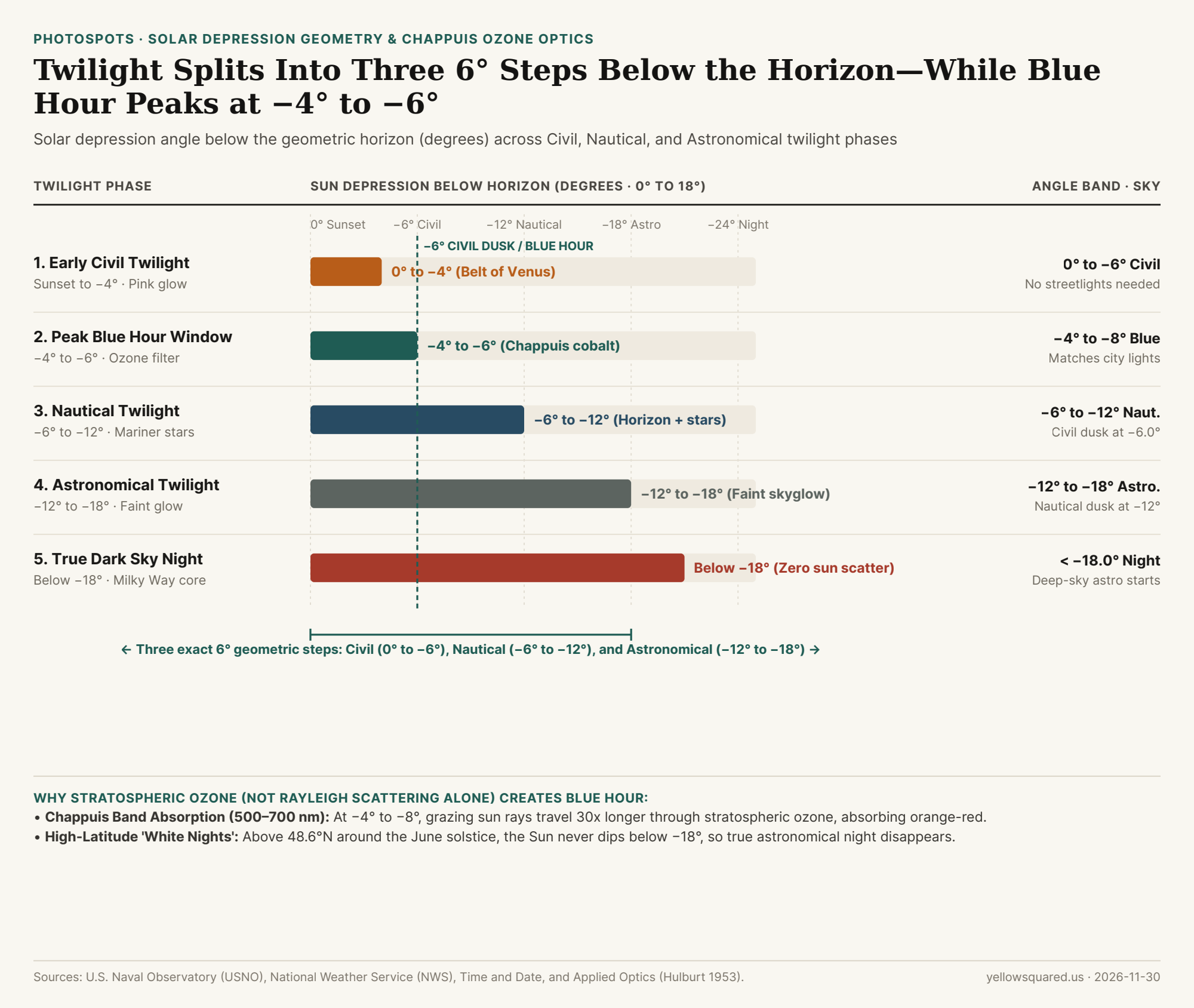
The Three 6-Degree Twilight Steps: Civil, Nautical, and Astronomical
Official sunrise and sunset occur when the upper limb of the Sun touches the horizon (when the Sun's geometric center sits at -0°50' due to 34' of atmospheric refraction plus the Sun's 16' semi-diameter). Once the Sun's center drops below the geometric horizon (0.0°), direct sunlight leaves the ground, but sunbeams continue to illuminate the stratosphere and mesosphere overhead. The three astronomical twilight stages divide that fade into 6° increments:
- 1. Civil Twilight (
0° to -6°Below the Horizon): From sunset until the Sun's center reaches-6.0°(ending at Civil Dusk, or beginning in the morning at Civil Dawn). Ambient scattered light remains bright enough to read outside and conduct outdoor activities without artificial lighting. In the first half (0° to -4°), looking away from the sunset reveals the pink-rose Belt of Venus arch hovering above Earth's rising dark-blue shadow wedge. Statutes frequently tie streetlamp activation, aviation VFR night rules, and hunting hours to Civil Dawn and Civil Dusk. - 2. Nautical Twilight (
-6° to -12°Below the Horizon): When the Sun sits between-6.0°and-12.0°. Named for classic sextant navigation at sea, this is the window where first- and second-magnitude navigation stars become clearly visible overhead while the line of the sea horizon is still distinct enough to measure star altitudes. On land, artificial lights dominate and landscape silhouettes lose unlit detail by-12°(Nautical Dusk). - 3. Astronomical Twilight (
-12° to -18°Below the Horizon): When the Sun sits between-12.0°and-18.0°. To the casual human eye in a city or suburb, the sky already looks completely black at-12°. However, faint scattered sunlight high in the upper atmosphere still washes out diffuse nebulae, galaxies, and the zodiacal light until the Sun drops past-18.0°(Astronomical Dusk), marking the start of true astronomical night.
Civil dusk (−6°) is when you need a headlamp on the trail; Nautical dusk (−12°) is when the sea horizon disappears; Astronomical dusk (−18°) is when the last solar glow leaves the Milky Way.
Why the Sky Turns Deep Cobalt During 'Blue Hour' (−4° to −8°)
Why doesn't the twilight sky simply fade from sunset orange to neutral gray? For decades, textbooks credited Rayleigh scattering alone (which scatters short blue wavelengths `~5.5x` more strongly than red). Yet in 1953, physicist E. O. Hulburt proved in the Journal of the Optical Society of America that Rayleigh scattering by itself would produce a pale yellowish-gray zenith at dusk. The rich, saturated royal blue of the Blue Hour (which spans roughly -4° to -8° and peaks between -4° and -6° right before Civil Dusk) is actually caused by Chappuis absorption in the stratospheric ozone layer (`15 to 35 km` altitude):
- The Grazing Ozone Path Length: When the Sun sits
4° to 6°below your horizon, its rays must travel nearly horizontally through hundreds of kilometers of the stratospheric ozone layer before scattering downward to your camera sensor. - The 500–700 nm Chappuis Band: Ozone is nearly transparent to blue light (
400–480 nm), but it possesses a broad absorption band—the Chappuis band between500 nm and 700 nm—that selectively swallows yellow, orange, and red photons over long grazing paths, acting as a giant natural cyan-blue optical filter across the zenith sky.
| Twilight / Lighting Phase | Solar Elevation Angle | Mid-Latitude Duration (40°N) | Atmospheric Optics & Sky Appearance | Photography & Navigation Use Case |
|---|---|---|---|---|
| Golden Hour (Low Sun) | +6.0° to 0.0° |
32 to 40 minutes | Rayleigh scattering strips blue; warm 3000K–4000K sun | Directional warm rim light and long soft shadows |
| Early Civil Twilight | 0.0° to -4.0° |
16 to 20 minutes | Pink-orange Belt of Venus opposite Earth's shadow | Pastel sky gradients; zero exposure clipping |
| Peak Blue Hour (Chappuis) | -4.0° to -6.0° |
8 to 12 minutes | Stratospheric ozone absorbs 500–700 nm orange-red | Cobalt sky matches 2700K city window exposure |
| Nautical Twilight | -6.0° to -12.0° |
26 to 32 minutes | Horizon line still visible alongside bright nav stars | Cityscapes transition to night; first star trails |
| Astronomical Twilight | -12.0° to -18.0° |
26 to 34 minutes | Sky looks dark to eye, but faint upper skyglow remains | Moonlit landscapes; faint Milky Way still washed |
| True Astronomical Night | Below -18.0° |
Until Astro Dawn | Zero scattered solar radiation in upper atmosphere | Deep-sky astrophotography & Milky Way core |
Why the −4° to −6° Window Is the 'Dynamic Range Sweet Spot' for Cityscapes
If you photograph a city skyline after Nautical Dusk (below -12°), the unlit sky is pitch black while illuminated office windows and neon signs are 10 to 14 stops brighter—causing either blown-out highlights or muddy shadows. Between -4° and -6° solar elevation (the final 10 minutes of Civil Twilight), the luminance of the Chappuis-filtered cobalt sky equals the luminance of warm 2700K–3200K architectural lighting on the ground, compressing the entire scene into a single 8-stop exposure with complimentary blue-and-gold color contrast. Also watch high latitudes in summer: anywhere above 48.56°N (`66.56° - 18°`, including Vancouver, London, Paris, and Berlin), the Sun never dips below -18° around the June solstice—meaning true astronomical night vanishes for weeks. To check exact Civil, Nautical, and Astronomical twilight timestamps and 3D sun paths offline at any location, Scout golden hour and blue hour angles in PhotoSpots.