
What Is the Inverse-Square Law in Lighting? (How Distance Controls Softbox Falloff)
Set up a studio softbox or an LED key light 1 meter (3.3 feet) from a portrait subject, meter the exposure on their face at f/16, and then pull the light stand back to 2 meters (6.6 feet). Intuition tells most beginners that doubling the distance should cut the brightness in half. Instead, your light meter drops by two full f-stops to f/8—meaning 75% of your light has vanished, leaving only 25% (one-quarter) of the original illumination on your subject's face. As documented in Wikipedia's physics derivation of the inverse-square law and studio photometry guides, this geometric rule governs every portrait, film set, and webcam setup: light intensity is inversely proportional to the square of the distance ($1 / d^2$).
Why does a beam of light lose 75% of its brightness when distance doubles, why do the standard f-stop numbers engraved on your camera lens (1.4, 2, 2.8, 4, 5.6, 8, 11, 16) give you an instant mental calculator for lighting distance, and how can you use the inverse-square law to turn a bright white wall into a dark charcoal backdrop? Here is the complete studio guide—and how to dial in your desk and studio light levels in Lumet.
Why Light Obeys $1 / d^2$: The 2D Pyramid of Expanding Rays
Why does doubling the distance divide light by four instead of two? Imagine a point source of light projecting a pyramid of rays through a 1 meter × 1 meter square window frame located at distance d = 1.0 m:
- At
1.0 MeterDistance ($d = 1$): All the light rays pass through an area of1 m x 1 m = 1 m². Illuminance is100%. - At
2.0 MetersDistance ($d = 2$): By similar triangles, the beam has expanded to twice the width (2 m) and twice the height (2 m). Those exact same photons are now spread across2 m x 2 m = 4 m²—so each square meter receives1/4(25.0%) of the light (a-2.0 EVf-stop loss). - At
3.0 MetersDistance ($d = 3$): The beam covers3 m x 3 m = 9 m², leaving1/9(11.1%) of the light. - At
4.0 MetersDistance ($d = 4$): The beam covers4 m x 4 m = 16 m², leaving just1/16(6.25%) of the light (a-4.0 EVf-stop loss).
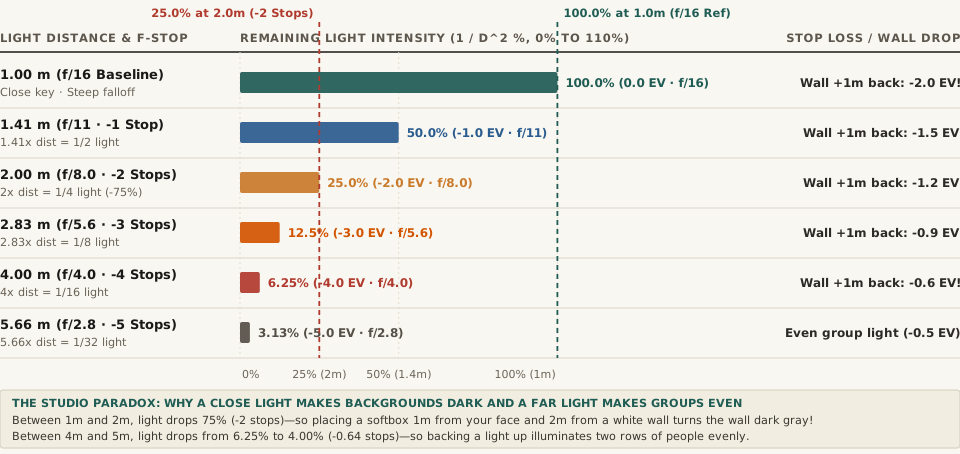
1 / d^2, as a percentage of a 1.0-meter baseline) and equivalent camera aperture stops across studio distances from 1.00 m to 5.66 m. Source: Wikipedia — Inverse-Square Law & Westcott Lighting Reference.The Photographer's Shortcut: Your Lens f-Stop Scale Is a Distance Calculator!
In photography and cinematography, one stop (1.0 EV) represents a halving (-50%) or doubling (+100%) of light. Because illuminance scales with $1/d^2$, the distance multiplier that cuts light in half is sqrt(2) = 1.414. Look at the sequence of powers of $\sqrt{2}$:
1.0 → 1.4 → 2.0 → 2.8 → 4.0 → 5.6 → 8.0 → 11 → 16
Those numbers are the exact f-stop scale printed on every camera lens! Every time you move a light from one number on the f-stop scale to the next number in meters (or feet), you lose exactly 1 stop of light:
- Move a light from
1.0 mto1.4 m=-1 stop(50%light remaining). - Move a light from
1.4 mto2.0 m=-1 stop(or-2 stopstotal from1.0 m,25%light remaining). - Move a light from
2.0 mto2.8 m=-1 stop(or-3 stopstotal from1.0 m,12.5%light remaining). - Move a light from
2.8 mto4.0 m=-1 stop(or-4 stopstotal from1.0 m,6.25%light remaining).
You never need a calculator to figure out inverse-square light loss on set: the standard f-stop numbers (1, 1.4, 2, 2.8, 4, 5.6, 8, 11) are powers of the square root of 2—so moving a light from 1.4 meters to 2.8 meters costs exactly 2 stops.
How to Control Background Darkness and Group Evenness With Light Distance
The most powerful application of the inverse-square law is not calculating your camera's ISO or f-stop—it is controlling how fast light falls off between your subject and the background (or between two people standing at different depths):
- Rule 1 — Close Key Light = Steep Falloff (Turns a White Wall Dark Gray): Suppose you are filming a video call or portrait in a small room with a white wall
1.5 metersbehind your chair. If you place your LED softbox0.5 meters(20 inches) from your face, the wall is2.0 metersfrom the light—4 times farther away than your face. By the inverse-square law, the wall receives(0.5 / 2.0)² = 1/16 = 6.25%of the light hitting your face (-4.0 stopsdarker), turning a bright white wall into a moody, dramatic dark gray backdrop with zero light spill! - Rule 2 — Far Key Light = Shallow Falloff (Lights a Group or Room Evenly): Now suppose you are photographing two people (or a subject and a background) separated by
1.0 meterof depth. If the light is at1.0 mfrom the front person and2.0 mfrom the rear person, the rear person gets only25%of the light (-2.0 stopsdark). Pull the light back to4.0 mfrom the front person (so the rear person is at5.0 m) and increase the light's power to expose the front person: now the rear person receives(4.0 / 5.0)² = 16/25 = 64%of the light—a difference of only-0.64 stops, making both people look evenly lit!
Complete Inverse-Square Law Distance, f-Stop & Background Falloff Table
The table below provides the exact percentage illuminance, EV stop loss, required aperture (from an f/16 baseline at 1.0 m), and 1-meter background falloff across studio distances (full dataset in inverse-square-law-lighting-distance-f-stop-loss-and-falloff-contrast.csv):
| Light-to-Subject Distance | Remaining Light (1/d^2) |
Light Lost vs. 1.0m |
Stop Loss (EV) |
Aperture (f/16 Ref) |
Drop to Wall +1m Behind Subject |
|---|---|---|---|---|---|
1.00 m (Baseline Close Key) |
100.0% |
0.0% |
0.0 EV |
f/16 |
-75.0% (-2.0 stops at 2.0m wall) |
1.41 m (sqrt(2) Distance) |
50.0% |
-50.0% |
-1.0 EV |
f/11 |
-65.6% (-1.5 stops at 2.41m wall) |
2.00 m (2x Distance) |
25.0% |
-75.0% |
-2.0 EV |
f/8.0 |
-55.6% (-1.2 stops at 3.0m wall) |
2.83 m (2*sqrt(2) Distance) |
12.5% |
-87.5% |
-3.0 EV |
f/5.6 |
-45.5% (-0.9 stops at 3.83m wall) |
4.00 m (4x Distance) |
6.25% |
-93.75% |
-4.0 EV |
f/4.0 |
-36.0% (-0.64 stops at 5.0m wall) |
5.66 m (4*sqrt(2) Distance) |
3.13% |
-96.88% |
-5.0 EV |
f/2.8 |
-27.9% (-0.47 stops at 6.66m wall) |
Setting up desk softbox illumination and Kelvin color balance for clean, natural skin tones on camera? Calibrate video call lighting in Lumet to match your screen light, distance falloff, and ambient room temperature in seconds.