
What Is the 'Moon Illusion'? Why the Moon Looks Huge on the Horizon (And How to Photograph It)
You are driving home at dusk when a glowing orange full Moon rises just above the distant hills and city skyline. To your eyes, the lunar disk looks colossal—easily twice as wide as it looks at midnight when floating high overhead. Excited, you pull over, hold up your smartphone or wide-angle camera, and snap a photo. When you look at your screen, the massive Moon your eyes are still staring at has shrunk into a microscopic white pinprick lost in an ocean of sky.
Why does the rising or setting Moon look enormous to human vision, yet refuse to show up large in a wide-angle photograph? Recorded since clay tablets in ancient Mesopotamia and analyzed by Aristotle (~330 BC), Ptolemy, Leonardo da Vinci, and Immanuel Kant, the Moon illusion is one of the most powerful perceptual tricks in nature. Even more astonishing: if you measure the Moon with a precision theodolite or telephoto lens, the horizon Moon is actually 1.5% smaller in true angular diameter than the overhead zenith Moon! Here is the astronomy, the neuroscience, and the exact telephoto distance math for capturing a giant Moon next to a landmark.
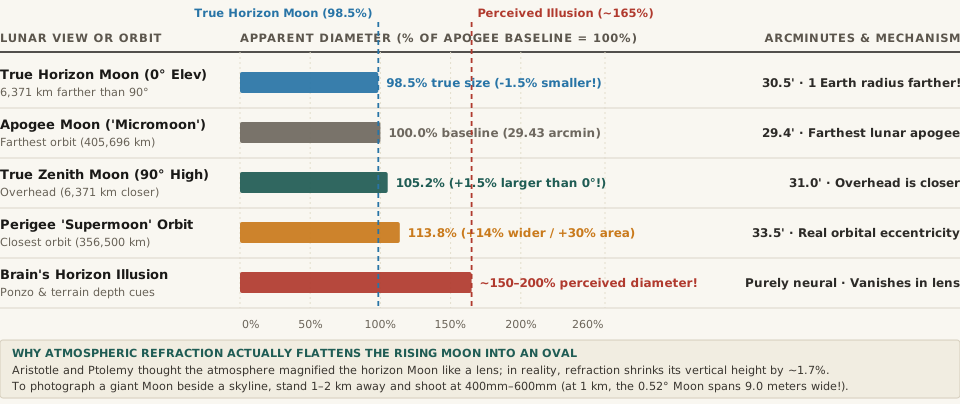
29.43 arcminutes), contrasting the 1.5% smaller physical horizon Moon against the +14% perigee Supermoon and the +50% to +100% perceptual Moon Illusion. Download the full dataset: moon-illusion-horizon-vs-zenith-angular-size-perigee-apogee-and-telephoto-scale.csv.1. Why the Horizon Moon Is Actually 1.5% Optically Smaller (And Squashed by Refraction)
When people first learn that the giant rising Moon is an optical illusion, their first guess is almost always atmospheric physics: “Doesn't the Earth's atmosphere act like a magnifying glass when you look through a thicker layer of air at the horizon?”
As proven by astronomers and detailed in Wikipedia's optical breakdown of the Moon illusion, the physical reality is the exact opposite in two ways:
- You Are 6,371 Kilometers (1 Earth Radius) Farther Away at Moonrise: When the Moon sits directly overhead at your local zenith (90° elevation), you are standing on the top of the Earth's sphere—roughly 6,371 km (3,959 miles) closer to the Moon than the center of the Earth. Six hours earlier, when the Moon was sitting on your eastern horizon (0° elevation), your viewing position was rotated 90 degrees to the side of the globe, making the Moon roughly 1.5% farther away (~384,400 km vs. ~378,029 km) and therefore 1.5% smaller in true angular diameter!
- Atmospheric Refraction Compresses the Moon Vertically (Into an Oblate Oval): Rather than magnifying the lunar disk laterally, differential atmospheric refraction bends light rays from the bottom limb of the rising Moon (closer to the horizon, passing through denser air) slightly more upward than rays from the top limb—squashing the vertical diameter of the horizon Moon by about 1.7% (roughly 0.5 arcminutes) while leaving its horizontal width unchanged.
You can prove this to yourself tonight without any camera gear: hold a small pea or aspirin tablet (8.4 mm / 0.33 inches wide) at arm's length (64 cm / 25 inches) with one eye closed. It will just barely eclipse the “giant” Moon on the horizon—and four hours later, when the Moon is high in the sky and looks tiny, that exact same pea at arm's length will cover it by the exact same margin (or view the horizon Moon upside-down between your legs, which immediately breaks the terrain context and shrinks the Moon by half!).
“When the Moon sits on the horizon, you are one full Earth radius (6,371 km) farther away from it than when it passes overhead—making the 'giant' rising Moon 1.5% optically smaller than the zenith Moon.”
2. How Your Visual Cortex Scales Up the Horizon Moon: Emmert's Law & Oculomotor Cues
If the image projected onto your retina is 0.52 degrees wide at both the horizon and the zenith, why does your visual cortex insist that the horizon Moon is 50% to 100% larger? As reviewed in Ross and Plug's The Mystery of the Moon Illusion and Royal Society psychophysical studies, two neural size-constancy mechanisms combine:
- The Flattened Sky Dome & Ponzo Distance Cues (Emmert's Law): Your brain's visual cortex calculates perceived physical size by multiplying an object's retinal angular size by its assumed distance (Perceived Size = Retinal Angle × Perceived Distance). When you look at the horizon across miles of receding buildings, trees, mountains, and cloud decks, rich perspective cues tell your subconscious visual system that the horizon lies very far away. When you crane your neck to look straight up into an empty, featureless sky vault, the lack of intermediate depth cues makes the sky dome feel much closer. Because both Moons subtend the same 0.52° retinal angle, your brain automatically scales up the “distant” horizon Moon just like the top bar in a Ponzo railroad-track illusion!
- Oculomotor Convergence and Relative Size Framing: When you gaze across a detailed horizon, your eyes focus at optical infinity, whereas staring into blank overhead darkness causes the eye's ciliary muscles to relax inward to a resting “dark focus” distance of just 1 to 2 meters (triggering oculomotor micropsia, which makes overhead objects look smaller). Simultaneously, seeing the 0.52° Moon framed right next to tiny distant house chimneys or treetops on the horizon (an Ebbinghaus relative-size contrast) reinforces its perceived scale.
3. How to Photograph a Giant Moon Next to a Landmark: The 9-Meters-Per-Kilometer Rule
Note carefully the difference between the nightly Moon Illusion (a 50–100% neural effect between horizon and zenith on the same night) and a real orbital Perigee “Supermoon” (which occurs when the full Moon coincides with the closest point of its elliptical orbit at ~356,500 km vs. ~405,696 km at apogee, producing a real +13.8% increase in angular diameter from 29.43 to 33.50 arcminutes, or +30% in disk area):
| Lunar Position, Orbit or Lens Setup | True Angular Size (Arcminutes) | Size vs. Apogee Baseline (%) | Image Width on 45MP Full-Frame Sensor | Physical, Optical or Perceptual Mechanism |
|---|---|---|---|---|
| True Horizon Moon (0° Elevation) | 30.50' (0.508°) | 98.5% (−1.5% smaller!) | 0.21 mm on 24mm (50 px) | Observer is 1 Earth radius (6,371 km) farther away at moonrise |
| Apogee Full Moon (“Micromoon”) | 29.43' (0.491°) | 100.0% Baseline | 0.21 mm on 24mm (49 px) | Farthest point in elliptical lunar orbit (~405,696 km) |
| True Zenith Moon (90° Overhead) | 30.96' (0.516°) | 105.2% (+1.5% vs. 0°) | 0.22 mm on 24mm (51 px) | Overhead observer is 6,371 km closer to the Moon |
| Perigee Full Moon (“Supermoon”) | 33.50' (0.558°) | 113.8% (+30% area) | 0.23 mm on 24mm (55 px) | Closest orbital perigee (~356,500 km); real physical size gain |
| Brain's Horizon Moon Illusion | 30.50' true | ~150%–200% perceived! | Neural cortex scaling | Ponzo terrain distance cues & oculomotor dark-focus shift |
| 400mm Telephoto (Subject at 1 km) | 31.00' (9.0 m wide @ 1 km) | 1,667% lens magnification | 3.61 mm on 400mm (830 px!) | Standing 1–2 km back shrinks the foreground landmark to match the Moon! |
The Photographer's Rule of 110 (9 Meters of Moon Width per Kilometer)
How do professional photographers capture those jaw-dropping viral photos where a rising full Moon looks as wide as a lighthouse, the Space Needle, or a mountain peak—without Photoshop compositing? Because the Moon's angular diameter is roughly 0.52 degrees (0.00908 radians, or ~1/110th of a radian), the Moon's apparent physical width compared to a foreground subject at distance D is simply:
Apparent Moon Width at Subject = D / 110 ≈ 9.08 meters per kilometer (or 48 feet per mile)
If you stand 50 meters from a 9-meter-wide lighthouse with a 24mm phone lens, the lighthouse fills your frame while the Moon (which never changes its 0.52° angle) is a tiny speck. But if you walk 1.0 kilometer (0.62 miles) back from the lighthouse and zoom in with a 400mm to 600mm telephoto lens, that 9-meter-wide lighthouse shrinks to the exact same 0.52-degree angular width as the Moon—so the rising Moon completely fills the frame behind the lighthouse, recreating on your camera sensor the exact dramatic scale your brain experiences during the Moon Illusion!
Line Up Moonrise Azimuths, Elevations, and Twilight in PhotoSpots
Because the rising Moon moves half a degree every two minutes and only looks balanced in exposure against a city skyline when moonrise occurs during civil twilight (15 to 25 minutes around sunset), nailing a 400mm telephoto Moon alignment requires knowing the exact compass bearing and elevation angle ahead of time. Track lighting ephemeris in PhotoSpots to calculate exact moonrise azimuths, golden-hour overlap windows, and shooting vectors for your next session.