
Why the 500 Rule Fails on Modern Cameras: How the NPF Rule Prevents Star Trails
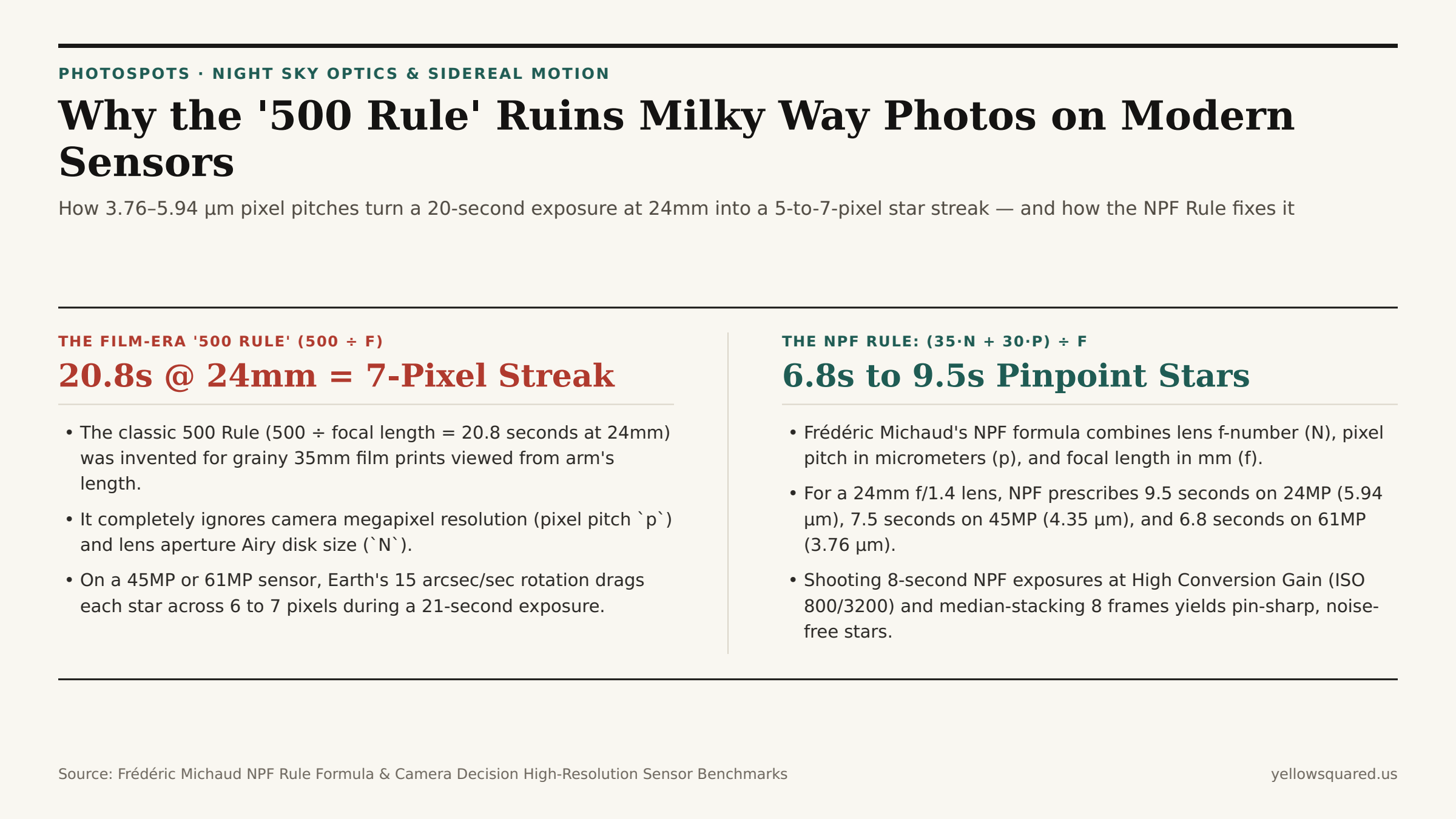
Every introductory astrophotography tutorial teaches the 500 Rule: divide 500 by your lens focal length (500 / 24mm = 20.8 seconds) to find the longest shutter speed you can use on a fixed tripod before Earth's rotation turns stars into streaks. Yet when you shoot a 20-second Milky Way exposure at 24mm on a modern 45-megapixel or 61-megapixel full-frame camera and zoom in, every star in the sky is stretched into an oblong, 6-to-7-pixel pill. The 500 Rule did not break because Earth spun faster — it broke because digital sensor pixels shrank to a fraction of the size of 1980s film grain.
To replace that outdated film-era heuristic with real optical physics, French amateur astronomer Frédéric Michaud derived the NPF Rule — an equation analyzed in Camera Decision's High-Resolution Sensor & NPF Rule Technical Analysis and Galactic Hunter's Astrophotography Comparison of the 500 Rule vs. NPF Rule. Before heading out for your next new-moon shoot, Plan dark-sky astrophotography shoots in PhotoSpots to align your NPF shutter window with galactic core rise times and azimuth angles.
The Sidereal Math: Why Pixel Pitch (p) and Aperture (N) Matter
As Earth completes one 360-degree sidereal rotation every 23 hours, 56 minutes, and 4 seconds, stars near the celestial equator drift across your stationary camera frame at an angular velocity of 15.04 arcseconds per second. How quickly that angular drift crosses from one pixel into its neighbor depends on three physical variables that Give the NPF Rule its name:
N— Lens Aperture (f-number): Because of wave diffraction and optical aberrations, a star is projected onto the sensor as an Airy disk whose diameter scales with f-number (N). A wider aperture (f/1.4) produces a tighter optical spot thanf/4, meaning star movement becomes visible sooner across adjacent pixels.p— Sensor Pixel Pitch (in micrometers, µm): A 12-megapixel full-frame sensor (like the Sony a7S III) has large 8.40 µm pixels, whereas a 45MP sensor (Nikon Z8 / Canon EOS R5) has 4.35 µm pixels and a 61MP sensor (Sony a7R V) has tiny 3.76 µm pixels. At 24mm focal length, a single3.76 µmpixel subtends just 3.23 arcseconds of sky — which means an equatorial star crosses an entire pixel every 0.215 seconds!f— Lens Focal Length (in millimeters): Longer focal lengths magnify angular motion linearly across the sensor plane.
Combining the Rayleigh Airy disk, Bayer demosaicing factor, and angular velocity near the celestial equator yields the standard Simplified NPF Formula (for full-frame or crop sensors alike, since pixel pitch p already accounts for pixel density):
t (seconds) = (35 × N + 30 × p) ÷ f
Why Stacking Eight 8-Second NPF Frames Beats One 20-Second Frame
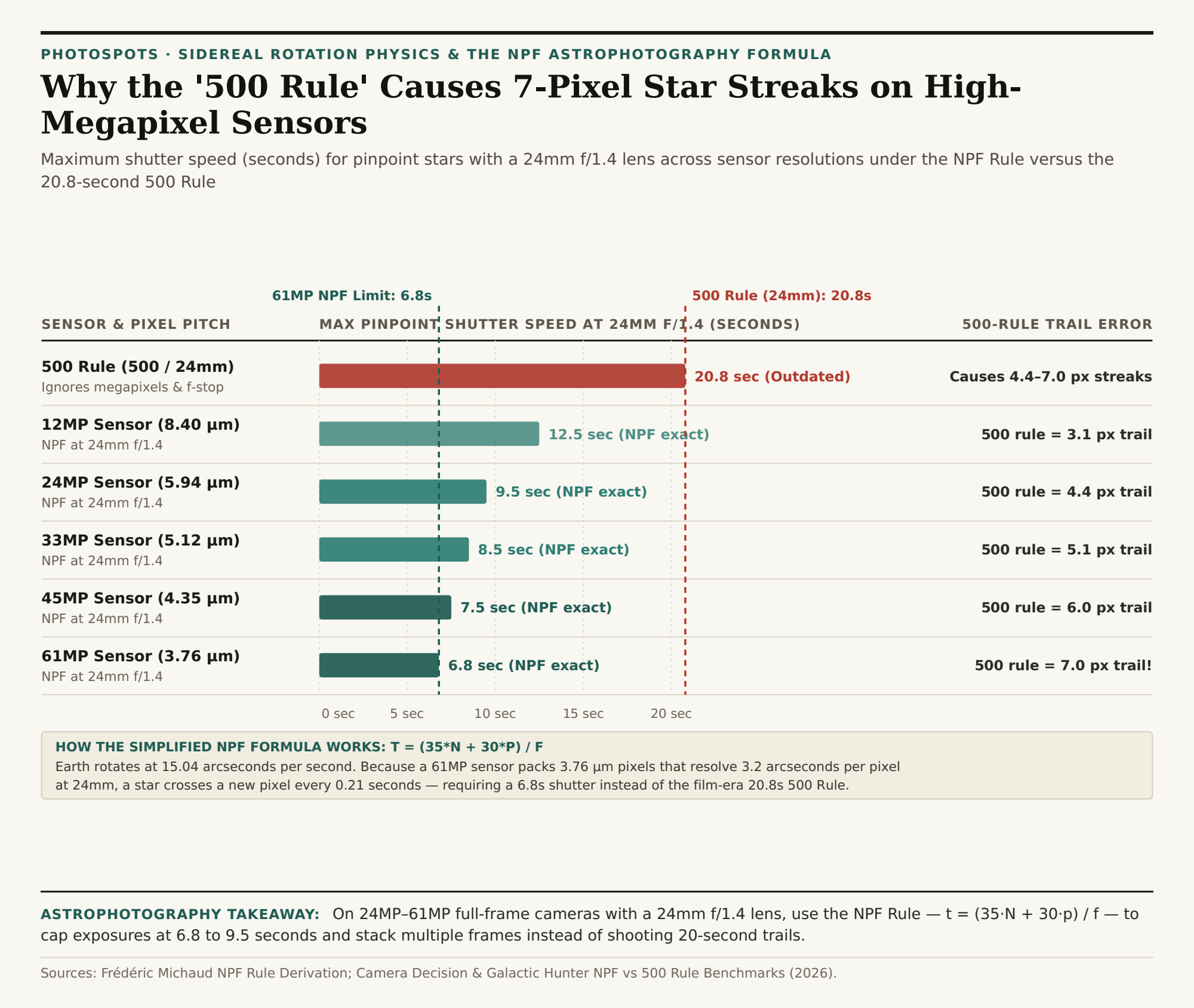
Plug a fast 24mm f/1.4 wide-angle lens into the NPF formula (t = (35 × 1.4 + 30 × p) / 24 = (49 + 30p) / 24) and compare the result against the 20.8-second 500 Rule across modern cameras:
- 12MP Full Frame (
p = 8.40 µm): NPF prescribes 12.5 seconds (500 Rulecauses a 3.1-pixel trail). - 24MP Full Frame (
p = 5.94 µm): NPF prescribes 9.5 seconds (500 Rulecauses a 4.4-pixel streak). - 45MP Full Frame (
p = 4.35 µm): NPF prescribes 7.5 seconds (500 Rulecauses a 6.0-pixel streak). - 61MP Full Frame (
p = 3.76 µm): NPF prescribes 6.8 seconds (500 Rulecauses a 7.0-pixel streak).
"Worried that cutting your exposure from 20 seconds to 8 seconds will make your Milky Way noisy? Shoot 6 to 8 consecutive 8-second NPF frames at your sensor's Dual Native HCG ISO (such as ISO 800 or 3200) and align-stack them in software: you collect 3x more total photons than a single 20-second exposure while keeping every star a 2-pixel pinpoint."
| Camera Sensor (at 24mm f/1.4) | Pixel Pitch (p) | 500 Rule Shutter | 500 Rule Star Trail | NPF Rule Shutter | NPF Star Footprint |
|---|---|---|---|---|---|
| 12MP Full Frame (a7S III) | 8.40 µm | 20.8 sec | 3.1 pixels (Mild oval) | 12.5 sec | 1.8 px (Pinpoint) |
| 24MP Full Frame (a7 IV / Z6 III) | 5.94 µm | 20.8 sec | 4.4 pixels (Visible trail) | 9.5 sec | 2.0 px (Pinpoint) |
| 33MP Full Frame (a7 IV) | 5.12 µm | 20.8 sec | 5.1 pixels (Oblong streak) | 8.5 sec | 2.1 px (Pinpoint) |
| 45MP Full Frame (Z8 / EOS R5) | 4.35 µm | 20.8 sec | 6.0 pixels (Severe streak) | 7.5 sec | 2.2 px (Pinpoint) |
| 61MP Full Frame (a7R V) | 3.76 µm | 20.8 sec | 7.0 pixels (7px streak!) | 6.8 sec | 2.3 px (Pinpoint) |
| 26MP APS-C (16mm f/1.4) | 3.76 µm | 20.8 sec (300: 18.8s) | 7.0 pixels (Severe streak) | 7.4 sec | 2.5 px (Pinpoint) |
Planning Moonless Galactic Core Windows
Because the Milky Way core rises in the southeast and arcs across the southern sky between March and October in the Northern Hemisphere, pairing an exact NPF shutter speed with dark-sky moon phase timing ensures maximum contrast on your stacked frames. Plan dark-sky astrophotography shoots in PhotoSpots and download the NPF vs. 500 Rule shutter-speed CSV dataset.