
Why Do We Underestimate How Long Tasks Take? The Planning Fallacy and Hofstadter's Law Explained
You sit down on Monday morning to scope a software feature, a research report, or a home renovation project. In your head, the steps look completely straightforward: you estimate three days under normal conditions, and to be extra conservative, you pad the schedule to five days as your “99%-certain worst-case scenario.” Yet Friday evening arrives and you are barely halfway done—even though you have written similar code or reports dozens of times before, and every single one of those past projects also took longer than you expected.
Why do smart, experienced professionals repeatedly underestimate task durations even when they know their past estimates were too optimistic? In 1979, two landmark works—psychologists Daniel Kahneman and Amos Tversky's paper introducing the Planning Fallacy and cognitive scientist Douglas Hofstadter's book Gödel, Escher, Bach introducing Hofstadter's Law—diagnosed this exact cognitive blind spot. Here is the empirical data from project-completion experiments and the three-step protocol that eliminates schedule overruns.
1. The 1979 Double Discovery: Kahneman & Tversky's Planning Fallacy and Hofstadter's Law
Remarkably, the two most famous formulations of human time-estimation failure were published in the exact same year (1979) from two different fields:
- The Planning Fallacy (Kahneman & Tversky, 1979): Working on intuitive judgment and decision-making under uncertainty (work later recognized with Kahneman's 2002 Nobel Memorial Prize in Economic Sciences and expanded with Dan Lovallo in 2003), Kahneman and Tversky defined the planning fallacy as the systematic tendency for people and organizations to underestimate the time, costs, and risks of future actions—even when they possess direct conscious knowledge that past tasks of the exact same nature took substantially longer than planned.
- Hofstadter's Law (Douglas Hofstadter, 1979): On page 152 of his Pulitzer Prize-winning book Gödel, Escher, Bach: An Eternal Golden Braid (originally discussing why computer chess researchers kept predicting a world-champion chess program was “10 years away” for decades until Deep Blue defeated Garry Kasparov in 1997), Hofstadter coined his famous self-referential law:
“Hofstadter's Law: It always takes longer than you expect, even when you take into account Hofstadter's Law.”
2. The Empirical Proof: Why 55% of People Miss Their Own “99%-Certain” Deadline
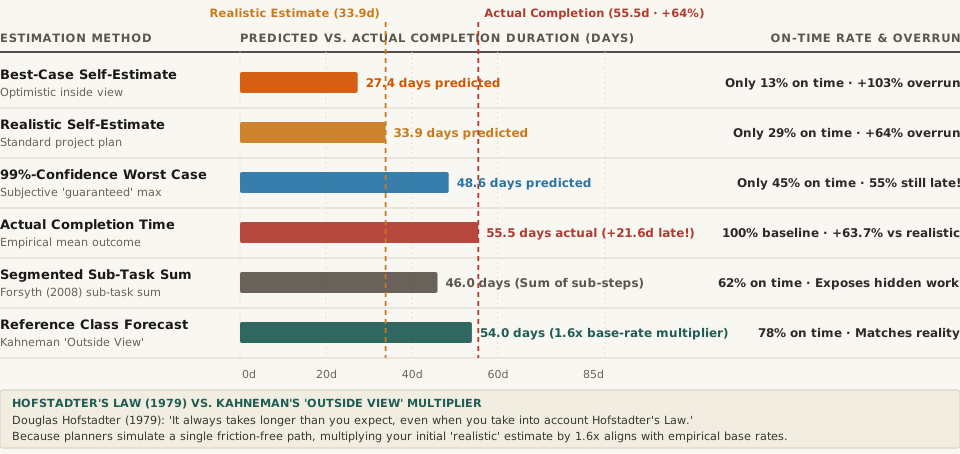
How severe is the Planning Fallacy when measured in controlled real-world studies? In a classic 1994 study by Roger Buehler, Dale Griffin, and Michael Ross (alongside confidence-interval replication studies cited in Wikipedia's review of empirical planning fallacy evidence), psychology researchers tracked university students completing their senior honors theses and asked them to estimate when they would finish under three distinct scenarios: if everything went as well as possible, their realistic expected date, and their worst-case date (even if everything went wrong).
The empirical gap between prediction and reality was staggering:
| Prediction Method or Confidence Level | Estimated vs. Actual Duration (Days) | Share Finished On Time (%) | Mean Schedule Overrun (%) | Empirical Study & Cognitive Mechanism |
|---|---|---|---|---|
| Best-Case “Everything Goes Right” | 27.4 days predicted | 13% (at P50 confidence) | +102.6% overrun | Buehler, Griffin & Ross (1994); focalism ignores all friction |
| Standard “Realistic” Self-Estimate | 33.9 days predicted | 29% on time | +63.7% overrun | Planners equate “realistic” with only slightly padded best-case |
| 99%-Confidence “Worst-Case” Estimate | 48.6 days predicted | 45% on time (55% missed!) | +14.2% mean overrun | Even at 99% subjective certainty, more than half missed their deadline! |
| Actual Empirical Completion Time | 55.5 days actual mean | 100% (Ground-truth outcome) | 0.0% (Actual baseline) | Took +21.6 days (+63.7%) longer than realistic estimate |
| Segmented Sub-Task Sum (Forsyth 2008) | 46.0 days (Sum of micro-steps) | 62% on time | +20.7% overrun | Decomposing into small sub-tasks exposes hidden integration work |
| Reference Class Forecast (Outside View) | 54.0 days (1.6× multiplier) | 78% on time | +2.8% variance | Kahneman & Flyvbjerg outside-view base-rate calibration |
Look closely at the third row: in confidence-calibration experiments, when participants gave a completion date they were 50% sure they would beat, only 13% finished on time; at 75% confidence, only 19% finished on time; and even when participants named a deadline they were 99% sure they would meet, only 45% actually finished on time (meaning a 99% subjective confidence interval was actually a 45% coin toss!).
3. Why Our Brains Ignore Past Overruns: Focalism and Asymmetric Attribution
Why doesn't experience automatically cure the Planning Fallacy? Cognitive psychology research points to three mechanisms that trap us in what Kahneman calls the “Inside View”:
- Focalism (Singular Scenario Simulation): When you estimate a future task, your brain constructs a single mental movie of the steps required to succeed. Because there is only one straightforward way for a project to go right, whereas there are thousands of low-probability ways for unexpected interruptions to occur (a sick child, a broken API dependency, a slow code review, a hardware bug), your mental simulation assigns near-zero weight to each individual disruption—even though the probability that at least one disruption occurs is nearly 100%.
- Self-Serving Asymmetric Attribution: When Buehler and colleagues asked people why their past projects ran late, participants blamed external, one-off flukes (“the server crashed that week,” “the client changed the spec”) and therefore discounted their own historical track record as unrepresentative of the next project.
- Memory Compression of Past Effort (Roy et al., 2005): Retrospective memory studies show that people also systematically remember past completed tasks as having taken less time than they actually logged on the calendar.
How to Beat the Planning Fallacy: Segmentation + The 1.6× Outside View
Two evidence-backed techniques reliably close the gap between planned and actual completion times:
- Exploit the Segmentation Effect (Forsyth, 2008): Never estimate a project that takes more than half a day as a single number. As shown in Forsyth's 2008 experiments on the segmentation effect, breaking a project into granular 30-to-90-minute sub-tasks (including setup, edge-case testing, formatting, and review) produces a sum that is dramatically closer to actual duration than a holistic top-down guess.
- Apply Reference Class Forecasting (The 1.6× Multiplier): Switch from the Inside View (simulating today's task steps) to Kahneman and Bent Flyvbjerg's Outside View: look up the actual calendar duration of your last 5 to 10 similar tasks, compute your empirical overrun ratio (in Buehler's study, 55.5 / 33.9 = 1.64×), and multiply your realistic estimate by that base-rate factor before committing to a deadline.
Calibrate Your Personal Estimation Multiplier and Daily Streaks in Timeli
The fastest way to replace optimistic inside-view guesses with accurate reference-class data is to log your daily execution blocks and see how many sessions each milestone actually requires over time. Track habit automaticity curves on Timeli to turn ambitious multi-week projects into repeatable daily execution streaks with zero deadline slippage.