
What Is the Planning Fallacy? How to Estimate Project Deadlines Without Running Late
What Is the Planning Fallacy? How to Estimate Project Deadlines Without Running Late
First coined by Daniel Kahneman and Amos Tversky in 1979 and quantified by Buehler, Griffin, and Ross in 1994, the planning fallacy shows that tasks take 64% longer than our 'realistic' estimate (55.5 vs. 33.9 days)—exceeding even our '99% worst-case' forecast.
Ask an experienced software engineer, writer, or architect how long a familiar project will take—even one they have completed ten times before—and a predictable comedy unfolds: they break the work down into logical steps, estimate three weeks, add an extra week as a "safety buffer," and ultimately finish in five and a half weeks.
In behavioral economics, the systematic tendency to underestimate task completion times despite knowing that past projects ran over is called the planning fallacy. First formulated by Nobel laureate Daniel Kahneman and Amos Tversky in 1979, and tested in a landmark 1994 field study by psychologists Roger Buehler, Dale Griffin, and Michael Ross, the planning fallacy is not a character flaw—it is a structural byproduct of how human memory simulates the future.
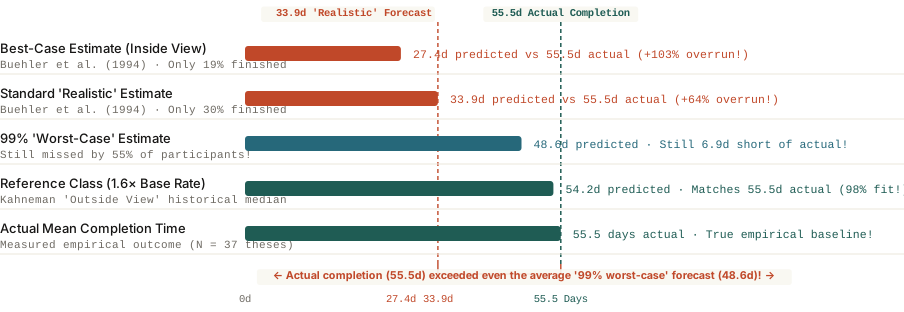
The 1994 Buehler Study: Why Even '99% Worst-Case' Estimates Fail
In their famous 1994 experiment published in the Journal of Personality and Social Psychology, Buehler, Griffin, and Ross asked senior psychology students to estimate when they would finish their honours thesis under three scenarios:
- Best-Case Estimate (`"If everything goes as well as it possibly can"`): Averaged `27.4 days` (only `19%` finished by this date).
- Realistic Prediction (`"Your standard expected completion date"`): Averaged `33.9 days` (only `30%` finished on time!).
- 99% Worst-Case Estimate (`"Even if almost everything goes wrong"`): Averaged `48.6 days`.
- Actual Measured Completion Time: Averaged `55.5 days` (`+64%` longer than the realistic estimate!)—meaning more than half (`55%`) of the participants blew past even their 99% worst-case deadline.
Why did intelligent people who had written dozens of papers miss their own 99% confidence interval? Because when asked to estimate a deadline, the human brain defaults to what Kahneman and Tversky called the "Inside View": you mentally visualize the specific steps required to finish the project. Because your mental movie contains only the task itself—and omits the unknown future interruptions (a sick child, an urgent production bug, a slow API review, or a crashed laptop)—your "Inside View" simulation is secretly a **best-case scenario in disguise**.
Your brain plans as if your current project exists in a vacuum; your calendar executes in a world full of competing priorities.
How to Cure the Planning Fallacy: The 'Outside View' (1.6× Rule)
Instead of trying harder to imagine every possible obstacle inside a project, Kahneman and infrastructure economist Bent Flyvbjerg proved that accurate estimation requires switching to the "Outside View" (Reference Class Forecasting):
- Find Your Historical Reference Class: Ignore the unique details of today's task and look at the raw calendar duration of your last 5 to 10 similar deliverables (including all the context switches, meetings, and review delays that occurred alongside them).
- Apply the Empirical Overrun Multiplier (`1.5× to 1.65×`): In Buehler et al.'s study, actual time divided by realistic predicted time was `55.5 ÷ 33.9 = 1.64×`. If your inside-view gut says a feature or report will take `10 days`, multiply by `1.6×` (`16 days`) before committing to an external deadline.
- Estimate in Uninterrupted Deep-Work Blocks, Not Calendar Days: A task that takes "12 hours of coding" does not take 1.5 workdays—because meetings and messaging leave most knowledge workers with only `2.5 to 3 hours` of uninterrupted focus per day (`12 hours ÷ 2.5 hrs/day = 5 full workdays`).
To measure your real deep-work capacity per day and calibrate your personal estimation multiplier against actual execution data, you can Block uninterrupted deep-work windows in Timeli before committing to your next sprint deadline.