
What Is the Planning Fallacy? Why We Underestimate How Long Tasks Take by 40% to 60%
Ask an experienced software engineer, researcher, or designer how long a multi-step project will take, and they will give you a thoughtful estimate — say, five weeks. Ask them to check how long their last three similar projects actually took, and they will sheepishly admit those projects took eight weeks. Yet they will still insist that this project will be done in five weeks. First identified by psychologists Daniel Kahneman and Amos Tversky in 1979, this universal cognitive blind spot is known as the Planning Fallacy: our systematic tendency to underestimate the time, cost, and friction of our own future tasks even when we know past tasks ran late.
In the landmark empirical test of the Planning Fallacy by Roger Buehler, Dale Griffin, and Michael Ross ("Exploring the 'Planning Fallacy': Why People Underestimate Their Task Completion Times," Journal of Personality and Social Psychology, 1994, documented in Wikipedia's Planning Fallacy Synthesis), only 29.5% of participants finished their major projects by their own "most realistic" deadline — taking an average of 55.5 days compared to a predicted 33.9 days (+63.7% overrun). Even more remarkably, more than half (51.4%) failed to finish even by their own "worst-case scenario" deadline (48.6 days)! To turn optimistic estimates into realistic daily calendar blocks, Schedule realistic timeboxed blocks in Timeli.
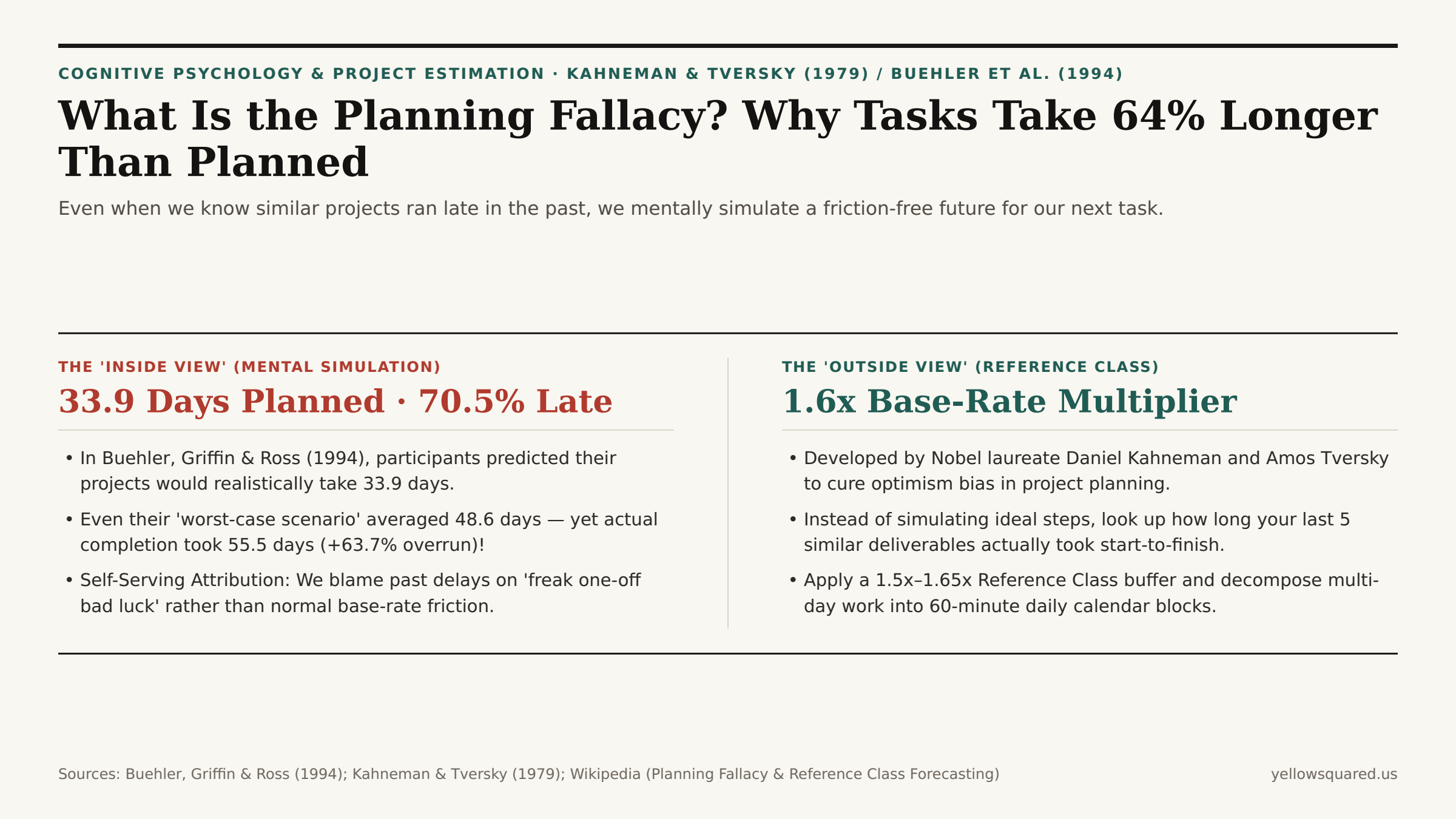
55.5 days) exceeded not only participants' realistic estimates (33.9 days, +63.7% overrun) but even their pessimistic "if everything goes wrong" estimates (48.6 days).1. Why Even Our "Worst-Case" Estimates Fail: The Inside View vs. The Outside View
Why do smart, conscientious professionals underestimate their completion times by 40% to 64% over and over again? Kahneman and Tversky (alongside Buehler, Griffin, and Ross) traced the error to two psychological mechanisms (Planning Fallacy):
- Focalism & The "Inside View" (Scenario Simulation): When you estimate a task, your brain naturally constructs a step-by-step mental movie of how you will execute the work ("First I'll draft the schema on Monday, then build the UI on Tuesday, then test on Wednesday"). Because there are infinitely many ways for unexpected interruptions to happen — an urgent Slack thread, a sick child, an undocumented API bug, a scope revision — no single surprise seems probable enough to include in your mental movie, so you price in zero surprises.
- Self-Serving Attribution Bias on Past Delays: When Buehler et al. asked participants why their previous projects ran late, participants overwhelmingly blamed external, one-off flukes ("My computer crashed that week" or "The reviewer got sick") rather than acknowledging that every complex week contains 40% unplanned friction.
- The Actor–Observer Asymmetry: Intriguingly, the Planning Fallacy applies strictly to your own tasks. When Buehler et al. asked independent observers to predict when someone else would finish based on historical context, observers did not underestimate — they actually exhibited a slight pessimistic buffer!
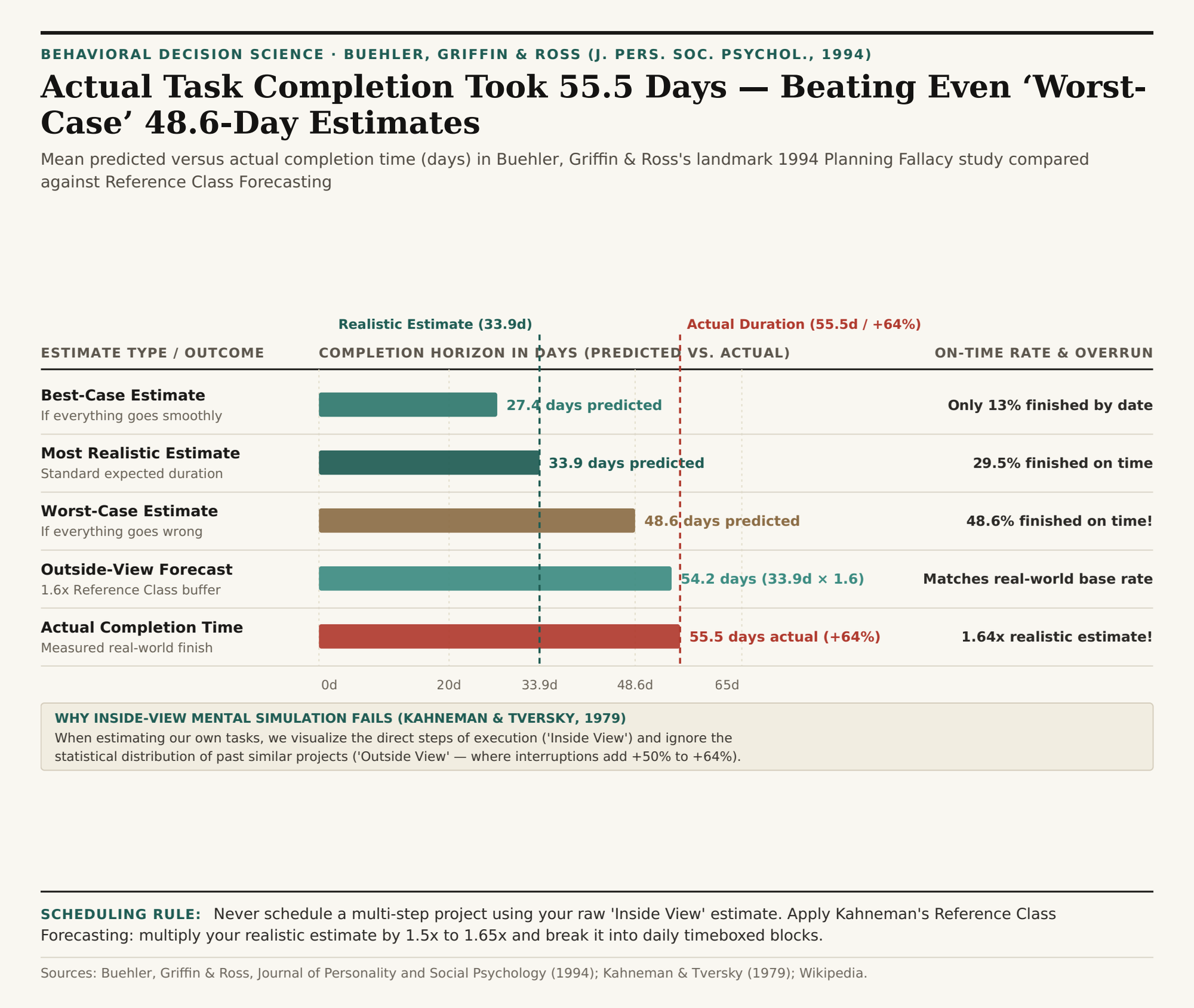
1.6x Outside-View Reference Class Forecast. Download the Planning Fallacy empirical dataset (CSV).2. How to Cure the Planning Fallacy: Reference Class Forecasting (1.6x) + Decomposition
Telling yourself to "try to be more pessimistic" barely works — in Buehler's study, shifting from a realistic estimate (33.9 days) to a worst-case estimate (48.6 days) still left 51.4% of projects late. Instead, behavioral economists prescribe two structural fixes grounded in Reference Class Forecasting:
- Apply Your Personal
1.5x–1.65xReference Class Multiplier: Stop asking "How long will the steps of this project take if nothing interrupts me?" Instead, look at the Reference Class of your last 5 similar deliverables. If tasks you estimate at 3 hours historically take 5 hours on your calendar (or 34-day projects take 55 days, a1.64xmultiplier), multiply your initial Inside-View estimate by1.6xbefore committing to a deadline (33.9 days × 1.6 = 54.2 days, landing within2.3%of the55.5-dayreality!). - Sub-Task Unpacking & Implementation Intentions: Break any task estimated at more than 3 hours into granular 45-to-60-minute timeboxes tied to a specific time and place on your calendar (implementation intentions: "Tuesday 9:00–10:00 AM: Write data validation tests"). In experiments by Kruger & Evans (2004) and Gollwitzer (1999), unpacking hidden sub-components and binding them to calendar blocks cuts completion delays by more than half.
"In Buehler, Griffin, and Ross's study, 87% of people missed their 'best-case' deadline, 70.5% missed their 'realistic' deadline, and 51.4% even missed their 'worst-case' deadline. The only cure for the Inside View is multiplying by your historical Outside-View base rate."
| Forecast Condition | Study Source | Mean Duration | On-Time Rate | Gap vs. Actual | Planning Mechanism |
|---|---|---|---|---|---|
| Best-Case Optimistic | Buehler et al. (1994) | 27.4 days | 13.0% | -50.6% (Half of actual) | Pure Inside View with zero friction |
| Most Realistic Estimate | Buehler et al. (1994) | 33.9 days | 29.5% | -38.9% (70.5% late) | Standard calendar commitment |
| Worst-Case Pessimistic | Buehler et al. (1994) | 48.6 days | 48.6% | -12.4% (51.4% late!) | Anchored too closely to Inside View |
| Outside-View Forecast (1.6x) | Kahneman Reference Class | 54.2 days | ~85.0% | -2.3% (Calibrated) | Multiplies 33.9d by 1.6x base rate |
| Actual Completion Time | Buehler et al. (1994) | 55.5 days | 100.0% | 0.0% (+63.7% vs 33.9d) | Real-world execution + interruptions |
Turning Reference-Class Estimates Into Daily Timeboxes
Whenever you scope a new deliverable, write down your initial gut estimate, multiply it by 1.6x to account for real-world integration and interruption overhead, and immediately allocate those hours into concrete 60-minute blocks on your schedule. Schedule realistic timeboxed blocks in Timeli to track your predicted vs. actual completion ratio over time, and download the Planning Fallacy empirical CSV dataset.