
Does the 25-Minute Pomodoro Technique Actually Work? (25/5 vs. 52/17 vs. 90-Minute Blocks)
In the late 1980s, an Italian university student named Francesco Cirillo was struggling to focus on his sociology and computer science textbooks. Picking up a mechanical, tomato-shaped kitchen timer (pomodoro is the Italian word for tomato), he challenged himself to study for just 10 uninterrupted minutes—and eventually settled on the interval that became the world's most famous productivity system: the Pomodoro Technique, built around 25 minutes of single-task focus followed by a 5-minute break (and a longer 15 to 30-minute break after every four pomodori). Decades later, millions of students and knowledge workers swear by the 25/5 timer—while just as many software engineers and writers complain that a 25-minute alarm rings right as they finally get into "the zone."
Why does a 25-minute countdown work like magic when you are procrastinating on a dreaded task, why does that same 25-minute cutoff backfire during complex architecture or long-form writing, and how do you choose between 25/5, 52/17, and 90/20 focus blocks? Here is the cognitive ergonomics breakdown—and how to log and analyze your focus intervals in Timeli.
How the Classic 25/5 Pomodoro Architecture Works (Cirillo's 5 Rules)
As documented in Wikipedia's overview of the Pomodoro Technique, Cirillo's original methodology is more than just setting an alarm; it is a strict single-tasking protocol designed to eliminate internal and external context switches:
- One Atomic Unit (
1 Pomodoro = 25 Minutes Work + 5 Minutes Rest): A pomodoro is indivisible—there is no such thing as "half a pomodoro." If you abandon the task to check a message at Minute 14, the pomodoro is voided and reset. - The "Inform, Negotiate, Call Back" Interruption Shield: When an internal distraction pops into your head (e.g., "I need to pay that invoice") or a colleague interrupts you, you jot it on an Unplanned & Urgent inventory sheet and immediately return to the current 25-minute block until the bell rings.
- The 4-Pomodoro Set Reset (
2 Hours = 100 Min Work + 30–45 Min Rest): After completing four consecutive 25/5 cycles, you take a longer15 to 30-minuterestorative break away from your desk to clear working-memory fatigue.
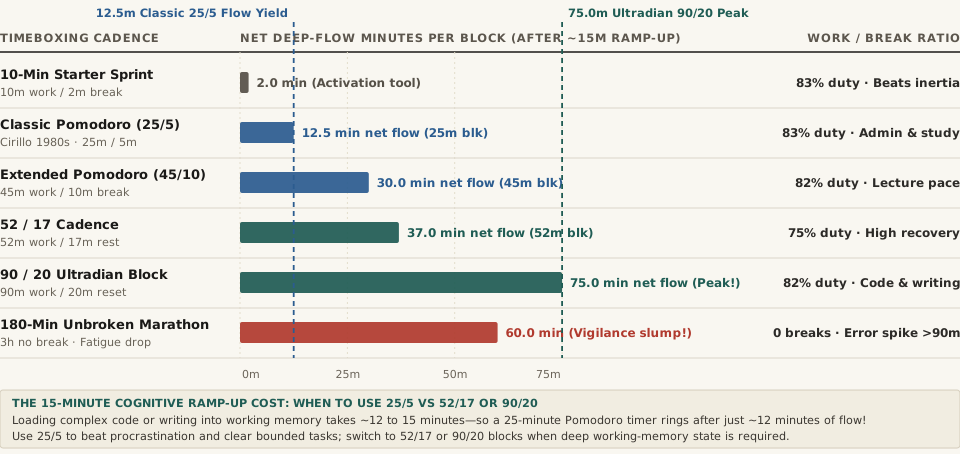
25/5 Pomodoro sprints, 52/17 intervals, and 90/20 ultradian blocks. Source: Wikipedia — Pomodoro Technique & Francesco Cirillo.The Cognitive Tradeoff: Activation Friction vs. Ramp-Up Overhead
Why do some tasks thrive on 25/5 while others stall? Because every cognitive task carries two opposing forces—activation friction (how hard it is to start) and context-loading ramp-up time (how long it takes to load the problem into working memory):
- When Activation Friction Is High (Procrastination, Admin, Studying, Bug Triage) → Use
25/5: When a task feels overwhelming or tedious, your brain triggers task-aversion resistance because it perceives an endless, unbounded slog. Promising yourself "I only have to work on this for 25 minutes until the bell rings" shrinks the psychological horizon, while the 5-minute break prevents time-on-task vigilance decay and boosts spaced memory consolidation. - When Context-Loading Ramp-Up Is High (Software Architecture, Math, Long-Form Writing) → Use
52/17or90/20: Workplace interruption studies show that loading a complex codebase, financial model, or multi-section argument into human working memory takes roughly12 to 15 minutes. If your timer forces a mandatory stop at Minute 25, you spend the first 13 minutes warming up and get only~12 minutesof peak flow before the alarm breaks your concentration!
A 25-minute Pomodoro solves the hardest part of productivity—starting—by shrinking the horizon to 25 minutes; but once you are inside a complex codebase that takes 15 minutes to load into working memory, a 52/17 or 90/20 block gives you 3x to 6x more net deep-flow time per session.
How to Scale Timeboxing: The 3-Tier "Adaptive Pomodoro" System
Instead of forcing every task into a single timer length, high-output engineers, researchers, and writers match the interval to the cognitive mode:
- Tier 1 — The
10/2or25/5Ignition Block (83.3%Duty Cycle): Use for morning startup when you feel resistance, clearing email/PR reviews, studying flashcards, or breaking down a vague project into concrete sub-tasks. - Tier 2 — The
52/17Sustainable Work Cadence (75.4%Duty Cycle): Popularized by empirical time-tracking analyses of top-decile knowledge workers, 52 minutes provides nearly37 minutesof post-ramp-up flow followed by a genuine 17-minute walk or screen-free reset. - Tier 3 — The
90/20Ultradian Deep-Work Block (81.8%Duty Cycle, or "Triple Pomodoro"): Aligns with Nathaniel Kleitman's 90-minute Basic Rest-Activity Cycle (BRAC), delivering75 minutesof uninterrupted deep flow before cognitive vigilance drops (whereas pushing past 90 minutes into a 3-hour unbroken marathon leads to rising error rates and afternoon exhaustion).
Complete Comparison Table of Focus Timeboxing Cadences
The table below compares work/break durations, duty cycles, context-loading overhead, and net deep-flow yield across six focus cadences (full dataset in pomodoro-25-5-vs-52-17-and-90-minute-focus-block-cadences.csv):
| Focus Timeboxing Cadence | Work Sprint | Break Length | Work Duty Cycle | Ramp-Up Cost | Net Deep-Flow Yield & Best Use Case |
|---|---|---|---|---|---|
10-Minute Micro-Sprint (10/2) |
10 min |
2 min |
83.3% |
Low-context tasks | ~2 min flow; beats severe task-initiation inertia |
Classic Pomodoro (25/5) |
25 min |
5 min (15–30m / 4) |
83.3% (76.9% net) |
~12.5 min |
12.5 min flow; best for study, admin & bounded tasks |
Extended Pomodoro (45/10) |
45 min |
10 min |
81.8% |
~15.0 min |
30.0 min flow; matches academic lecture cadence |
| 52 / 17 Empirical Cadence | 52 min |
17 min |
75.4% |
~15.0 min |
37.0 min flow; high recovery prevents afternoon slump |
| 90 / 20 Ultradian Deep Work | 90 min |
20 min |
81.8% |
~15.0 min |
75.0 min flow; ideal for coding, math & deep writing |
| 180-Min Unbroken Marathon | 180 min |
0 min |
100% nominal |
Fatigue after 90m |
~60.0 min effective; vigilance decay & error spike |
Want to log your focus blocks with one tap and see whether 25-minute sprints or 90-minute deep-work sessions fit your daily rhythm best? Track habit automaticity curves on Timeli to build consistent, high-focus daily routines.