
What Is the Sunny 16 Rule in Photography? How to Calculate Daylight Exposures Without a Light Meter
Long before digital cameras introduced multi-zone matrix metering and real-time histograms, photojournalists, mountaineers, and cinema crews relied on a simple physical invariant of Earth’s atmosphere: on a cloudless day with the sun at least 30° above the horizon, direct solar illuminance on a front-lit subject is virtually constant across mid-latitudes at approximately 80,000–100,000 lux, corresponding to an Exposure Value of EV100 = 15. That physical constant gives rise to the Sunny 16 rule: set your aperture to f/16 and your shutter speed to the reciprocal of your ISO (1 / ISO seconds)—and your highlights and midtones will be accurately exposed without a light meter.
Even on modern mirrorless cameras, knowing the Sunny 16 ladder alongside solar elevation forecasts in PhotoSpots solves the single biggest failure mode of built-in camera meters: reflected-light calibration bias on snow, white beach sand, bridal gowns, and dark forest canopies.
The Photometric Math Behind EV100 = 15 and Reciprocal Shutter Speeds
In photographic sensitometry (standardized under ISO 2720), Exposure Value (EV) is a base-2 logarithmic scale combining lens relative aperture (f-number N) and exposure time (t in seconds):
- The Exposure Value Equation: At ISO 100,
EV100 = log2(N2 / t). Each +1 integer step in EV represents a doubling of scene luminance (or a halving of sensor exposure). - Checking the Sunny 16 Plug-In: Set
N = 16(soN2 = 256) and set shutter speed to the nearest standard mechanical click for ISO 100,t = 1/125 s. ThenN2 / t = 256 / (1/125) = 32,000. Sincelog2(32,768) = 15.00,f/16at1/125 s(or1/100 s) equals exactlyEV100 = 14.97 ≈ 15.0. - Scaling Across Any ISO: Because doubling ISO halves the required photon exposure, increasing sensitivity from ISO 100 to ISO 400 (+2 stops) at
f/16simply shifts the shutter speed from1/100 sto1/400 s(1/500 s).
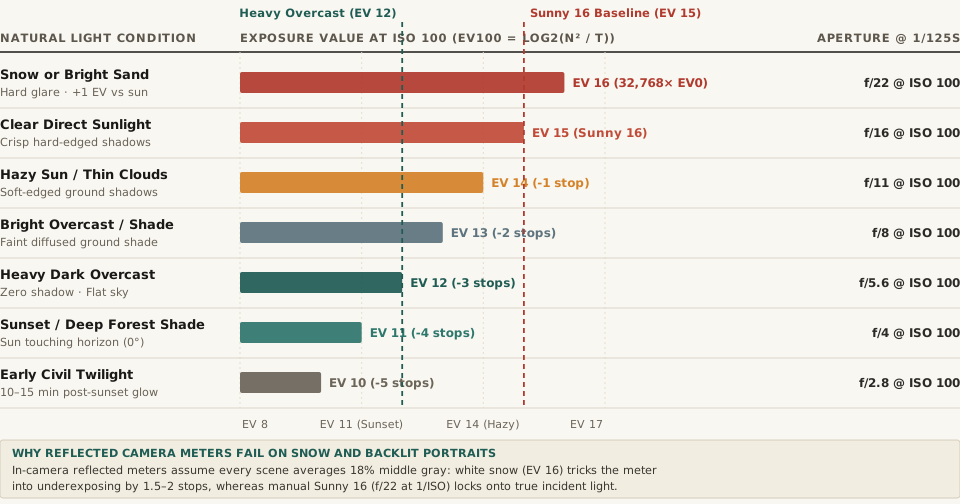
EV100) and matching aperture at 1/125 s across seven natural outdoor lighting conditions. Download the full field exposure table in sunny-16-exposure-value-ev100-ambient-light-chart.csv.The Complete Outdoor Daylight & Shadow-Edge Exposure Table
You do not need to guess cloud density by looking up at the sky—instead, look down at the sharpness of the shadow edges cast on the ground. Every stop of atmospheric scattering softens shadow boundaries in a predictable step from EV 16 down to EV 10:
| Outdoor Lighting Condition | Field Rule Name | EV100 | Aperture @ 1/ISO Shutter | Shutter @ ISO 100 | Equivalent @ f/8 (ISO 100) | Ground Shadow Edge Diagnostic |
|---|---|---|---|---|---|---|
| Snow or White Beach Sand | Glare / Snow f/22 |
16.0 |
f/22 | 1/100 s (1/125 s) |
1/1000 s |
Hard shadows + bright surface albedo (+1 EV) |
| Clear Direct Daylight Sun | Sunny 16 Baseline | 15.0 |
f/16 | 1/100 s (1/125 s) |
1/500 s |
Crisp, hard-edged dark shadows on ground |
| High Thin Cirrus / Hazy Sun | Slightly Overcast f/11 |
14.0 |
f/11 | 1/100 s (1/125 s) |
1/250 s |
Soft-edged, fuzzy but distinct shadows |
| Open Shade / Bright Overcast | Overcast f/8 |
13.0 |
f/8 | 1/100 s (1/125 s) |
1/125 s |
Faint, diffused or barely visible shadow |
| Heavy Dark Overcast / Storm | Heavy Overcast f/5.6 |
12.0 |
f/5.6 | 1/100 s (1/125 s) |
1/60 s |
Zero directional shadow; flat sky dome |
| Sunset / Deep Canopy Shade | Sunset / Shade f/4 |
11.0 |
f/4 | 1/100 s (1/125 s) |
1/30 s |
Sun touching horizon (0° altitude) |
| Early Civil Twilight / Dusk | Twilight f/2.8 |
10.0 |
f/2.8 | 1/100 s (1/125 s) |
1/15 s |
10–15 min post-sunset ambient sky glow |
“Your camera’s built-in meter measures reflected light and tries to turn white snow into 18% middle gray—underexposing winter scenes by 1.5 to 2 stops. Sunny 16 (f/22 on snow, f/16 in sun) acts as a virtual incident meter that never gets fooled by subject reflectance.”
Three Field Adjustments Every Photographer Should Memorize
You rarely want to shoot every daylight frame stopped down to f/16 (where lens diffraction begins softening micro-contrast on high-megapixel full-frame and APS-C sensors). Here is how to apply Sunny 16 dynamically:
- Trading Aperture for Shutter Speed (Law of Reciprocity): Suppose you are shooting a portrait in direct midday sun (
EV100 = 15) at ISO 100, and you want shallow depth of field atf/2.8instead off/16. Count the full aperture stops fromf/16down tof/2.8:f/11 → f/8 → f/5.6 → f/4 → f/2.8equals 5 stops wider (+5 EV of light). Compensate by shifting your shutter speed 5 stops faster from1/125 s:1/250 → 1/500 → 1/1000 → 1/2000 → 1/4000 s. Thusf/2.8at1/4000 sgives the exact same exposure asf/16at1/125 s. - Backlit Subjects and Side-Lighting (+1 to +2 Stops): Sunny 16 assumes the sun illuminates the front of your subject. If your subject is side-lit (half in sun, half in shadow), open up +1 stop (to
f/11); if your subject is backlit with their face in shadow against bright sun, open up +2 stops (tof/8, matching the Open Shade row). - Golden Hour Solar Altitude Decay: Once the sun drops below
15°elevation during the final hour before sunset, atmospheric air mass increases rapidly, reducing direct illuminance by 1 stop roughly every 15–20 minutes until reachingEV100 = 11(f/4at1/125 s) right at sunset.
Planning an outdoor shoot and want to check exact golden-hour, blue-hour, and solar-elevation windows before you pack your lenses or neutral-density filters? Open PhotoSpots to map sun angles and natural light timing for your location, or explore our photography planning guides.