
What Is the Sunny 16 Rule? How to Meter Daylight Without a Light Meter
What Is the Sunny 16 Rule? How to Meter Daylight Without a Light Meter
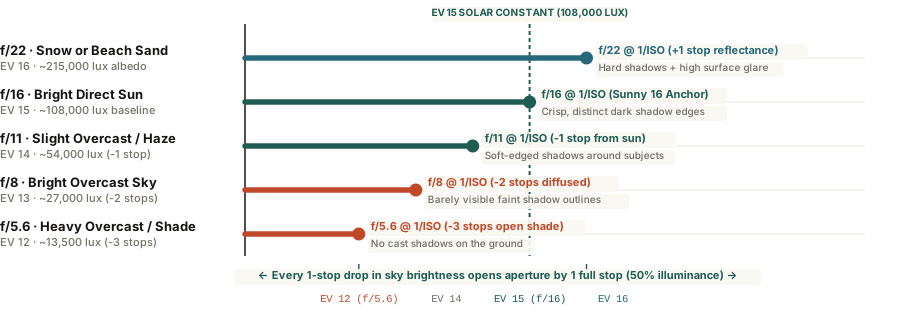
Because direct midday sunlight at sea level delivers a constant ~108,000 lux (EV 15 at ISO 100), setting your aperture to f/16 and your shutter speed to 1/ISO yields an exact incident exposure—scaling down one f-stop for each step of cloud cover.
Every modern digital camera packs a sophisticated multi-zone reflective light meter, yet experienced landscape, street, and film photographers still run into scenes where automatic metering fails dramatically. Point your camera at a bride in a white dress against a sunlit wall, a snowy alpine ridge, or a dark forest canopy backlit by the sun, and your camera's meter—programmed to force every world surface toward 18% middle gray—will systematically underexpose bright scenes and overexpose dark ones.
Before handheld light meters existed, photographers relied on an empirical law of atmospheric physics known as the Sunny 16 Rule. Because the sun is an unwavering nuclear fusion lamp located 93 million miles away, the amount of light hitting Earth's surface on a clear day is virtually constant—allowing you to calculate exact manual exposure settings in your head by glancing at the shadows on the ground.
The Physics: Why Direct Sunlight Equals EV 15 (108,000 Lux)
Outside Earth's atmosphere, solar irradiance sits at a steady `1,361 W/m²` (the solar constant). After passing through a clean atmosphere when the sun sits at least 30 degrees above the horizon, direct sunlight plus blue sky scatter delivers an incident illuminance of roughly 100,000 to 108,000 lux (`10,000 foot-candles`). In standardized photographic sensitometry (ISO 2720 / ANSI PH2.7), that illuminance corresponds to exactly Exposure Value 15 (`EV 15`) at ISO 100.
The Sunny 16 Rule translates `EV 15` into a single sentence: On a sunny day, set your aperture to f/16 and your shutter speed to the reciprocal of your ISO (`1/ISO`).
- At ISO 100: Set aperture to f/16 and shutter speed to 1/100s (or 1/125s on mechanical dials).
- At ISO 200: Set aperture to f/16 and shutter speed to 1/200s (or 1/250s).
- At ISO 400: Set aperture to f/16 and shutter speed to 1/400s (or 1/500s).
Once you lock in that `EV 15` baseline, the law of reciprocity lets you trade aperture for shutter speed stop-for-stop. Want shallow depth of field at **f/2.8** on an ISO 100 sunny day? Since opening from `f/16` to `f/2.8` lets in **5 stops more light** (`f/11 → f/8 → f/5.6 → f/4 → f/2.8`), simply make your shutter speed 5 stops faster (`1/125s → 1/250s → 1/500s → 1/1000s → 1/2000s → 1/4000s`).
Never judge outdoor brightness by squinting up at the sky; look down at the sharpness of the shadow edges cast on the ground.
The Shadow-Edge Ladder (f/22 to f/4)
Human pupils dilate and constrict automatically, making our eyes terrible gauges of absolute brightness. Instead of guessing how bright the clouds look, inspect the edge of your own shadow on the pavement while keeping your shutter speed locked at `1/ISO`:
- f/22 (`EV 16` — Snow or White Sand in Full Sun): High-albedo surfaces reflect an extra stop of light back onto your subject. Stop down 1 stop from `f/16` to `f/22`.
- f/16 (`EV 15` — Crisp, Hard-Edged Shadows): Clear direct sun. If your subject is backlit (sun behind their head), open up 2 stops to `f/8` so their shadowed face is properly exposed.
- f/11 (`EV 14` — Soft-Edged Shadows): High thin cirrus clouds or haze blur the outline of shadows on the ground (`~54,000 lux`).
- f/8 (`EV 13` — Faint Shadow Outlines): Bright overcast sky where you can barely see a diffuse dark patch beneath a car or person (`~27,000 lux`).
- f/5.6 (`EV 12` — Zero Ground Shadows): Heavy overcast cloud deck or open shade on the north side of a building (`~13,500 lux`).
- f/4 (`EV 11` — Sunset / Golden Hour): When the sun drops below `10°` elevation just before sunset, atmospheric path length cuts illuminance by 4 stops (`~6,750 lux`).
To check exact solar elevation angles, golden-hour timing, and directional shadow azimuths before arriving at a shoot location, you can Track lighting ephemeris in PhotoSpots for any coordinate worldwide.