
What Is the Zeigarnik Effect? Why Unfinished Tasks Keep Looping in Your Brain
It is 10:30 PM on a Wednesday night. You closed your laptop four hours ago, yet as you try to read a book or fall asleep, your brain keeps firing involuntary pop-up reminders: the half-written email sitting in your drafts folder, the failing unit test you didn't finish debugging before dinner, and the 37 open browser tabs you left unclosed because closing them felt like losing a commitment. Meanwhile, the six complex tasks you did finish earlier today have vanished from your thoughts completely.
Why does the human brain cling to incomplete tasks with a vise-like grip while instantly flushing completed tasks from working memory? Discovered in 1927 by Lithuanian-Soviet Gestalt psychologist Bluma Zeigarnik under her mentor Kurt Lewin at the University of Berlin—and significantly refined in 2011 by psychologists E. J. Masicampo and Roy Baumeister—the Zeigarnik effect explains both why unfinished work drains your focus and the exact written protocol that convinces your brain to let an open loop go.
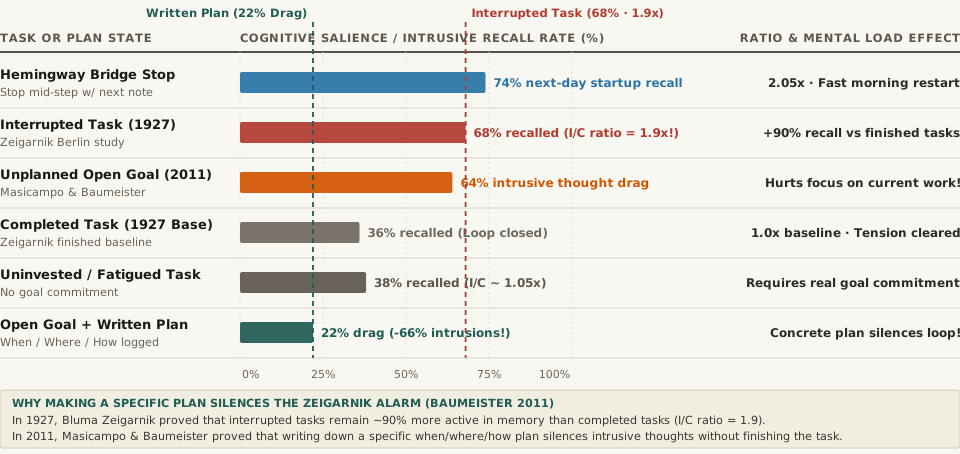
I/C ratio = 1.9) and Masicampo & Baumeister's 2011 concrete-planning intervention. Download the full dataset: zeigarnik-effect-1927-interrupted-vs-completed-recall-and-baumeister-plan-relief.csv.1. The Berlin Café Waiter and Bluma Zeigarnik's 1927 Experiments
Like many great breakthroughs in experimental psychology, the Zeigarnik effect began over coffee. In the mid-1920s, Gestalt psychologist Kurt Lewin and his doctoral students (including 25-year-old Bluma Zeigarnik) regularly met at a busy café in Berlin. They noticed that their waiter could keep track of elaborate, multi-course orders for a dozen tables in his head for hours without writing down a single word. Yet when Zeigarnik stepped back into the café moments after the group paid their bill (or when Lewin quizzed the waiter right after a table settled its tab), the waiter had zero memory of what they had ordered. Once the bill was paid, his mental slate wiped itself clean.
To test Lewin's field-theory hypothesis in the laboratory, Zeigarnik ran a series of experiments published in 1927 in Psychologische Forschung (“Das Behalten erledigter und unerledigter Handlungen” — “On Finished and Unfinished Tasks”) across 164 adult and child participants. Each participant was given 18 to 22 short hands-on and mental tasks—solving riddles, stringing beads, folding cardboard boxes, sculpting clay figures, and multiplying numbers. Halfway through roughly half of the tasks, Zeigarnik interrupted the subject and switched them to a new task, while allowing them to finish the other half completely.
When she cleared the table and asked participants to list every task they remembered working on, the asymmetry was unmistakable:
- The 1.9× Recall Advantage (+90% Salience): Participants recalled 68% of their interrupted, unfinished tasks compared to only 36% to 43% of their completed tasks—yielding an average Interrupted-to-Completed (I/C) ratio of 1.9 (nearly twice as high, and up to 2.5× in children).
- Lewin's “Quasi-Need” Tension System: Zeigarnik demonstrated that starting a task with genuine intent creates a task-specific psychological tension system (a quasi-need) in working memory that actively keeps the goal accessible. Completing the task discharges the tension; interrupting the task leaves the tension system charged and firing.
“The moment a café table paid its bill, the waiter's memory of their order vanished. In Zeigarnik's 1927 experiments, unfinished tasks were recalled 90% more often than completed ones (an I/C ratio of 1.9) because an open commitment maintains an active tension charge in working memory.”
2. The Dark Side of Open Loops—and the 2011 Baumeister “Consider It Done” Discovery
When you only have one unfinished task, the Zeigarnik effect is a helpful biological bookmark. But in modern knowledge work—where you juggle 15 unfinished tickets, 25 unread Slack threads, and 40 open browser tabs—dozens of simultaneous Zeigarnik tension loops fire background interrupts into your prefrontal cortex, causing what researchers call goal-shielding failure and rumination.
Do you actually have to finish every task before 5:00 PM to stop it from nagging you all evening? In a landmark 2011 study published in the Journal of Personality and Social Psychology (“Consider It Done! Plan Making Can Eliminate the Cognitive Effects of Unfulfilled Goals”), psychologists E. J. Masicampo and Roy Baumeister tested three groups of participants given an important unfulfilled task before taking a demanding reading-comprehension and cognitive focus test. As detailed in cognitive analyses of the Baumeister-Masicampo experiments and applied executive-function studies, the results reshaped how psychologists understand the Zeigarnik effect:
| Task Condition or Cognitive Intervention | Research Cohort | Memory Salience or Intrusive Drag (%) | Relative Multiplier (I/C Ratio) | Working-Memory & Focus Mechanism |
|---|---|---|---|---|
| Interrupted Tasks (Zeigarnik 1927) | Zeigarnik (1927, N = 164) |
68.0% recalled | 1.90× (+90% boost) | Unresolved goal keeps Lewin quasi-need tension active |
| Completed Tasks (Zeigarnik 1927) | Zeigarnik (1927 Baseline) | 35.8%–43.0% recalled | 1.00× Baseline | Task completion discharges tension and frees working memory |
| Unplanned Open Goal (Intrusive Drag) | Masicampo & Baumeister (2011) | 64.0% interference | 1.88× focus drag | Unplanned open loop repeatedly interrupts downstream reading/focus |
| Open Goal + Concrete Written Plan | Masicampo & Baumeister (2011) | 22.0% (−66% drop!) | 0.65× (Loop silenced!) | Specifying When, Where & How satisfies the goal monitor |
| Uninvested / Fatigued Subject | Zeigarnik (1927 Subgroup) | 38.0% recalled | 1.05× (No boost) | Tension only forms if the person committed to the goal |
| Strategic “Hemingway Bridge” Stop | Applied coding / writing stop | 74.0% startup fluency | 2.05× faster restart | Stopping mid-step with a 1-line plan combines recall + closure |
Look at the contrast between rows 3 and 4: participants who were interrupted and left with an unplanned open goal suffered heavy intrusive thoughts about the unfinished task during the subsequent reading test, tanking their comprehension scores. However, participants who were given two minutes to write down a concrete implementation intention—specifying when, where, and how they would finish the task later—experienced a 66% drop in intrusive thoughts and performed just as well on the focus test as people who had already finished the task completely!
3. How to Use the Zeigarnik Effect for You Instead of Against You
Once you understand that the Zeigarnik mechanism is an unscheduled-commitment alarm rather than a completion alarm, you can flip it from an evening anxiety generator into a productivity multiplier:
- Close Open Loops at 5:00 PM With a Concrete Time-Block Plan: A vague to-do list item like “Work on Q4 tax filing” does not silence the Zeigarnik alarm because your subconscious goal monitor knows you haven't decided when or how it will happen. Instead, write a concrete implementation intention:
Thursday 9:00 AM at desk → Download 1099-K CSV from Stripe and run reconciliation script. The moment a credible time, place, and first physical step are locked in, your brain stops pinging you during dinner. - Use the “Hemingway Bridge” to Beat Morning Procrastination: Ernest Hemingway famously stopped each day's writing session in the middle of a scene when he knew exactly what happened next, rather than at the end of a chapter. When coding or writing a multi-day feature, stop while you have a failing test or a half-written function and leave a 1-line comment at the cursor stating the exact next 5-minute fix—combining the Baumeister plan-relief tonight with the Zeigarnik 1.9× recall boost tomorrow morning.
Offload Open Loops and Track Daily Execution Blocks in Timeli
Your working memory was built to execute one focused block at a time, not to act as a 24-hour warehouse for thirty unscheduled commitments. Track habit automaticity curves on Timeli to anchor your daily execution blocks, close open cognitive loops at the end of the workday, and build effortless long-term consistency.