
UTC vs. GMT: What is the Difference?
Coordinated Universal Time (UTC) and Greenwich Mean Time (GMT) share the exact same current hour during winter, but they are fundamentally different: UTC is an unshifting atomic time standard, while GMT is a civil time zone that London abandons for British Summer Time every March. Because of this distinction, relying on GMT as an anchor for software, aviation, or international calendars triggers automated errors and confusion whenever the United Kingdom springs forward into BST.
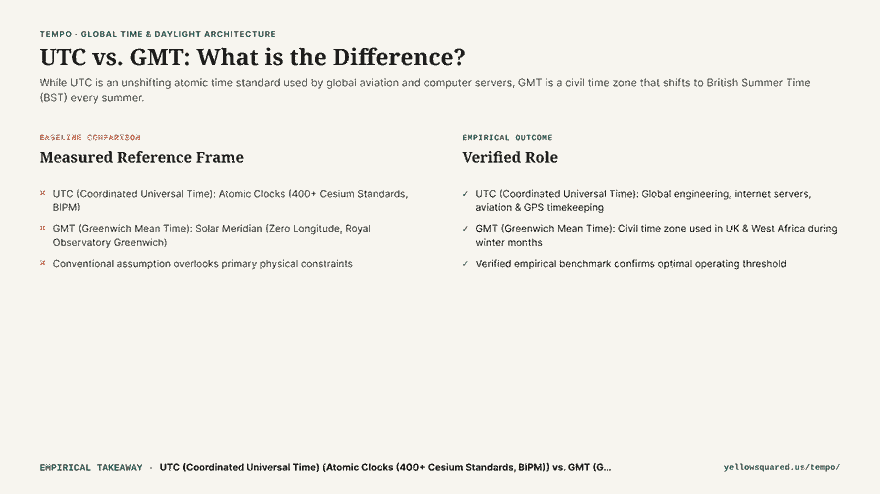
For over a century, the phrase “Greenwich Mean Time” was synonymous with universal timekeeping. Ships navigated across oceans using marine chronometers referenced to the Royal Observatory at Greenwich, England. However, the modern digital economy requires timekeeping with sub-microsecond precision that astronomical observations of Earth’s fluctuating rotation speed simply cannot provide. This led the International Bureau of Weights and Measures (BIPM) and the International Telecommunication Union to establish UTC in 1960 as the true global foundation of time.
UTC is a measurement system; GMT is a legal jurisdiction. Devices run on UTC; citizens in London wake up to GMT only during the winter.
The Technical Difference: Atomic Clocks vs. Solar Meridian
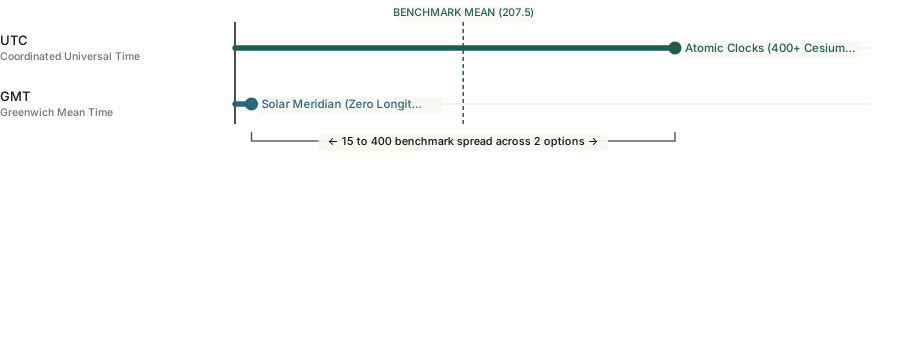
The primary scientific difference between UTC and GMT lies in how a single second is measured:
- Greenwich Mean Time (GMT): Historically measured by the mean solar transit of the sun across the Royal Observatory’s Prime Meridian (0° longitude). Because tidal friction and tectonic shifts cause Earth’s rotation to slow down irregularly, a solar second drifts over time. Today, GMT is maintained as a civil time zone equivalent to UTC+0 without daylight saving adjustments.
- Coordinated Universal Time (UTC): Calculated by combining International Atomic Time (TAI)—measured by an ensemble of over 400 ultra-precise cesium atomic clocks across global metrology laboratories—with occasional leap seconds to keep UTC within 0.9 seconds of solar time (UT1). UTC never observes daylight saving time and never shifts seasonally.
Why London Changes Time but UTC Never Does
The most common practical mistake occurs every spring. Under the UK Summer Time Act, London changes its clocks on the last Sunday of March, transitioning from GMT (UTC+0) to British Summer Time (BST, UTC+1). During the seven months from late March to late October, the United Kingdom is one hour ahead of UTC.
If an international organization schedules a global conference call for “14:00 GMT” in July, UK participants frequently assume the meeting is at 14:00 local time, whereas it is actually 15:00 BST. Stating “14:00 UTC” eliminates ambiguity because UTC has no seasonal variant.
Comparison Summary: UTC vs. GMT
| System | Measurement Base | Seasonal DST Shifts? | Primary Practical Use |
|---|---|---|---|
| UTC | Atomic Clocks (BIPM Cesium) | Never shifts (Permanent anchor) | Cloud servers, aviation flight plans (Zulu), GPS, international APIs |
| GMT | Prime Meridian Solar Time | UK switches to BST (UTC+1) in summer | Civil time in UK and West Africa during winter months |
How to Prevent Cross-Border Meeting Misunderstandings
- Never schedule events in GMT during summer: If your team works with London colleagues between April and October, reference either UTC or local British Summer Time (BST) rather than GMT.
- Lock distributed servers to UTC: Unix timestamps and database transaction logs should always be stored in UTC to avoid duplicate records during autumn “fall back” hours.
- Visualize multi-city hour offsets before scheduling: You can Open Tempo in your browser to inspect interactive time zone dials and confirm exact city offsets across changing daylight saving boundaries.