
What Is Virga? Why Rain Evaporates in Mid-Air Before Reaching the Ground
What Is Virga? Why Rain Evaporates in Mid-Air Before Reaching the Ground
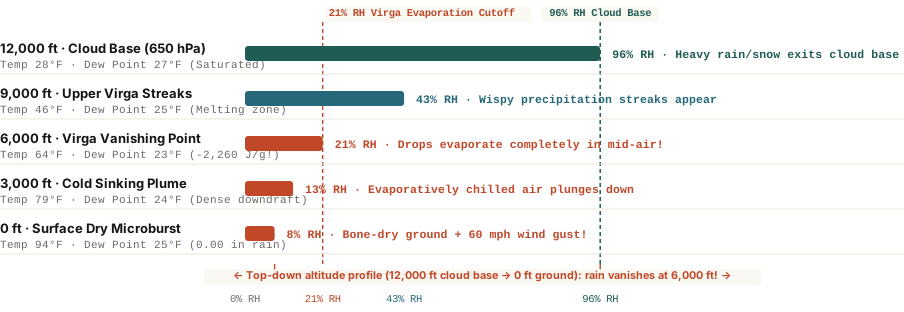
When precipitation falls from a high cloud base (10,000–12,000 ft) into a bone-dry boundary layer, every evaporating gram of water absorbs 2,260 Joules of latent heat—vaporizing the rain mid-air while chilling a dense downdraft that hits the ground as wind.
Step outside on a warm afternoon in Denver, Phoenix, Salt Lake City, or eastern Washington after your phone's weather radar app alerts you that a green blob of "moderate rain" is directly overhead. You look up at the sky: dark, dramatic gray streaks hang down from the undersides of the clouds like jellyfish tentacles, gracefully curving sideways—and then vanishing into thin air. Not a single drop of water hits the pavement.
Those wispy, comma-shaped precipitation shafts that evaporate or sublimate before reaching the earth are called virga (from the Latin word for a twig, rod, or streak). While virga looks harmless—and explains why weather radar apps frequently report "phantom rain"—the thermodynamic energy exchange happening inside a virga shaft can generate dangerous 50 to 75 mph surface wind gusts out of a dry sky.
Why Virga Forms (And Why It Curves Like a Comma)
In humid maritime climates, cloud bases sit low (`2,000 to 4,000 feet` above ground level) and the air underneath is nearly saturated (`70%–90% RH`), allowing raindrops to fall intact to the street. In arid or semi-arid continental climates—or ahead of an approaching warm front—moisture arrives aloft at `10,000 to 15,000 feet` while the lower atmosphere (`boundary layer`) remains desert-dry (`8%–25% RH`, with a `40°F to 65°F` spread between temperature and dew point).
When snow crystals and raindrops fall out of that `12,000-foot` cloud base into the dry sub-cloud layer, two physical effects create the signature hooked shape of virga:
- Shrinking Terminal Velocity: A large `3 mm` raindrop falls at roughly `8 meters per second` (`18 mph`). As dry air strips water molecules off the outside of the drop, its diameter shrinks below `0.5 mm`, cutting its terminal fall speed to less than `2 meters per second`.
- Wind-Shear Comma Hooks: Because horizontal wind speed changes with altitude (`vertical wind shear`), those tiny, slow-falling droplets drift horizontally with the lower wind current just before they completely evaporate—curving the bottom of the rain shaft into a graceful comma hook.
- Why Radar Apps Show 'Phantom Rain': Because NEXRAD Doppler radar beams tilt upward at `0.5°` (and curve higher with Earth's curvature), a radar station 50 miles away is scanning the atmosphere at 5,000 to 8,000 feet aloft—detecting the heavy precipitation inside the upper virga shaft even though `100%` of it evaporates above `4,000 feet`.
The rain inside a virga shaft disappears, but its momentum and cooling energy keep falling all the way to the ground.
The 2,260-Joule Hazard: How Virga Triggers Dry Microbursts
Where does the energy go when millions of tons of falling rain evaporate at `6,000 feet`? Phase changes require enormous thermal energy: melting ice into water absorbs `334 Joules per gram` (latent heat of fusion), and evaporating liquid water into vapor absorbs `2,260 Joules per gram` (latent heat of vaporization).
- Rapid Mid-Air Cooling: That latent heat comes directly out of the surrounding sub-cloud air parcel, chilling the air inside the virga shaft by `15°F to 30°F`.
- Negative Buoyancy Acceleration: Because cold air is significantly denser than the hot `94°F` ambient air around it, the chilled parcel plunges downward like an invisible lead weight.
- The Dry Microburst Outflow: When that sinking column of cooled air slams into the ground, it spreads out horizontally in all directions as a dry microburst—producing sudden 50 to 75 mph straight-line wind gusts and blowing dust rings without a single drop of rain reaching the surface.
To inspect real-time and historical Skew-T atmospheric profiles, sub-cloud dew-point depressions, and inverted-V microburst soundings, you can Analyze atmospheric soundings on Eranorms across global radiosonde stations.