
What Is Wet-Bulb Temperature and Why Is 31°C the Real Limit?
A dry-bulb thermometer tells you how hot the air is, but it misses the variable that determines whether human sweat can still evaporate: humidity. Wet-bulb temperature (Tw)—measured by wrapping a thermometer bulb in a water-soaked cloth exposed to moving air—captures the lowest temperature air can reach through evaporative cooling alone.
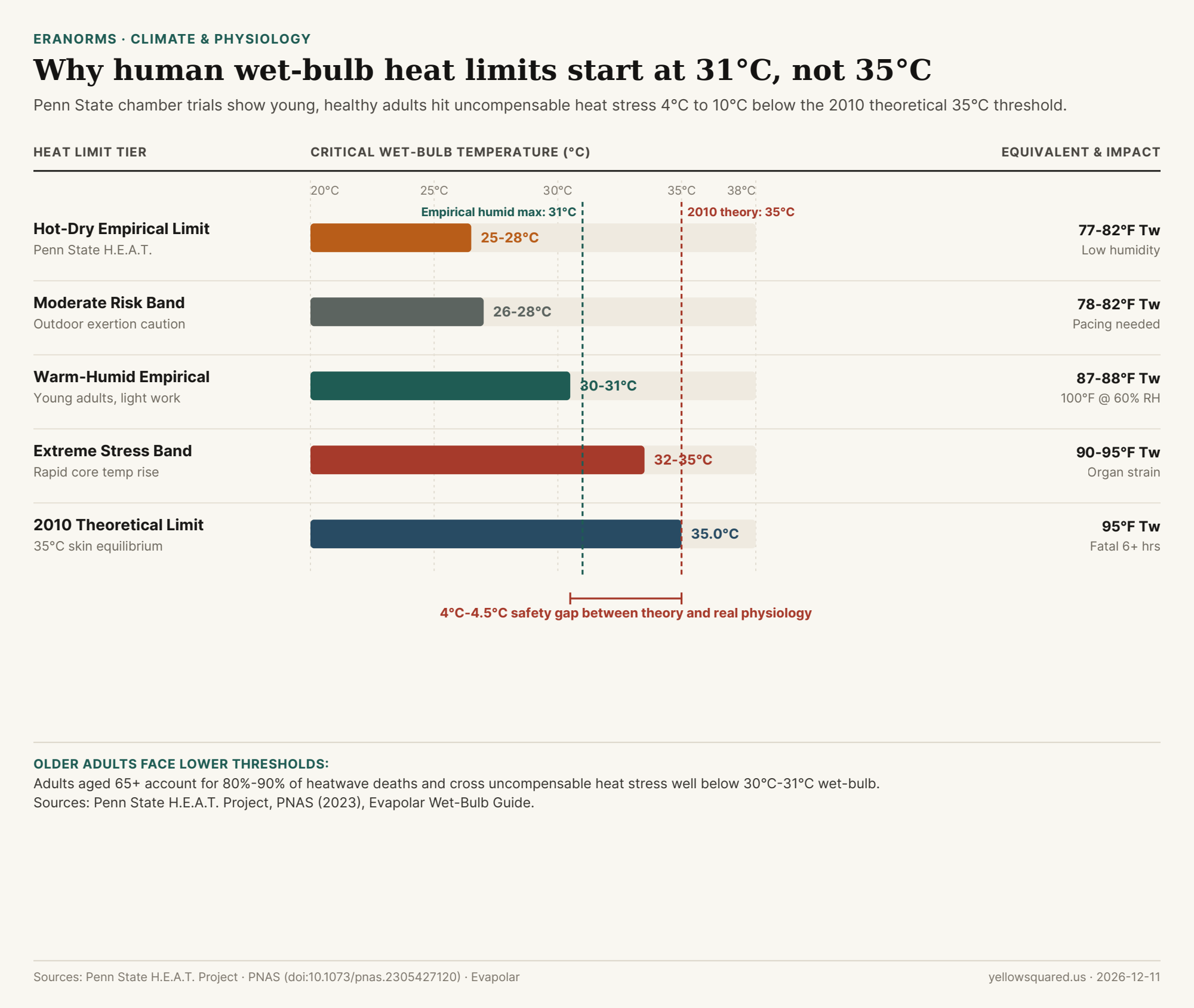
Why 35°C Was Never a Safe Ceiling
For more than a decade after a 2010 modeling paper, climate headlines treated 35°C (95°F) wet-bulb—roughly 95°F at 100% relative humidity, or 115°F (46°C) at 50% humidity—as the point where human survival fails beyond roughly six hours, even in shade with unlimited water. Because human skin sits near 35°C, ambient wet-bulb temperatures above that mark prevent sweat from dissipating heat into the air.
However, controlled environmental-chamber trials by the Penn State H.E.A.T. Project (led by W. Larry Kenney) and published in PNAS proved that real human physiology fails much sooner. Even among healthy young adults performing minimal daily movement, core temperature begins rising continuously at 30°C to 31°C (87°F–88°F) wet-bulb in warm-humid conditions—and at just 25°C to 28°C (77°F–82°F) wet-bulb in hot-dry desert heat, where sweat rates max out before air humidity does.
"Our studies on young, healthy men and women show that this upper environmental limit is even lower than the theorized 35 C. It's more like a wet-bulb temperature of 31 C (88 F)." — W. Larry Kenney, Penn State H.E.A.T. Project
Wet-Bulb Risk Tiers and Real-World Air Combinations
As Evapolar's wet-bulb reference guide illustrates, identical 95°F (35°C) air feels dramatically different depending on moisture: at 30% relative humidity, wet-bulb sits near 75°F (~24°C), whereas at 70% relative humidity it jumps to 88°F (~31°C)—crossing right into the uncompensable zone.
| Wet-Bulb Range | Risk Level | Physiological Effect |
|---|---|---|
| 25–28°C (77–82°F) | Moderate / Hot-Dry Limit | Hydration pacing required; hot-dry sweat ceiling reached |
| 28–31°C (82–87°F) | High Risk | Sweat cooling slows; older adults (65+, 80%–90% of heat deaths) at high risk |
| 31–32°C (87–90°F) | Very High Risk | Young healthy adults cross uncompensable heat stress in humid air |
| 32–35°C (90–95°F) | Extreme | Core temperature climbs rapidly; acute cardiovascular strain |
| >35°C (>95°F) | Lethal | Zero evaporative cooling possible; fatal beyond ~6 hours |
To place modern climate extremes alongside historical temperature records and human-era baselines, explore climate and history timelines in Eranorms.