
What Time Zone Are North and South Korea In, and Why Did Pyongyang Use UTC+08:30 from 2015 to 2018?
Both South Korea (Asia/Seoul) and North Korea (Asia/Pyongyang) currently observe Korea Standard Time (KST, UTC+09:00) year-round without Daylight Saving Time. Yet for nearly three years—from August 15, 2015, to May 4, 2018—crossing the Demilitarized Zone (DMZ) required turning your watch back by 30 minutes into Pyongyang Time (PYT, UTC+08:30) (Time in North Korea - Wikipedia). Half a century earlier, South Korea enacted the exact same half-hour offset between March 21, 1954, and August 9, 1961 (Time in South Korea - Wikipedia).
The reason both Korean governments independently experimented with UTC+08:30 comes down to solar geometry. Because Earth rotates 15° every 60 minutes (4 minutes per degree of longitude), the UTC+09:00 meridian lies at 135.0°E—passing directly through Akashi, Japan. The Korean Peninsula, however, sits centered along 127.5°E, the exact mathematical meridian for UTC+08:30 (Time in Korea - Wikipedia). When you compare cross-Pacific engineering standups or East Asian flight schedules in Open Tempo in your browser, both Korean capitals now align with Tokyo at UTC+09:00 while running 32 to 37 minutes ahead of local solar time.
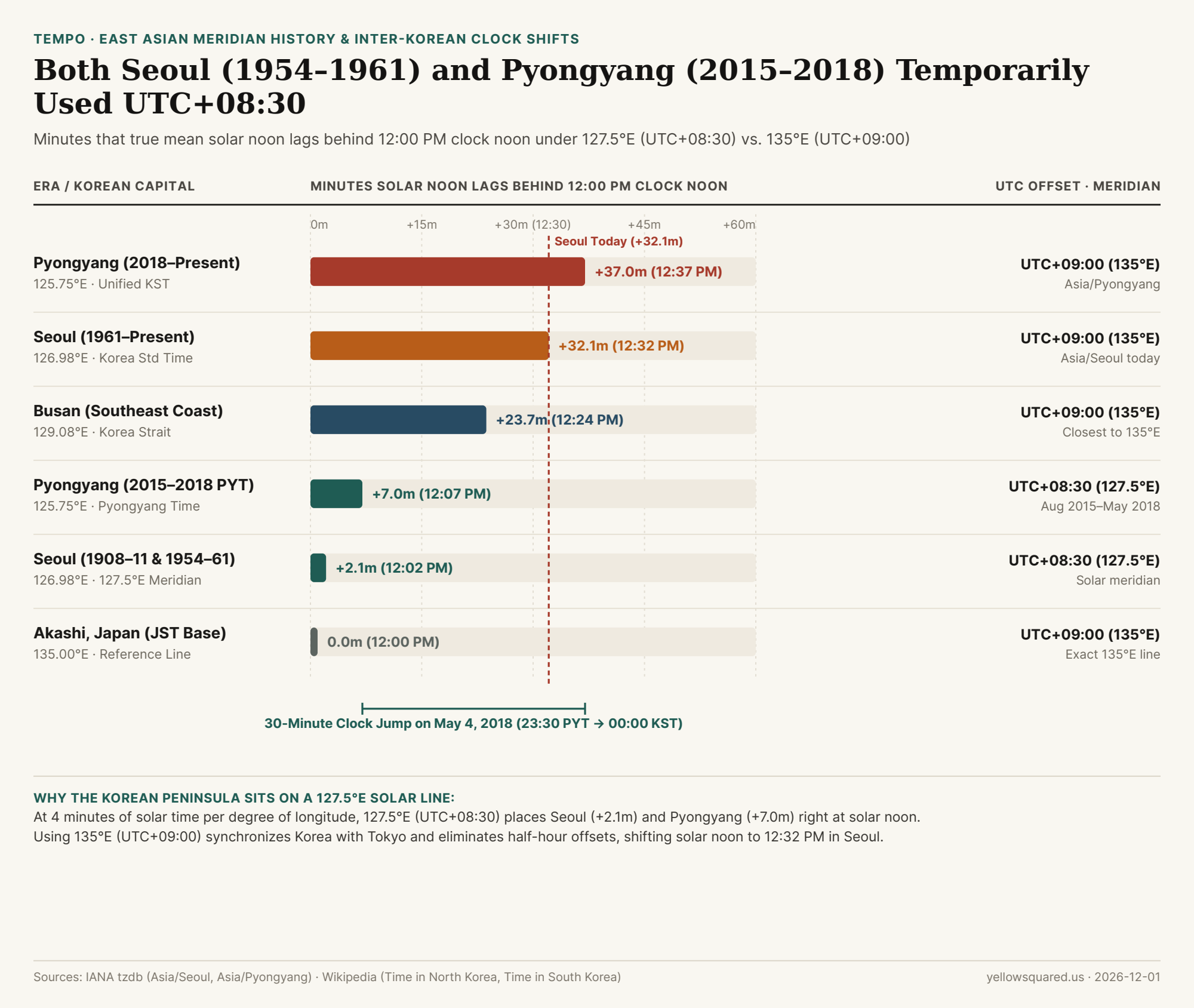
The 127.5°E Peninsula Meridian vs. the 135.0°E Akashi Meridian
In standard solar timekeeping, each one-hour UTC offset spans 15° of longitude, and each 30-minute offset sits midway between whole-hour meridians. Multiplying any city's longitude offset from its governing meridian by 4 minutes per degree reveals the exact gap between 12:00 PM on a wall clock and true mean solar noon:
- Pyongyang (125.75°E under UTC+09:00 / 135.0°E): Sitting
9.25°west of the135.0°Emeridian, the sun reaches its highest point9.25 × 4 = 37.0 minutesafter clock noon, at 12:37 PM KST (Time in North Korea - Wikipedia). - Seoul (126.98°E under UTC+09:00 / 135.0°E): Sitting
8.02°west of135.0°E, mean solar noon arrives8.02 × 4 = 32.1 minutesafter clock noon, at 12:32 PM KST (Time in South Korea - Wikipedia). - Busan (129.08°E under UTC+09:00 / 135.0°E): On the southeastern coast along the Korea Strait, the lag narrows to
5.92 × 4 = 23.7 minutes(solar noon at 12:24 PM KST). - Seoul and Pyongyang under UTC+08:30 (127.5°E): When governed by the
127.5°Emeridian, Seoul sits just0.52°west of the reference line (solar noon at 12:02 PM, a+2.1 minutelag) and Pyongyang sits1.75°west (solar noon at 12:07 PM, a+7.0 minutelag) (Time in Korea - Wikipedia).
"When a peninsula centered at 127.5°E uses a 135°E clock, every morning commute happens 30 minutes earlier in the solar cycle in exchange for zero half-hour friction with Tokyo and regional aviation."
Six Historical Clock Transitions Across Korea (1908–Present)
The IANA Time Zone Database maintains two separate zone identifiers—Asia/Seoul and Asia/Pyongyang—specifically because the two capitals diverged twice after 1945:
- April 1, 1908 – December 31, 1911 (UTC+08:30): The Korean Empire established its first national standard time anchored to the
127.5°Emeridian (Time in South Korea - Wikipedia). - January 1, 1912 – March 20, 1954 (UTC+09:00): Following the 1910 annexation, the Governor-General of Korea shifted clocks forward 30 minutes to
UTC+09:00to match Japan Standard Time (Time in North Korea - Wikipedia). - March 21, 1954 – August 9, 1961 (South Korea at UTC+08:30): After the Korean War armistice, South Korean President Syngman Rhee ordered clocks turned back 30 minutes to
UTC+08:30to restore the pre-1912 Korean Empire meridian, creating the first 30-minute split across the DMZ (Time in South Korea - Wikipedia). - August 10, 1961 – Present (South Korea at UTC+09:00): Less than three months after the May 1961 military coup, Park Chung Hee's Supreme Council for National Reconstruction returned South Korea to
UTC+09:00to align regional military operations and trade with US forces and Japan (Time in South Korea - Wikipedia). South Korea also briefly tested Daylight Saving Time (UTC+10:00) during 1948–1951, 1955–1960, and for the 1987–1988 Seoul Olympic Games, before abolishing DST permanently after October 1988. - August 15, 2015 – May 4, 2018 (North Korea at UTC+08:30): By decree of the Supreme People's Assembly on August 5, 2015, North Korea turned clocks back 30 minutes on the 70th anniversary of Liberation Day to establish Pyongyang Time (PYT, UTC+08:30), creating a 30-minute offset at the jointly operated Kaesong Industrial Region (Time in North Korea - Wikipedia).
- May 5, 2018 – Present (Unified UTC+09:00): Following the April 2018 Inter-Korean Summit at Panmunjom—where two wall clocks in the Peace House showed Seoul and Pyongyang 30 minutes apart—North Korea advanced its clocks by 30 minutes at 23:30 on May 4, 2018 to jump directly to 00:00 on May 5, 2018 (UTC+09:00) (Time in North Korea - Wikipedia).
| Korean Era or City | Active UTC Offset | Standard Meridian | City Longitude | Mean Solar Noon | Solar Lag vs. 12:00 PM |
|---|---|---|---|---|---|
| 1. 1908–1911 Korean Empire | UTC+08:30 |
127.50°E |
126.98°E (Seoul) |
12:02 PM | +2.1 min behind noon |
| 2. 1912–1954 Colonial & War Era | UTC+09:00 |
135.00°E |
126.98°E (Seoul) |
12:32 PM | +32.1 min behind noon |
| 3. 1954–1961 South Korea (ROK) | UTC+08:30 |
127.50°E |
126.98°E (Seoul) |
12:02 PM | +2.1 min behind noon |
| 4. 1961–Present Seoul (ROK) | UTC+09:00 (KST) |
135.00°E |
126.98°E (Seoul) |
12:32 PM | +32.1 min behind noon |
| 5. 2015–2018 Pyongyang (PYT) | UTC+08:30 (PYT) |
127.50°E |
125.75°E (Pyongyang) |
12:07 PM | +7.0 min behind noon |
| 6. 2018–Present Pyongyang (DPRK) | UTC+09:00 (KST) |
135.00°E |
125.75°E (Pyongyang) |
12:37 PM | +37.0 min behind noon |
How to Handle Korean Timestamps and Cross-Pacific Scheduling
If your software parses historical Asian log files, financial market ticks, or satellite imagery recorded between August 15, 2015, and May 4, 2018, never hardcode Korea as a static +09:00 offset. Always bind timestamps to the explicit IANA zone identifier (Asia/Seoul or Asia/Pyongyang) so historical tzdb transition tables automatically apply the +08:30 window when needed. Because neither South Korea nor Japan observes Daylight Saving Time, Seoul stays locked at a 16-hour gap ahead of Seattle/San Francisco during PDT (UTC−07:00) and a 17-hour gap during PST (UTC−08:00). To compare live working hours across Seoul, Tokyo, Taipei, and U.S. time zones at a glance, Open Tempo in your browser.