
When Do Airlines Release Award Seats? How the 355-Day Partner Window Beats U.S. 331-Day Calendars
If you have ever logged into American Airlines AAdvantage or United MileagePlus exactly 331 days before a dream trip to Tokyo or Paris — hoping to grab two saver business-class seats the second the schedule opens — only to find zero availability on every single flight, you did not lose to faster fingers. You lost to a structural calendar gap: foreign alliance loyalty programs open their award calendars at 355 to 360 days before departure, giving their members an 18-to-29-day head start over U.S. airline programs.
As documented across AwardFares' Ultimate Guide to Airline Award Release Dates, Award Travel Finder's 34-Program Release Window Database, and Upgraded Points' Schedule-Open Availability Audit, most international carriers release only 1 to 2 guaranteed saver business-class seats (Class I) per flight when a new date loads into the Global Distribution System (GDS). By the time a U.S. program's 331-day or 337-day calendar reaches that date, those seats have already been exposed to foreign partner portals for nearly a month. To model which transferable credit card currencies unlock early-window partner programs at the highest cents-per-point value, Compare transfer partner valuations in Pointsuno.
The Three Tiers of Airline Schedule-Open Windows (360 vs. 355 vs. 331 Days)
Airlines do not load full-year schedules on a single universal clock; each Passenger Service System (Amadeus Altea vs. Sabre vs. native host systems) exposes new dates at a fixed horizon prior to departure:
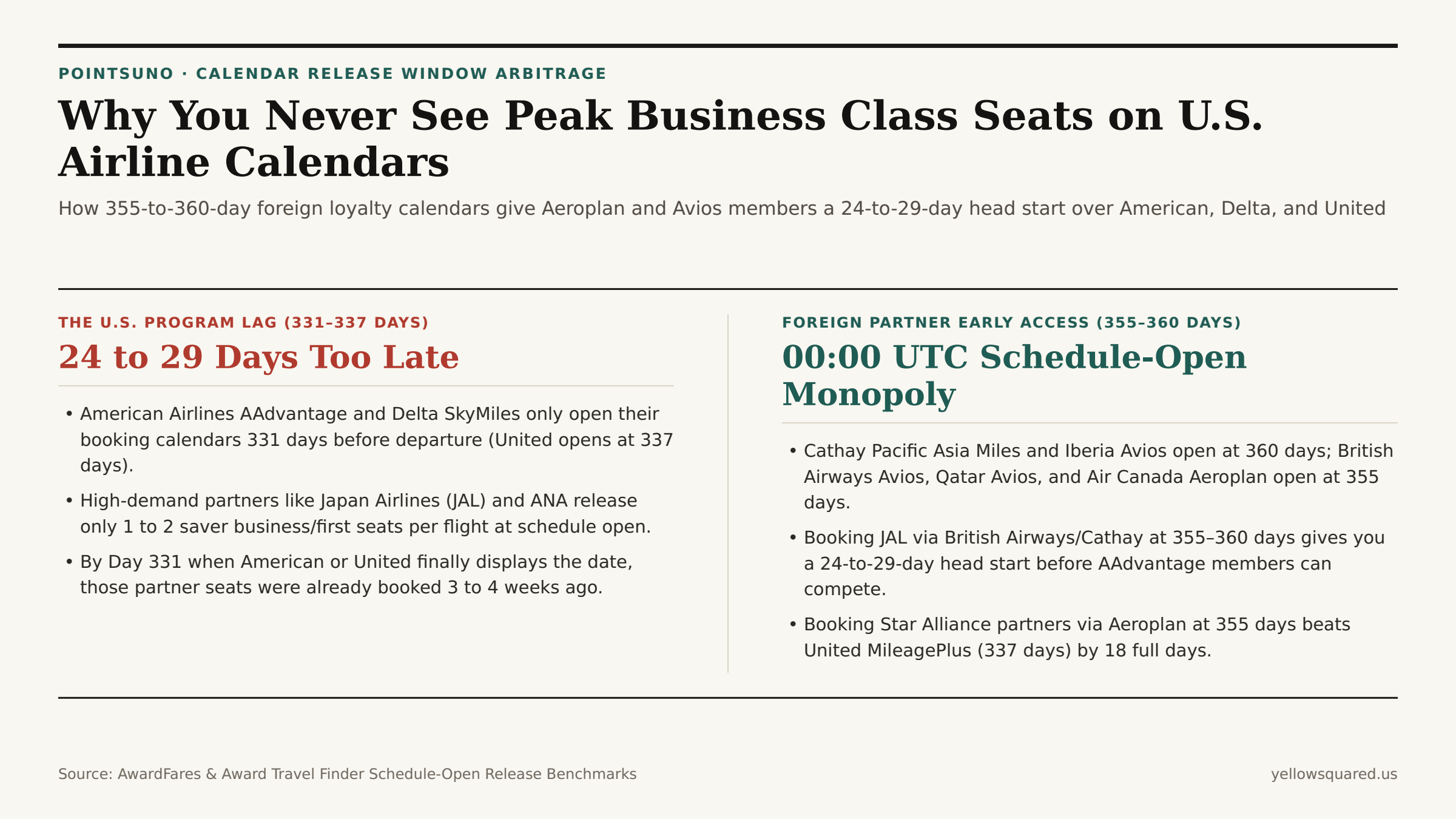
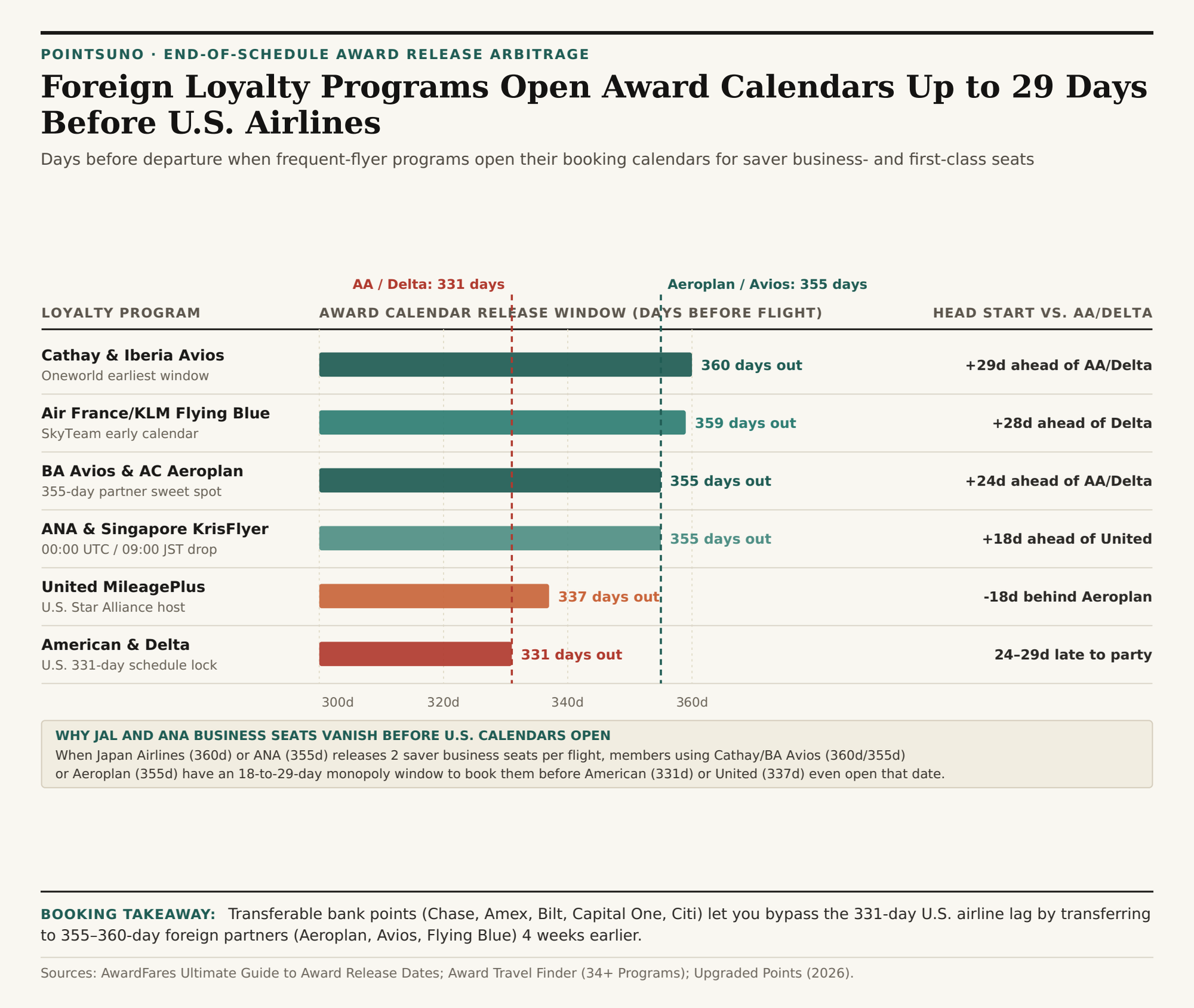
- The 359–360 Day Pioneers (Cathay Pacific, Iberia, JAL, Air France/KLM): Cathay Pacific Asia Miles and Iberia Plus (Avios) open bookings at 360 days before departure, while Air France/KLM Flying Blue opens at 359 days. When Japan Airlines (
JAL) loads its schedule at360 days out (00:00 UTC / 09:00 JST), Cathay Pacific members can book those JAL business- and first-class seats a full 29 days before American Airlines AAdvantage members (331 days) can even click the date onaa.com. - The 355 Day Alliance Sweet Spot (British Airways / Qatar Avios, Air Canada Aeroplan, ANA, KrisFlyer): At 355 days out, five of the most powerful transferable-points partners open simultaneously: British Airways Executive Club (Avios), Qatar Airways Privilege Club (Avios), Air Canada Aeroplan, ANA Mileage Club, and Singapore Airlines KrisFlyer. Because Aeroplan (
355 days) opens 18 days earlier than United MileagePlus (337 days), Aeroplan members get first pick of Star Alliance saver releases on ANA, EVA Air, Swiss, and Austrian. - The 331–337 Day U.S. Lag (United, American, Delta, Alaska): United MileagePlus opens at 337 days, while American Airlines AAdvantage, Delta SkyMiles, and Alaska Airlines Atmos Rewards open at 331 days. On routes where foreign partners only release 2 saver seats at schedule open, waiting until Day 331 means hoping for a second wave of inventory or a close-in
T-14drop two weeks before departure.
Why Transferable Bank Points Beat Co-Branded U.S. Airline Cards at Schedule Open
If all of your miles are locked inside a single U.S. airline program (such as American AAdvantage or United MileagePlus), you are permanently restricted to that program's 331-day or 337-day calendar horizon — even when booking flights operated by foreign alliance partners. By holding flexible bank points (Chase, Amex, Bilt, Capital One, or Citi) that transfer 1:1 to British Airways/Iberia/Qatar Avios, Cathay Pacific Asia Miles, Air Canada Aeroplan, or Flying Blue, you can shift your booking horizon forward to 355–360 days out.
"For peak cherry-blossom Tokyo flights or June European lie-flat cabins, the difference between a 355-day Aeroplan/Avios calendar and a 331-day U.S. calendar is the difference between wide-open saver space and a sold-out cabin."
| Loyalty Program | Alliance | Release Horizon | Lead Over AA/Delta | Daily Drop Time | Primary Schedule-Open Sweet Spot |
|---|---|---|---|---|---|
| Cathay Asia Miles & Iberia Avios | Oneworld | 360 days | +29 days | 00:00 UTC | Earliest access to JAL, Iberia & Cathay cabins |
| Air France / KLM Flying Blue | SkyTeam | 359 days | +28 days | 00:00 CET | 4-week head start on SkyTeam Europe business |
| BA / Qatar Avios & AC Aeroplan | Oneworld / Star | 355 days | +24 days | 00:00 UTC | Scoops up ANA, EVA, Qatar & JAL partner seats |
| ANA Mileage Club & KrisFlyer | Star Alliance | 355 days | +24 days (+18d vs UA) | 00:00 UTC (09:00 JST) | Direct host access to Tokyo & Singapore suites |
| United MileagePlus | Star Alliance | 337 days | +6 days (-18d vs AC) | Rolling CST | Trails Aeroplan by 18 days on partner space |
| American AAdvantage & Delta | Oneworld / SkyTeam | 331 days | 0 days (Baseline) | 00:00 CT / EST | Best for domestic flights & close-in T-14 drops |
Calculating Net Value Before You Book at 355 Days
While foreign partner programs give you a 24-to-29-day head start, they sometimes levy higher carrier surcharges or stricter change fees than U.S. programs. Before transferring points at T-355, Compare transfer partner valuations in Pointsuno to weigh early-access availability against net cents-per-point yield, and download the airline award release window CSV table.