
When Is It Worth Paying a Credit Card Processing Fee to Earn Points? Break-Even Math for Taxes and Tuition
Every April — and every quarterly estimated-tax deadline in June, September, and January — millions of U.S. taxpayers face the same mathematical temptation: the Internal Revenue Service allows you to pay federal income taxes with a credit card through official payment processors for a 1.75% to 1.85% convenience fee. Similarly, universities, insurance carriers, and municipal property-tax portals routinely charge 2.0% to 2.85% to pay by card. When does paying a processing fee destroy value, and when does it generate hundreds or thousands of dollars in net travel rewards?
Using the official IRS Pay by Card Processor Fee Schedule (Pay1040 at 1.75% and ACI Payments at 1.85%) alongside NerdWallet's Tax-Payment Points Break-Even Analysis and The Points Guy's Guide to Paying Taxes With a Credit Card, the answer comes down to a single break-even equation. To model your exact card portfolio and partner redemption value before paying a fee, Calculate your exact cents-per-point break-even in Pointsuno.
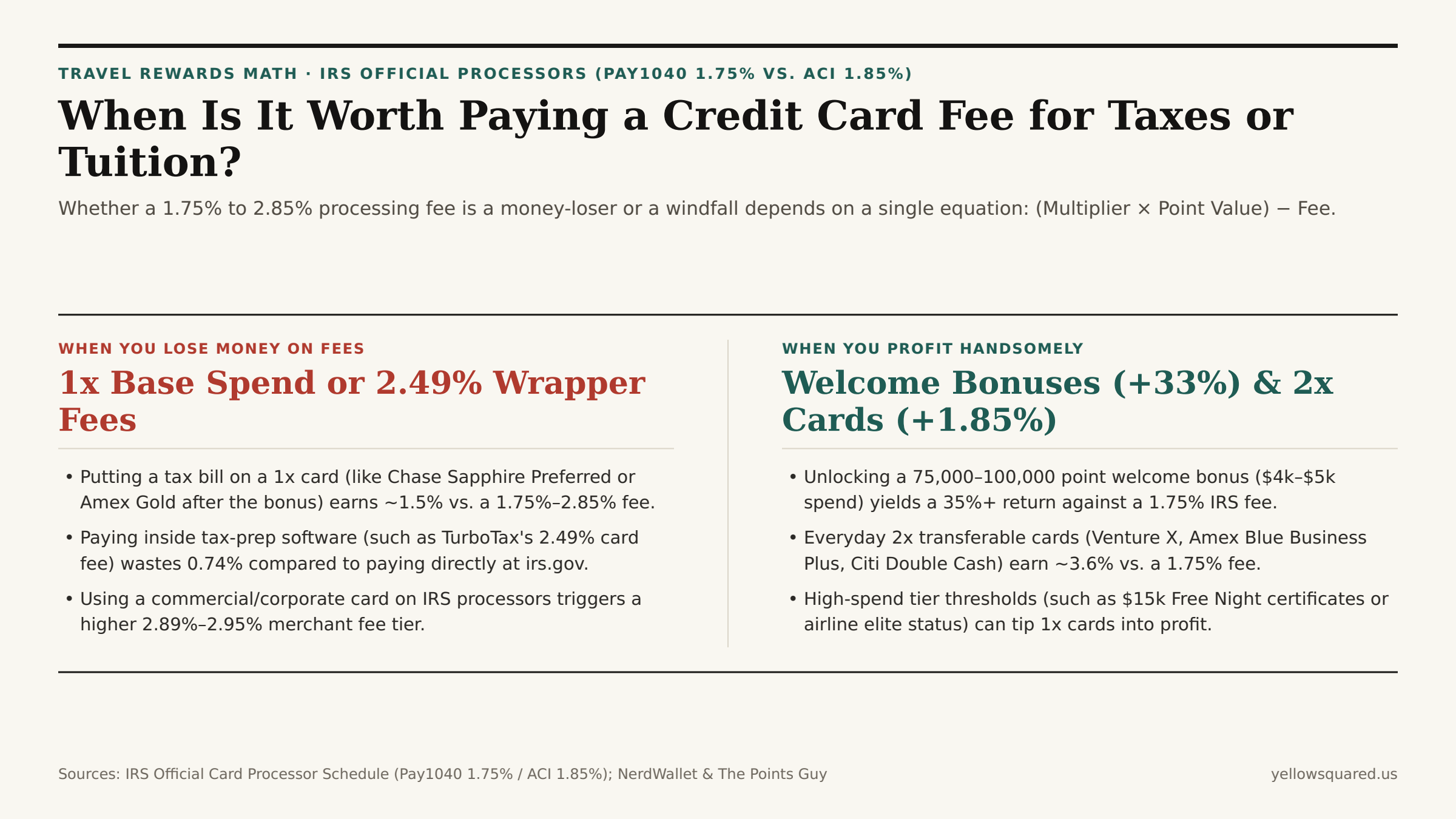
1. The Break-Even Equation: Required Point Value (CPP) = Fee (%) ÷ Card Multiplier
According to the IRS Official Payment Processor Schedule, two authorized processors handle personal and business tax payments online: Pay1040 (1.75% fee for consumer credit cards; $2.50 minimum) and ACI Payments, Inc. (1.85% fee for consumer credit cards; $2.50 minimum). *(Crucial warning: never pay your tax bill by credit card directly inside third-party tax-prep software like TurboTax, which charges an inflated 2.49% convenience fee — always file your return and submit your payment separately at irs.gov/payments!)*
To determine whether a fee is profitable on everyday spend, divide the processor fee by your card's base earn multiplier (Points Per Dollar):
- On a
1xCard (Chase Sapphire Preferred,Amex Gold/Platinumbase spend, or1xairline cards): Your break-even valuation is1.75% ÷ 1.0 = 1.75 cents per point (CPP). If you redeem those points for1.25¢–1.5¢(1.25%–1.50%return), you lose0.25% to 0.50%on every dollar. - On a
2%Flat Cash-Back Card (Citi Double Cash,Wells Fargo Active Cash,Fidelity Rewards): Paying1.75%to earn2.00%cash back yields a tiny+0.25%net margin (+$25on a$10,000tax bill) — rarely worth tying up your credit line unless paired with a 0% APR promotion. - On a
2xTransferable Points Card (Capital One Venture X,Amex Blue Business Plus, orCiti Double Cashpaired withStrata Premier): Your break-even point valuation drops to just1.75% ÷ 2.0 = 0.875 cents per point! When you transfer those2xpoints to international airline or hotel partners (such as Air Canada Aeroplan, British Airways/Qatar Avios, Flying Blue, or World of Hyatt) at a conservative1.8 cents per point, your gross return is3.60%— netting a clean+1.85%profit (+$185net value per$10,000paid) (The Points Guy).
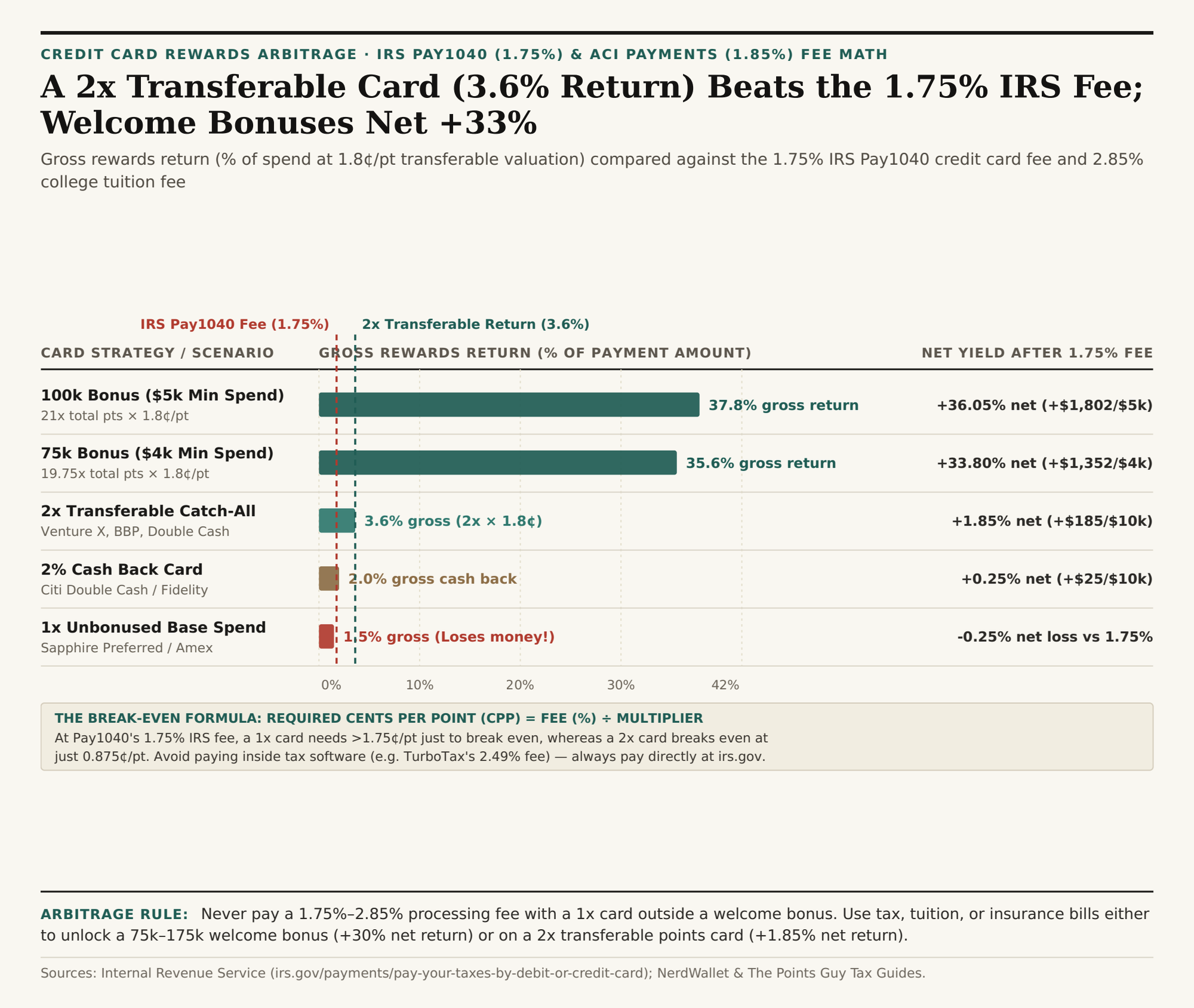
1.75% IRS Pay1040 fee across five credit card scenarios. Download the credit card processing fee break-even dataset (CSV).2. Why Welcome Bonuses Turn a 1.75%–2.85% Fee Into a 30%+ Windfall
Where fee-based bill payments shine brightest is clearing high minimum-spend requirements on new credit card welcome bonuses — especially business cards (Chase Ink Business Preferred, Amex Business Platinum, Capital One Venture X Business) that require $4,000 to $15,000 in spending within 3 months (NerdWallet):
- The
$5,000Tax Bill on a100,000-PointWelcome Offer: Suppose you open a card offering100,000 transferable pointsafter spending$5,000in 3 months (+1xbase point per dollar =105,000 total points, or21x points per dollar). You pay a$5,000quarterly estimated tax bill via Pay1040 for an$87.50fee (1.75%). - The Net Math: Even at a baseline cash/travel-portal floor of
1.0¢/pt,105,000 pointsare worth$1,050(+$962.50net profit). Transferred to airline or Hyatt partners at1.8¢/pt, those105,000 pointsdeliver$1,890in travel value (37.8%gross return) — leaving you with+$1,802.50in net profit (+36.05%net return) after subtracting the$87.50fee! - Even a
2.85%College Tuition or Property Tax Fee Wins: On that same100,000-pointwelcome bonus, paying a2.85%university tuition fee ($142.50on$5,000) still nets+$1,747.50(+34.95%net return).
"Never evaluate a credit card processing fee in isolation: paying $87.50 in IRS Pay1040 fees (1.75%) to unlock a 100,000-point welcome bonus buys transferable points for 0.083 cents apiece — a 20-to-1 return on your fee."
| Card Strategy | Effective Earn | Point Value | Gross Return | Pay1040 Fee | Net Return (Per $10k) |
|---|---|---|---|---|---|
| 100k Welcome Bonus ($5k spend) | 21.0x pts/$ | 1.8¢ / pt | 37.80% | 1.75% | +36.05% (+$1,802 on $5k) |
| 75k Welcome Bonus ($4k spend) | 19.75x pts/$ | 1.8¢ / pt | 35.55% | 1.75% | +33.80% (+$1,352 on $4k) |
| 2x Transferable (Venture X / BBP) | 2.0x pts/$ | 1.8¢ / pt | 3.60% | 1.75% | +1.85% (+$185 per $10k) |
| 2% Flat Cash Back Card | 2.0% cash | 1.0¢ (Cash) | 2.00% | 1.75% | +0.25% (+$25 per $10k) |
| 1x Base Spend (No Bonus) | 1.0x pt/$ | 1.5¢ / pt | 1.50% | 1.75% | -0.25% (-$25 net loss!) |
Modeling Your Exact Fee Break-Even Before You Pay
Before submitting a large tax, tuition, or insurance payment by credit card, verify whether your card is classified as a consumer card (1.75% on Pay1040) or a commercial business card (2.89% on Pay1040 — though note that many small-business cards still price at the 1.75% consumer rate during checkout preview). Calculate your exact cents-per-point break-even in Pointsuno to compare your card's transfer partner value against the exact processor fee, and download the credit card fee break-even CSV table.