
Why Are Autumn, Summer, August, and June Top Baby Names—While Spring and October Are Almost Never Used?
According to U.S. National Center for Health Statistics (NCHS) natality records, August, July, September, and October are four of the busiest birth months in America. Yet when you inspect the U.S. Social Security Administration (SSA) baby name database across all four seasons and twelve calendar months, parents do not name babies in proportion to the calendar. In the latest SSA national release analyzed by AnyWho and Stacker, August hit an all-time record of 3,958 boy births (#81), Autumn led all season names for girls with 2,805 births (Top-100), and June (1,978 births, #150) and Summer (1,973 births, #152) ran neck-and-neck—while Spring peaked at just 251 births in 1976 and October, November, and February barely register at all.
Reader outcome: You will see the exact SSA birth counts and rank trajectories for every major season and month name, understand the phonetic and historical forces separating winners (`August`, `Autumn`, `June`, `Summer`) from faded hits (`April`, down 95% since 1980), and learn the three SSA dataset limits that split spellings like `May` vs. `Mae`.
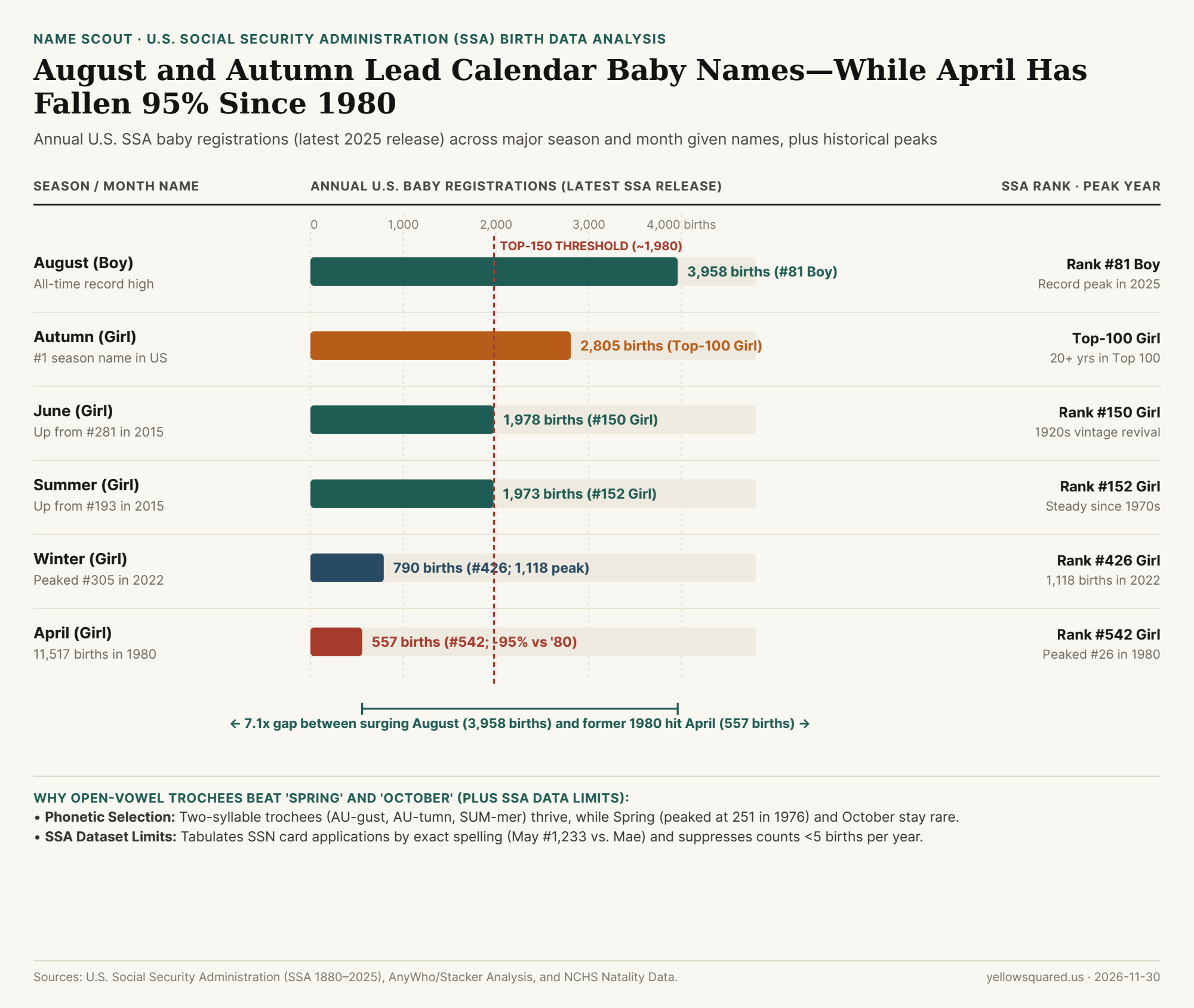
The Four Seasons in SSA Data: Why Autumn and Summer Beat Winter and Spring
Why did English speakers embrace Autumn and Summer as mainstream given names in the 1970s while leaving Spring almost untouched? In SSA historical records, the four seasons split along strict phonetic and semantic lines:
- Autumn (
2,805births · Top-100 Girl): Derived from Latin autumnus,AU-tumnis a two-syllable trochee (first-syllable stress) starting with an open vowel and ending in a soft nasal consonant—matching the exact phonetic template of perennial favorites likeLauren,Morgan, andEden. It has remained inside the U.S. Top 100 for more than two decades. - Summer (
1,973births ·#152Girl): Entering the U.S. Top 1000 in 1970,SUM-merblends the familiar two-syllable-ercadence of occupational surnames (Harper,Piper,Parker) with warm seasonal imagery, rising from#193in 2015 to#152. - Winter (
~790–1,118births ·#426Girl): Sharing the crisp-erending ofSummer,WIN-terclimbed rapidly during the 2010s nature-name wave to peak at#305with1,118girl births in 2022 (plus alternative spellingWynter) before cooling to#426. - Spring (Peaked at
251births in 1976): Unlike the two-syllable trocheesAU-tumn,SUM-mer, andWIN-ter,Springis a single-syllable word opening with a heavy three-consonant cluster (spr-) and doubling as a mechanical noun ("coil spring") and action verb ("spring forward"). After briefly appearing in 1951 and peaking at251births in 1976, it vanished from the Top 1000.
Every enduring season name in the U.S. Top 500—Autumn, Summer, and Winter—is a two-syllable trochee (DUM-da), while one-syllable Spring never cleared 251 annual births.
The Twelve Months Compared: August's Surge, June's Return, and April's 95% Drop
Calendar month names show an even sharper generational rotation. While folk heuristics like a strict "100-year rule" fail as universal clocks—because some names cycle in 40 years while others never return—empirical SSA counts show three distinct cohorts among the months:
| Calendar / Seasonal Name | Primary Sex | Latest SSA Births | Latest SSA Rank | Historical Peak Rank & Year | Phonetic & Demographic Trajectory |
|---|---|---|---|---|---|
| August | Boy (Unisex) | 3,958 |
#81 Boy | #81 in 2025 (Record high) |
Latin Augustus; surged into Top 100 with nickname Auggie |
| Autumn | Girl | 2,805 |
#94 Girl | #67 in 2019 |
Category leader among all four seasons; Top-100 staple |
| June | Girl | 1,978 |
#150 Girl | #39 in 1925 |
Early-20th-century classic revival; climbed from #281 in 2015 |
| Summer | Girl | 1,973 |
#152 Girl | #142 in 1977 & 2008 |
Steady two-syllable open-vowel favorite; up from #193 in 2015 |
| Winter | Girl | ~790 |
#426 Girl | #305 in 2022 (1,118) |
Modern nature entrant; peaked in 2022 before cooling to #426 |
| April | Girl | 557 |
#542 Girl | #26 in 1980 (11,517) |
Gen-X smash hit that dropped 95% from its 1980 peak |
| May (excluding Mae) | Girl | 183 |
#1,233 Girl | #53 in 1900 |
Split across exact spellings May (#1,233) and Mae (Top 600) |
| Spring | Girl | <25 |
Outside Top 1000 | 251 births in 1976 |
spr- consonant cluster and verb homophone limited adoption |
Why October and September Stay Rare—And Three SSA Data Limits to Watch
Why do parents born or expecting in the fall choose Autumn (2,805 births) or seasonal nature names like Rowan, Sienna, Marigold, and Noel/Noelle rather than September, October, or November? In English prosody, three-syllable amphibrachs (Sep-TEM-ber, Oc-TO-ber, No-VEM-ber, De-CEM-ber) place primary stress on the middle syllable and lack natural one-syllable nicknames, whereas May, June, April, and August were all given names in Roman or medieval Europe long before modern calendar naming.
Finally, when comparing calendar names in the public SSA dataset, keep three structural data limitations in mind:
- SSN Card Applications, Not Birth Certificates: The SSA dataset tabulates applications for Social Security cards rather than NCHS birth certificates directly (nor does it include birth-month timestamps in the public national file).
- Exact-Spelling Separation: Every distinct spelling is ranked as a separate string. For example, while calendar spelling
Maysits at#1,233(183births), vintage spellingMae—and variants likeWyntervs.WinterorNoellevs.Noel—are counted separately. - Small-Count Privacy Suppression (
<5Births): Any name given to fewer than 5 babies of the same sex in a calendar year is omitted from the national file, which is why ultra-rare month names likeFebruaryorNovemberfrequently drop below the reporting floor. To compare exact spelling variants and 140-year popularity curves side by side, Explore historical name trends in Name Scout.