
Why Are Botanical Baby Names (Lily, Hazel, Violet, Willow, Iris, and Rowan) Surging in U.S. Birth Records?
Scan recent U.S. Social Security Administration (SSA) birth rankings in Social Security Baby Name Rankings and U.S. state popularity tables and one naming family stands out: botanical flower and tree names. Six plant-inspired names—Violet, Hazel, Lily, Willow, Rowan, and Iris—now sit simultaneously inside the U.S. Top 65.
Yet grouping them together hides a striking split in American naming history. While Hazel (#23 in 1900), Violet (#90 in 1902), and Iris (#113 in 1917) are century-old Edwardian revivals returning from mid-century obscurity, Willow and Rowan had zero presence in the U.S. Top 1000 before 1998. Compare botanical and vintage baby name trajectories in Name Scout to inspect exact spelling counts and multi-decade curves.
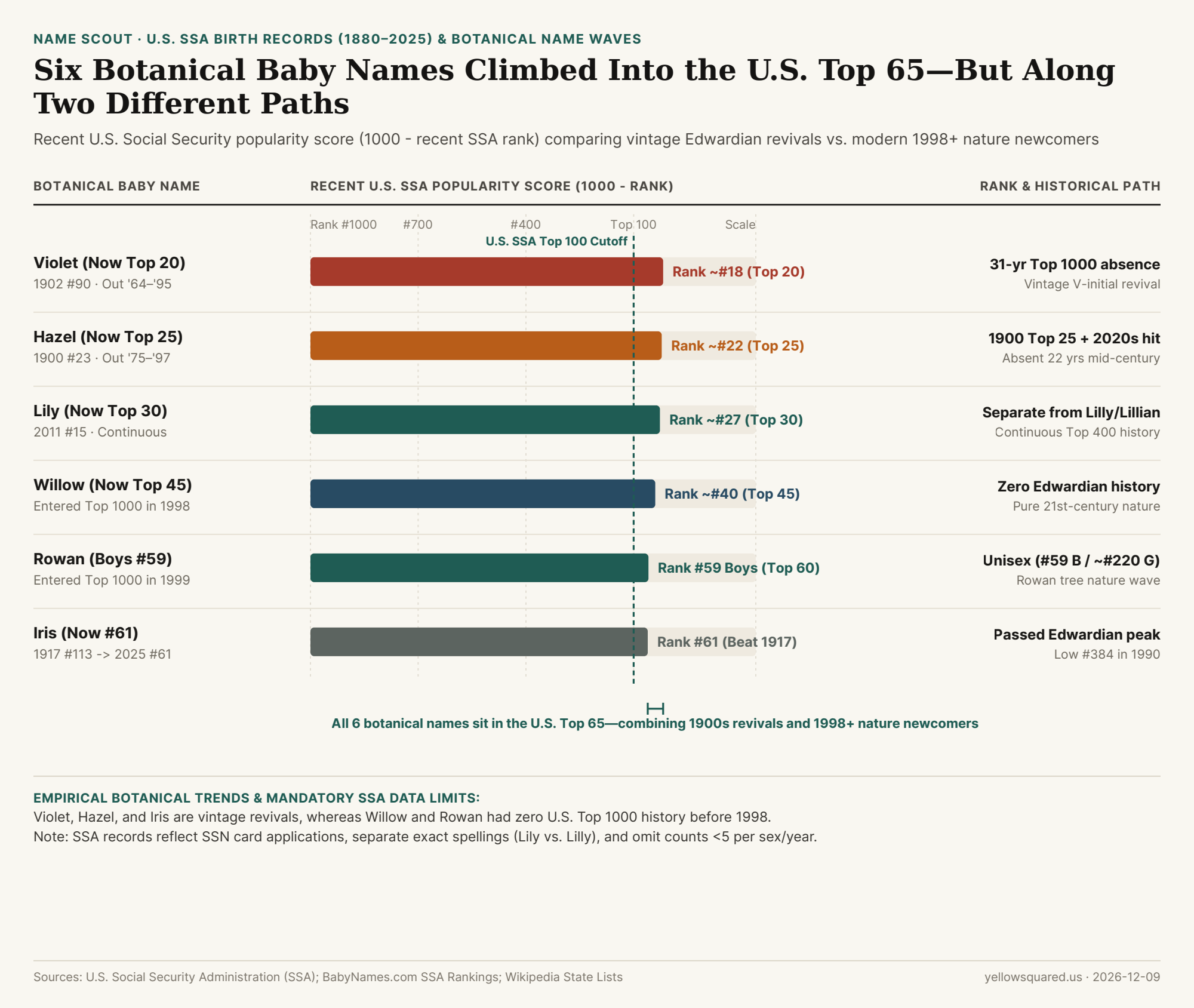
1000 − Rank) across six leading botanical baby names, contrasting vintage Edwardian revivals with post-1998 nature newcomers. Sources: SSA Baby Name Rankings (BabyNames.com) and Wikipedia U.S. State Lists · Download CSV dataset.Two Paths to the Top 65: Edwardian Revivals vs. Modern Nature Newcomers
Looking at 145 years of SSA records shows why botanical names cannot be explained by a single folk "100-year rule":
- Path 1 — Vintage Edwardian Revivals (Violet, Hazel, Iris): Hazel peaked at
#23in 1900 before dropping completely out of the Top 1000 from1975 to 1997; it has since climbed more than 700 spots back into the Top 25. Violet peaked at#90in 1902, vanished from the Top 1000 for 31 years (1964–1995), and surged into the Top 20. Iris beat its 1917 high (#113) to reach Rank#61in recent SSA rankings. Meanwhile, other 1900s floral contemporaries like Myrtle and Beulah never returned—showing that soft vowel-and-liquid phonetics (L,V,Z) drive which vintage botanicals revive. - Path 2 — Modern 1998+ Nature Newcomers (Willow, Rowan): Unlike Violet or Hazel, Willow never cracked the U.S. Top 1000 once between 1880 and 1997; it debuted in
1998and climbed steadily into the Top 45. Similarly, Rowan (from the European mountain-ash tree) entered the U.S. boys' Top 1000 in1999and now ranks#59for boys (and inside the Top 250 for girls). - Path 3 — Continuous Floral Staple (Lily): Lily never left the U.S. Top 400 in the 20th century, peaked at
#15in 2011, and remains a Top 30 fixture.
"These rankings describe historical SSA curves rather than a universal 100-year naming clock: while Violet, Hazel, and Iris rebounded from mid-century troughs, Edwardian floral peers like Myrtle stayed out of the Top 1000—and Willow and Rowan are purely 21st-century nature arrivals."
Botanical Name Trajectory Table & Mandatory SSA Data Limits
Before comparing counts in the table below (download the raw CSV dataset), note three structural limits of U.S. Social Security Administration baby name records:
- SSN Card Applications vs. Birth Certificates: SSA counts reflect Social Security card applications rather than raw state birth certificates (undercounting early-1900s rural births before 1937 and universal 1987 hospital enumeration).
- Exact-Spelling Separation: Every spelling is counted separately—so Lily (Top 30), Lilly, and Lillie appear as separate entries even though they sound identical.
- Small-Count Suppression (
<5): Names with fewer than 5 occurrences (<5) in a given sex and birth year are omitted for privacy.
| Botanical Name | Primary Sex | Plant / Tree Origin | Historical Peak | Mid-Century Trough | Recent SSA Rank |
|---|---|---|---|---|---|
| Violet | Female | Viola flower | #90 (1902) |
Out of Top 1000 (1964–1995) |
#15–#20 (Top 20) |
| Hazel | Female | Corylus hazel tree | #23 (1900) |
Out of Top 1000 (1975–1997) |
#19–#25 (Top 25) |
| Lily | Female | Lilium flower | #15 (2011) |
#387 (1979) |
#24–#30 (Top 30) |
| Willow | Female | Salix willow tree | 2022–2025 |
Unranked pre-1998 |
#35–#45 (Top 45) |
| Rowan | Unisex (B/G) | Sorbus rowan tree | 2023–2025 |
Unranked pre-1999 |
#59 Boys / ~#220 Girls |
| Iris | Female | Iris flower | #113 (1917) |
#384 (1990) |
#61 (New all-time high) |
How to Check Spelling Clusters & Unisex Balance
If you are considering Lily or Rowan, check both spelling clusters (Lily + Lilly) and combined boy-plus-girl totals so you know how often your child will actually hear their name in a classroom. Compare botanical and vintage baby name trajectories in Name Scout to explore year-by-year counts and regional trends side by side.