
Why Are Eggs Refrigerated in the US but Kept on the Counter in Europe?
Walk into a supermarket in Paris, Rome, or London and you will find cartons of eggs stacked on unrefrigerated dry-goods shelves next to bread and baking flour. Walk into any grocery store in the United States and every carton of shell eggs sits inside a chilled dairy case held at or below 40°F to 45°F (4.4°C to 7.2°C). Neither system is a mistake: the two continents engineered opposite biological defenses against Salmonella Enteritidis centered on a microscopic protein layer called the egg cuticle (or "bloom").
When a hen lays an egg, the calcium-carbonate shell is perforated by 7,000 to 17,000 microscopic respiratory pores that allow carbon dioxide and moisture to escape while the embryo develops. Moments before laying, the hen coats the shell in a liquid glycoprotein film that dries into the cuticle — sealing those pores against bacterial invasion while still permitting gas exchange. As detailed in the ANSI Food Safety Standards Comparison of U.S. vs. European Egg Regulation and the USDA Food Safety and Inspection Service (FSIS) Shell Egg Guidelines, American regulations wash that cuticle off and rely on continuous refrigeration, whereas European regulations forbid washing so the natural cuticle stays intact at room temperature. To log purchase dates and cold-chain storage windows for your perishables, Track egg freshness in Redberi.
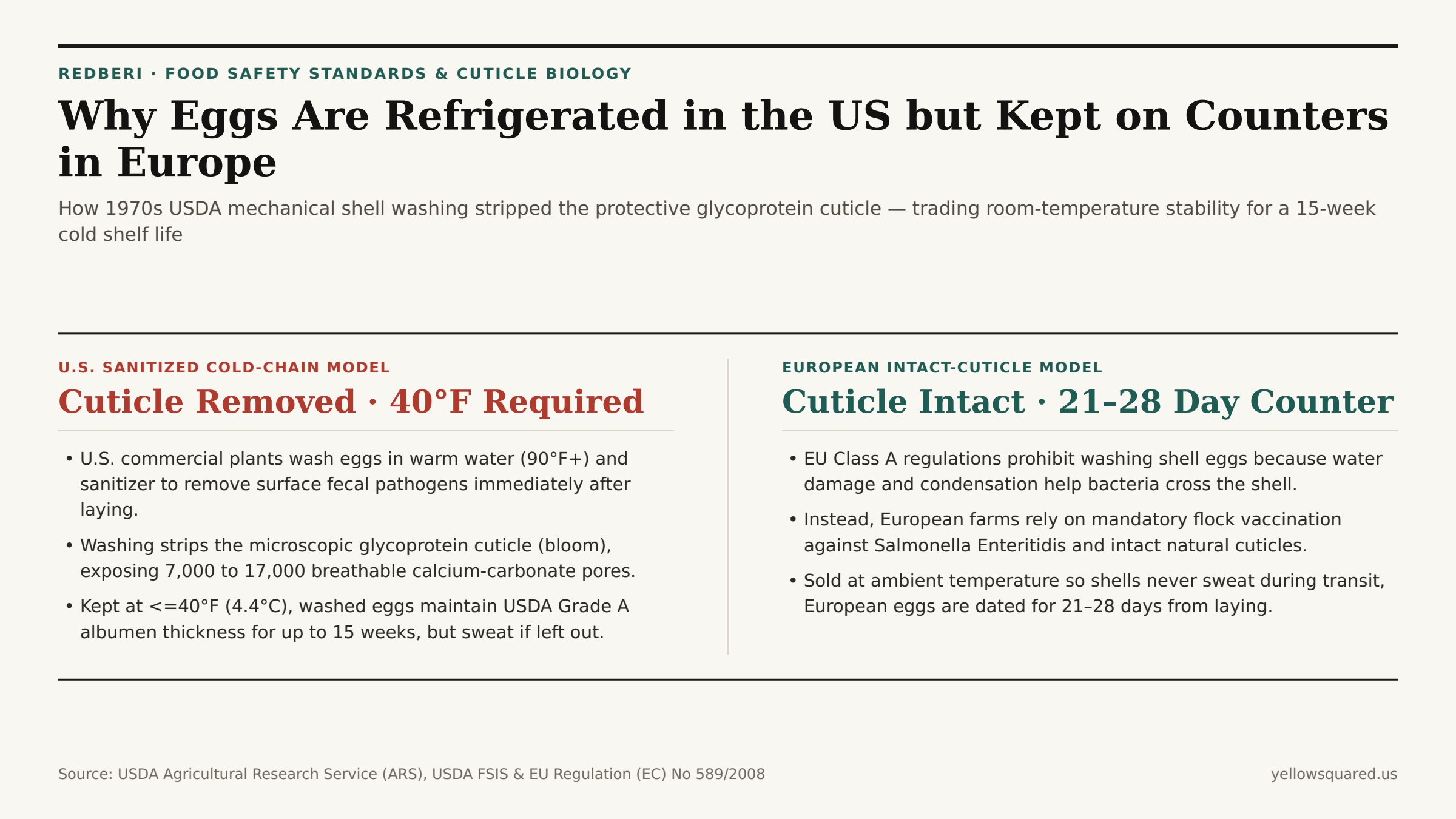
What the 15-Week USDA Agricultural Research Service Trial Proved
To test how washing and temperature interact over time, food technologists at the USDA Agricultural Research Service (ARS) National Egg Quality Lab tracked washed and unwashed shell eggs stored for 15 weeks at refrigerated temperatures (7.7°C / 45.8°F) versus ambient room temperature (22.0°C / 71.6°F). Their measurements of internal Haugh units (the standard metric of albumen protein height and thickness) revealed a stark thermodynamic divide:
- Washed + Refrigerated (40°F–45°F): Maintained USDA Grade A internal quality for a full 15 weeks (105 days), with virtually zero loss in yolk membrane strength or albumen viscosity.
- Unwashed + Refrigerated (40°F–45°F): Also held USDA Grade A quality for 15 weeks, showing that cold temperature is the dominant factor slowing internal protein breakdown.
- Unwashed + Room Temperature (72°F / 22°C): Held Grade A quality for roughly 3 weeks (21–28 days) before enzyme-driven thinning dropped the eggs below Grade A thresholds.
- Washed + Room Temperature (72°F / 22°C): Degraded from Grade A to Grade B in just 1 week (7 days) and lost 15% of total egg weight over 15 weeks through unsealed shell pores.
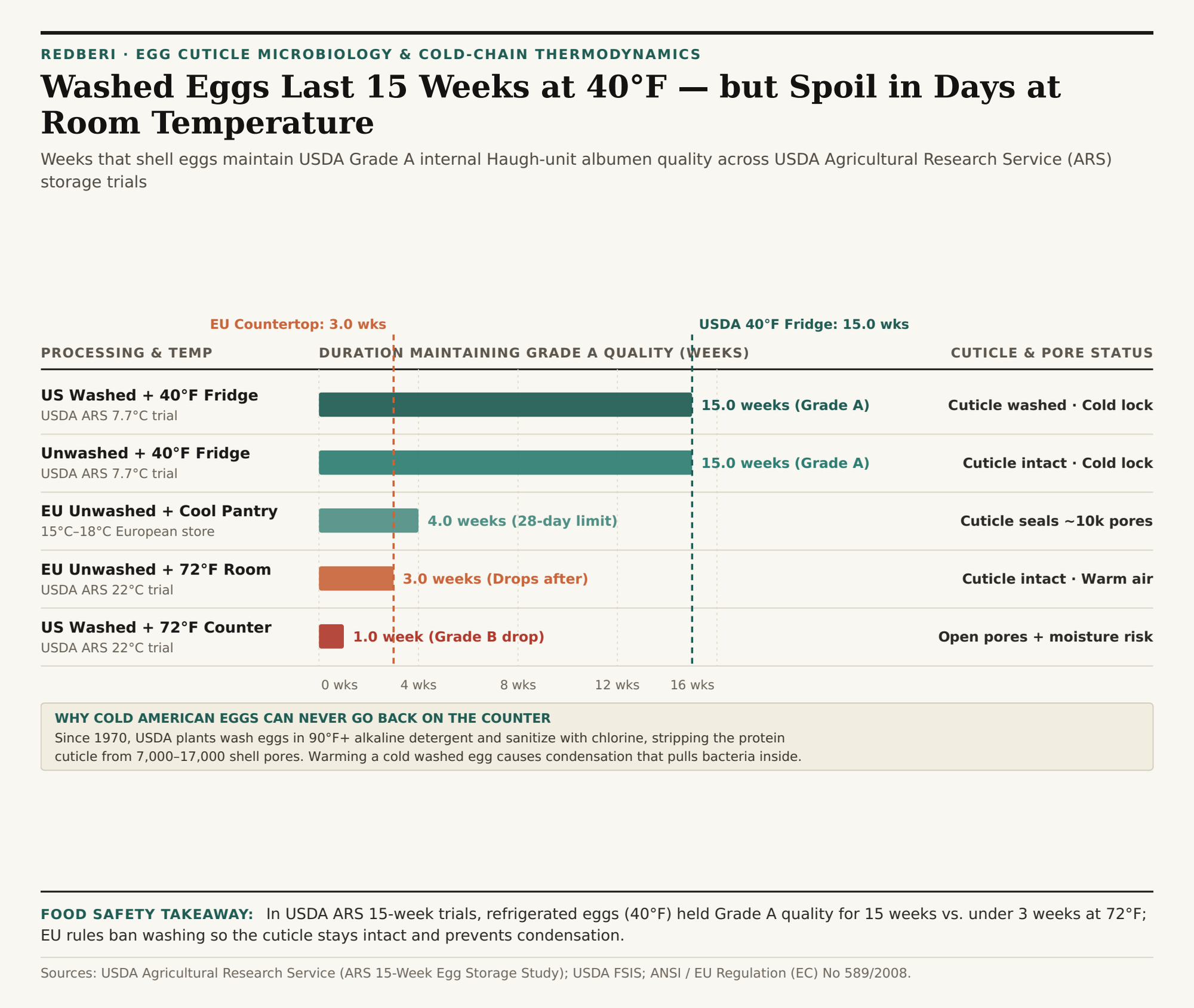
Why Cold American Eggs Must Never Be Left on the Counter
Once an egg has been washed and chilled, leaving it out on a kitchen counter for more than two hours creates a physical hazard known as shell sweating. When a 40°F egg is placed into 72°F room air, atmospheric moisture condenses into microscopic water droplets across the cold shell. Because the protective cuticle was stripped during commercial washing, capillary action and thermal contraction pull that surface water — along with any bacteria on the shell — directly through the 7,000+ open pores into the albumen.
"European supermarkets keep unwashed Class A eggs unrefrigerated for the exact same physical reason: if an unwashed egg were chilled in the store and then warmed up in a shopper's car on the way home, condensation on the shell would break down the cuticle and promote mold and bacterial entry."
| Processing & Storage Method | Cuticle Status | Storage Temp | Grade A Window | Primary Bacterial Barrier | Regulatory Standard |
|---|---|---|---|---|---|
| US Washed + Refrigerated | Removed by 90°F+ wash | 4.0°C–7.7°C (39°F–45°F) | 15.0 weeks | Cold bacteriostasis (<7.2°C) | USDA FSIS & FDA Cold Chain |
| Unwashed + Refrigerated | Intact glycoprotein bloom | 4.0°C–7.7°C (39°F–45°F) | 15.0 weeks | Sealed pores + cold chain | Farm-direct cold storage |
| EU Unwashed + Pantry | Intact (~10k pores sealed) | 15.0°C–22.0°C (59°F–72°F) | 3.0–4.0 weeks | Intact cuticle + hen vaccine | EU Reg (EC) No 589/2008 |
| US Washed + Countertop | Removed (open pores) | 22.0°C (72°F ambient) | 1.0 week | None (condensation risk) | Unsafe past 2 hours (USDA) |
Practical Rules for Storing Eggs at Home
If you buy standard supermarket eggs in North America, store them in their original cardboard carton on an interior refrigerator shelf at 38°F–40°F rather than in the refrigerator door bin (where repeated door openings fluctuate temperatures and jostle the chalazae cords). If you live in Europe and purchase unwashed room-temperature eggs, placing them into your home refrigerator once you arrive home is completely safe — provided they stay refrigerated until cooking so they never sweat. To automate expiration alerts across dairy, produce, and eggs, Track egg freshness in Redberi and download the USDA ARS egg storage CSV table.