
Why Are Flights Faster Flying East Than West? How the Jet Stream Cuts Up to an Hour Off Eastbound Routes
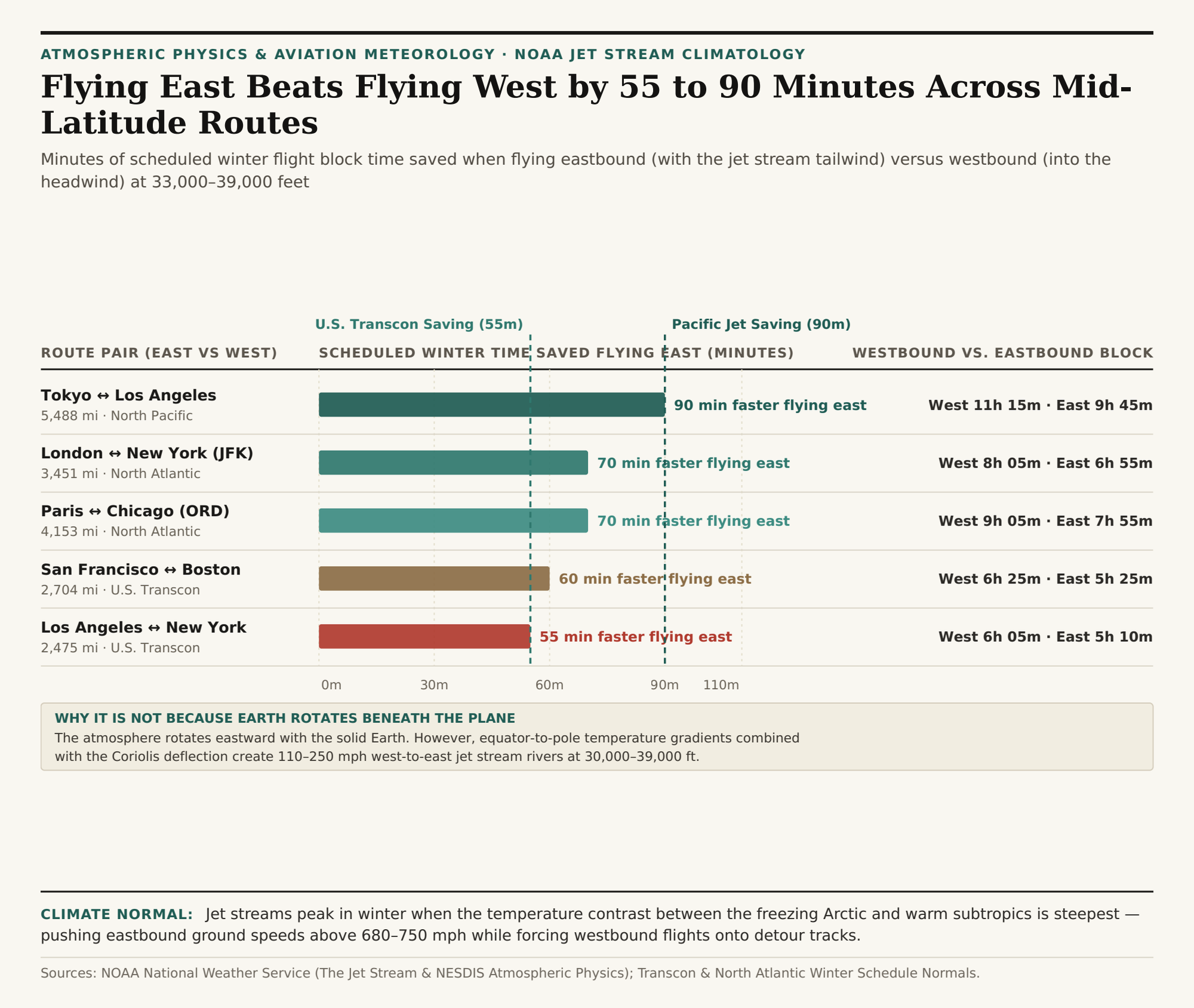
Look up any nonstop airline schedule across the United States, the North Atlantic, or the North Pacific, and you will notice a lopsided asymmetry: a winter flight from Los Angeles to New York (JFK) is scheduled for 5 hours and 10 minutes, whereas the return flight west from New York to Los Angeles takes 6 hours and 5 minutes. Across the Pacific, flying east from Tokyo (NRT) to Los Angeles saves a full 90 minutes compared to flying west (9h 45m vs. 11h 15m).
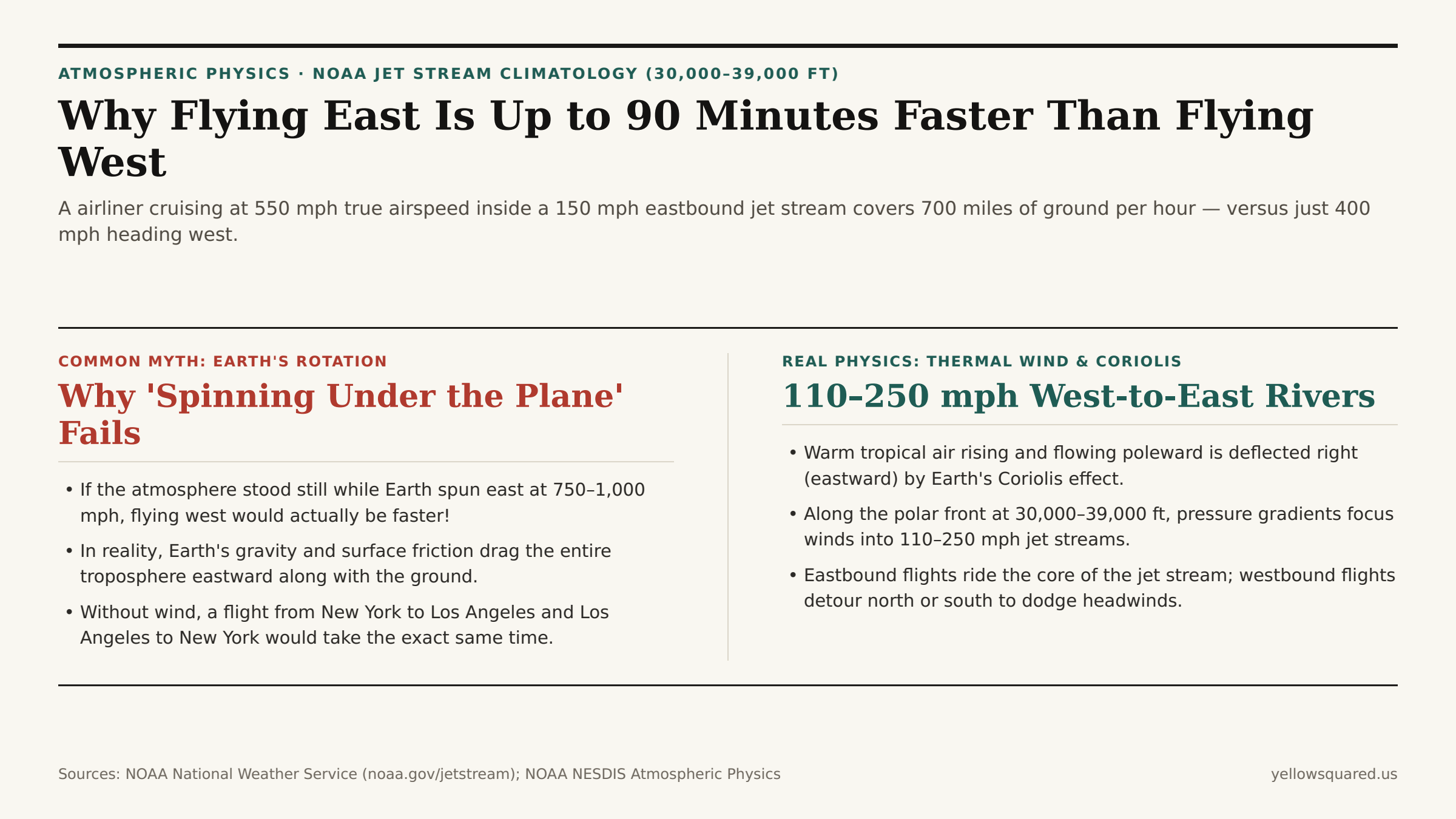
A common intuition is that flights going east or west differ because the solid Earth is spinning beneath the airplane. In reality, as explained in NOAA's National Weather Service Guide to the Global Jet Stream and NOAA NESDIS's Atmospheric Jet Stream Physics Overview, the entire lower atmosphere rotates eastward along with the planet — and if it didn't, flying west would actually be faster! The true culprit is the polar and subtropical jet streams: narrow, high-altitude rivers of wind at 30,000 to 39,000 feet that blow from west to east at 110 to 250 mph. To explore upper-air wind climatology and seasonal temperature gradients across global flight corridors, Compare historical climate and wind normals in Eranorms.
1. Why "Earth Spinning Under the Plane" Would Actually Favor Westbound Flights
At the equator, the Earth's surface rotates from west to east at 1,037 mph (1,670 km/h), and at mid-latitudes (40°N, near New York, Madrid, and Beijing) the ground moves eastward at roughly 790 mph. If an airplane lifted off into a stationary atmosphere while the ground spun eastward underneath it, a plane flying west would see its destination racing toward it at 790 mph, while a plane flying east at 550 mph could never even catch up to its destination!
That never happens because gravity and surface friction lock the troposphere into co-rotation with the solid Earth. When a jet sits on the runway in Los Angeles, the plane, the runway, and the surrounding air mass already share the exact same eastward momentum.
2. How Temperature Gradients + Coriolis Deflection Create 150+ mph West-to-East Winds
Why, then, do upper-level winds at commercial cruising altitudes (30,000 to 39,000 feet, or 9 to 12 km near the tropopause) blow overwhelmingly from west to east in both the Northern and Southern Hemispheres? As documented by NOAA's JetStream Meteorology Program, two physical forces combine:
- The Pole-to-Equator Pressure Gradient (Thermal Wind): Solar heating warms tropical air, causing it to expand upward into a high-altitude pressure ridge, while cold, dense polar air sinks into a low-pressure trough aloft. At
35,000 feet, air flows from the warm subtropical high toward the cold polar low. - Conservation of Angular Momentum & the Coriolis Effect: As a parcel of upper-tropospheric air moves poleward from
20°Ntoward50°N, its distance to Earth's rotational axis shrinks. Just as a figure skater spins faster when pulling their arms inward, the poleward-moving air conserves angular momentum by accelerating eastward relative to the slower-moving ground below (Coriolis deflection to the right in the Northern Hemisphere, and to the left in the Southern Hemisphere— which is eastward in both hemispheres!).
Along the sharp boundary where cold polar air meets warm subtropical air (the polar front), this thermal wind concentrates into a ribbon 100 to 300 miles wide and 1 to 3 miles thick where winter core wind speeds routinely hit 120 to 200+ mph (and exceeded 265 mph over the Atlantic and Washington, D.C. during record winter jet streaks, pushing Boeing 777 and 787 ground speeds past 800 mph).
"An airliner cruising at 550 mph true airspeed inside a 150 mph eastbound jet stream achieves a 700 mph ground speed — whereas a westbound flight facing that same wind would crawl at 400 mph unless dispatchers route it hundreds of miles north or south out of the jet core."
| Flight Corridor | Distance | Winter Westbound | Winter Eastbound | Eastbound Saving | Typical Winter Jet Core |
|---|---|---|---|---|---|
| Tokyo (NRT) ↔ Los Angeles (LAX) | 5,488 mi | 11h 15m (675m) | 9h 45m (585m) | 90 min faster | 140–190 mph North Pacific Jet |
| London (LHR) ↔ New York (JFK) | 3,451 mi | 8h 05m (485m) | 6h 55m (415m) | 70 min faster | 120–165 mph North Atlantic Tracks |
| Paris (CDG) ↔ Chicago (ORD) | 4,153 mi | 9h 05m (545m) | 7h 55m (475m) | 70 min faster | 115–160 mph Polar Front Jet |
| San Francisco (SFO) ↔ Boston (BOS) | 2,704 mi | 6h 25m (385m) | 5h 25m (325m) | 60 min faster | 110–150 mph Northern Tier Jet |
| Los Angeles (LAX) ↔ New York (JFK) | 2,475 mi | 6h 05m (365m) | 5h 10m (310m) | 55 min faster | 105–145 mph Subtropical/Polar Jet |
Why the East-West Time Gap Shrinks in Summer
Because the speed of the jet stream is driven by the temperature difference between the Arctic and the tropics, jet streams weaken and shift northward in July and August when the Northern Hemisphere warms up — trimming transcontinental and transatlantic east-west flight time differences by 15 to 25 minutes compared to January. Compare historical climate and wind normals in Eranorms across every month of the year, and download the eastbound vs. westbound jet stream CSV table.