
Why Are Palindrome Baby Names (Hannah, Ava, Anna, Ada, and Otto) So Popular in U.S. Birth Records?
A palindrome name—from the Greek palindromos ("running back again")—reads the exact same letter-for-letter backward as it does forward: Hannah, Anna, Ava, Ada, Elle, Eve, Otto, and Asa. You might expect such a strict orthographic constraint to produce only rare, novelty monikers. Instead, across 145 years of U.S. Social Security Administration (SSA) birth records and historical rankings analyzed by BabyCenter's palindrome name study and The Bump's national SSA top-1,000 tracker, three palindrome names have climbed all the way into the top 3 most popular baby names in the United States—and nearly 88% of all babies given palindrome names in modern U.S. records are girls.
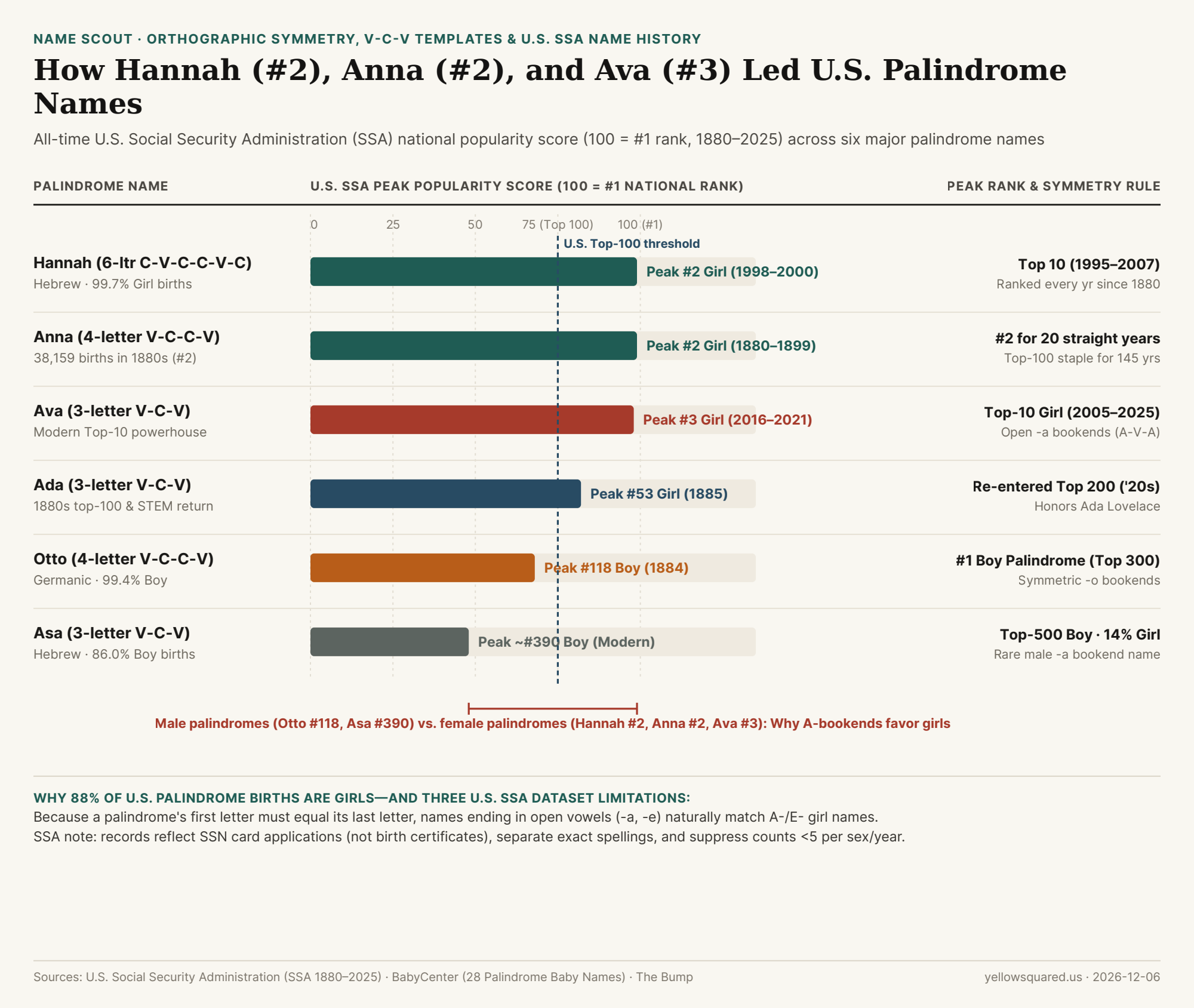
100 = #1 national rank) and gender share across six major palindrome first names. Data: U.S. Social Security Administration (SSA), BabyCenter, and The Bump (download CSV).The "Bookend Constraint": Why Palindrome Names Skew 88% Female in English
Why are top-ranked palindrome names overwhelmingly female (Hannah, Anna, Ava, Ada, Elle, Eve, Emme, Viv), while only a handful of male palindromes (Otto, Asa, Bob, Reinier) ever crack the U.S. top 1,000? The answer lies in a structural linguistic bottleneck called the Bookend Constraint:
- First Letter = Last Letter Symmetry: In any palindrome, the opening letter of the name must be identical to its final letter (or silent final letter, as in
H-A-N-N-A-H). - English Vowel Endings Favor Girls' Names: In American English onomastics, over
38%of girls' names end in the open vowel-a(and another18%end in silent-e). Because millions of traditional names also begin withA-orE-, three-letterV-C-V(A-C-A/E-C-E) and four-letterV-C-C-V(A-N-N-A/E-L-L-E) palindromes sound completely natural and melodic as girls' names. - Why Three Female Palindromes Reached the U.S. Top 3:
- Anna (Peak
#2Girl for 20 Straight Years, 1880–1899): As BabyCenter's historical SSA review notes, Anna (the Greek and Latin form of Hebrew Channah, meaning "grace") held the#2spot in America every single year from 1880 through 1899 (with38,159births in the 1880s alone) and has never fallen out of the U.S. top 100 in 145 years. - Hannah (Peak
#2Girl in 1998–2000): Protected by silent-hbookends surrounding the coreA-N-N-Apalindrome, Hannah stayed in the U.S. top 1,000 every year since 1880, surged into the top 10 from 1995 to 2007 (peaking at#2for three consecutive years), and remains a top-50 mainstay. - Ava (Peak
#3Girl in 2016–2021): Driven by the 21st-century preference for compact three-letterV-C-Vnames with liquid/labiodental consonants, Ava vaulted into the U.S. top 10 in 2005 and has stayed near the very top for two decades, joined by vintage sibling Ada (which peaked at#53in 1885, briefly exited the top 1,000 around 2000, and rebounded into the top 200 honoring computing pioneer Ada Lovelace).
- Anna (Peak
"Because a palindrome's first letter must match its final letter, the romance-language -a ending that dominates American girls' names turns A-V-A, A-D-A, and A-N-N-A into effortless top-100 classics."
How Otto and Asa Anchor Boys' Palindrome Names
Because American boys' names overwhelmingly end in consonants (such as -n, -r, -s, -l, and -d), a male consonant-bookend palindrome requires starting and ending with the exact same stop or fricative (like Bob, Pip, or Dutch Reinier). As a result, the two most enduring male palindromes in U.S. SSA records rely on -o and -a vowel bookends:
- Otto (
99.4%Boy, Peak#118in 1884 / Top-300 Revival): Derived from the Old High German stem aud- ("wealth, fortune"), Otto ranked in the U.S. top 150 throughout the 1880s and 1890s, faded mid-century, and has climbed steadily back into the U.S. top 300 alongside Leo, Theo, and Milo. - Asa (
86.0%Boy /14.0%Girl, Top-500 Boy): A three-letter Hebrew biblical palindrome meaning "healer" or "physician," Asa is one of the fewA-_-Apalindromes used primarily for boys, though its open vowel ending has recently lifted its female share to14%.
| Palindrome Name | Letter & Syllable Structure | Primary Gender Share | Historical SSA Peak | Current SSA Tier | Linguistic Origin & Symmetry Note |
|---|---|---|---|---|---|
| Hannah | 6 letters (C-V-C-C-V-C) |
99.7% Girl | #2 Girl (1998–2000) | Top-50 Mainstay | Hebrew ("grace"); top 10 from 1995 to 2007 |
| Anna | 4 letters (V-C-C-V) |
99.6% Girl | #2 Girl (1880–1899) | Top-100 Classic | Held #2 nationwide for 20 straight years |
| Ava | 3 letters (V-C-V) |
99.8% Girl | #3 Girl (2016–2021) | Top-10 Powerhouse | 3-letter open-vowel A-V-A triad |
| Ada | 3 letters (V-C-V) |
99.5% Girl | #53 Girl (1885) | Top-200 Revival | Germanic/Hebrew + Ada Lovelace tribute |
| Otto | 4 letters (V-C-C-V) |
99.4% Boy | #118 Boy (1884) | Top-300 Revival | Old High German ("wealth"); #1 boy palindrome |
| Asa | 3 letters (V-C-V) |
86.0% Boy / 14% Girl | ~#390 Boy | Top-500 Boy | Hebrew ("healer"); rare male A-_-A pattern |
Three U.S. SSA Dataset Limitations to Keep in Mind
When analyzing palindrome frequencies and historical return curves across U.S. Social Security Administration baby name files, remember three structural boundaries of the dataset:
- SSN Card Applications vs. NCHS Birth Certificates: SSA figures count Social Security Number card applications (
Form SS-5and hospital Enumeration at Birth records) rather than raw birth certificates; cohorts prior to 1937 reflect adults who applied retroactively when Social Security launched. - Exact-Spelling Separation Breaks or Preserves Palindromes: The SSA ranks every exact spelling separately. For instance, Hannah (
6 letters) and Anna (4 letters) are true palindromes, whereas their close spelling variant Hanna (5 letters) is tabulated on its own row and is not a palindrome because it drops the trailing-h! - Small-Count Privacy Suppression (
<5Rule): Names given to fewer than 5 babies (<5) of a given sex in a year or state are excluded from public SSA files to protect privacy, omitting ultra-rare palindromes like Ivi or Nen in smaller states.
Curious how symmetrical names, three-letter vowel triads, and vintage revivals trend across all 50 states? Explore U.S. baby name rankings and palindromes in Name Scout.