
Why Are Singapore and Malaysia on UTC+08:00 Instead of UTC+07:00 Like Bangkok and Jakarta?
Board a 90-minute flight from Changi Airport in Singapore (103°51'E) to Soekarno-Hatta International Airport in Jakarta (106°51'E), and you fly 3 degrees of longitude east—yet when you land in Jakarta, you have to set your watch back one hour from UTC+08:00 to UTC+07:00. Look north to Bangkok (100°30'E) and Ho Chi Minh City (106°40'E), and both cities also observe UTC+07:00. By spherical solar geometry, where every 15° band of longitude equals one hour of Earth's rotation (centered on 105°E for UTC+07:00 and 120°E for UTC+08:00), both Peninsular Malaysia (101.69°E at Kuala Lumpur) and Singapore (103.85°E) sit squarely inside the natural UTC+07:00 time zone.
Why, then, do Singapore and Kuala Lumpur share the UTC+08:00 clock of Manila (120.98°E), Taipei (121.56°E), Hong Kong (114.17°E), and Beijing? As documented in historical records of Time in Malaysia and Singapore Time, the answer traces back to a synchronized 30-minute clock jump at midnight on January 1, 1982. When scheduling cross-border engineering meetings or APAC market handoffs across Southeast Asia, you can Open Tempo in your browser to compare Asia/Singapore (UTC+08:00) against Asia/Bangkok and Asia/Jakarta (UTC+07:00) at a glance.
Six Time Zones in Eighty Years: From GMT+06:55:25 to the 20-Minute Daylight Saving Bill
Because Singapore sits just 1.3° (85 miles) north of the Equator, day length barely fluctuates between December and June (12 hours and 3 minutes vs. 12 hours and 12 minutes). Yet despite its equatorial latitude, Singapore and the Malay Peninsula modified their civil clocks six times during the twentieth century, as chronicled by the National Library Board of Singapore in BiblioAsia's history of Singapore's shifting time zones:
- Pre-1905 Local Mean Time (
GMT+06:55:25): From January 1, 1901 to May 31, 1905, the Straits Settlements and Federated Malay States anchored their clocks to the Fort Canning time ball in Singapore (103°51'16"E), running6 hours, 55 minutes, and 25 secondsahead of Greenwich. - 1905–1932 Geographical Standard Time (
GMT+07:00): On June 1, 1905, British Malaya and Singapore adopted the105°Emeridian (GMT+07:00), bringing solar noon to a natural12:05 PMin Singapore and12:13 PMin Kuala Lumpur. - 1933–1941 The 20-Minute Daylight Saving Compromise (
GMT+07:20): After colonial legislators proposed a 30-minute summer-style clock shift so residents could play outdoor tennis and cricket after work, business opposition yielded an unusual compromise under the Daylight Saving Ordinance: on January 1, 1933, clocks moved forward by exactly 20 minutes toGMT+07:20. - 1941–1981 Half-Hour Standard Time & Wartime Occupation (
GMT+07:30andGMT+09:00): On September 1, 1941, the offset was rounded up by another 10 minutes toGMT+07:30. During the World War II Japanese Occupation (February 16, 1942 to September 11, 1945), clocks were forced 90 minutes further ahead to Tokyo Standard Time (GMT+09:00) before reverting toGMT/UTC+07:30on September 12, 1945.
"When Peninsular Malaysia and Singapore jumped from UTC+07:30 to UTC+08:00 at 11:30 PM on December 31, 1981, New Year's Day 1982 arrived thirty minutes early—permanently locking both countries onto permanent equatorial Daylight Saving Time."
Why December 31, 1981 Moved Peninsular Malaysia and Singapore to UTC+08:00
Following the formation of the Federation of Malaysia in 1963, the country was split across two different time zones separated by the South China Sea: Peninsular (West) Malaysia observed UTC+07:30, while East Malaysia (Sabah and Sarawak on the island of Borneo, spanning 110°E to 119°E) observed UTC+08:00. Government offices, domestic Malaysia Airlines flights, and interbank transfers between Kuala Lumpur and Kota Kinabalu constantly lost half an hour to clock confusion.
In December 1981, Prime Minister Mahathir Mohamad introduced the Malaysian Standard Time Act 1981, decreeing that at 11:30 PM (23:30) on December 31, 1981, Peninsular Malaysia would advance its clocks by 30 minutes to 12:00 AM (00:00) on January 1, 1982—unifying the entire country on East Malaysia's UTC+08:00 (120°E) meridian. Because Singapore shares a massive daily commuter, aviation, and financial corridor with Malaysia—and saw an immediate strategic advantage in sharing the exact same UTC+08:00 trading hours as Hong Kong, Taipei, Manila, and Beijing—Singapore's cabinet matched the shift on the exact same night.
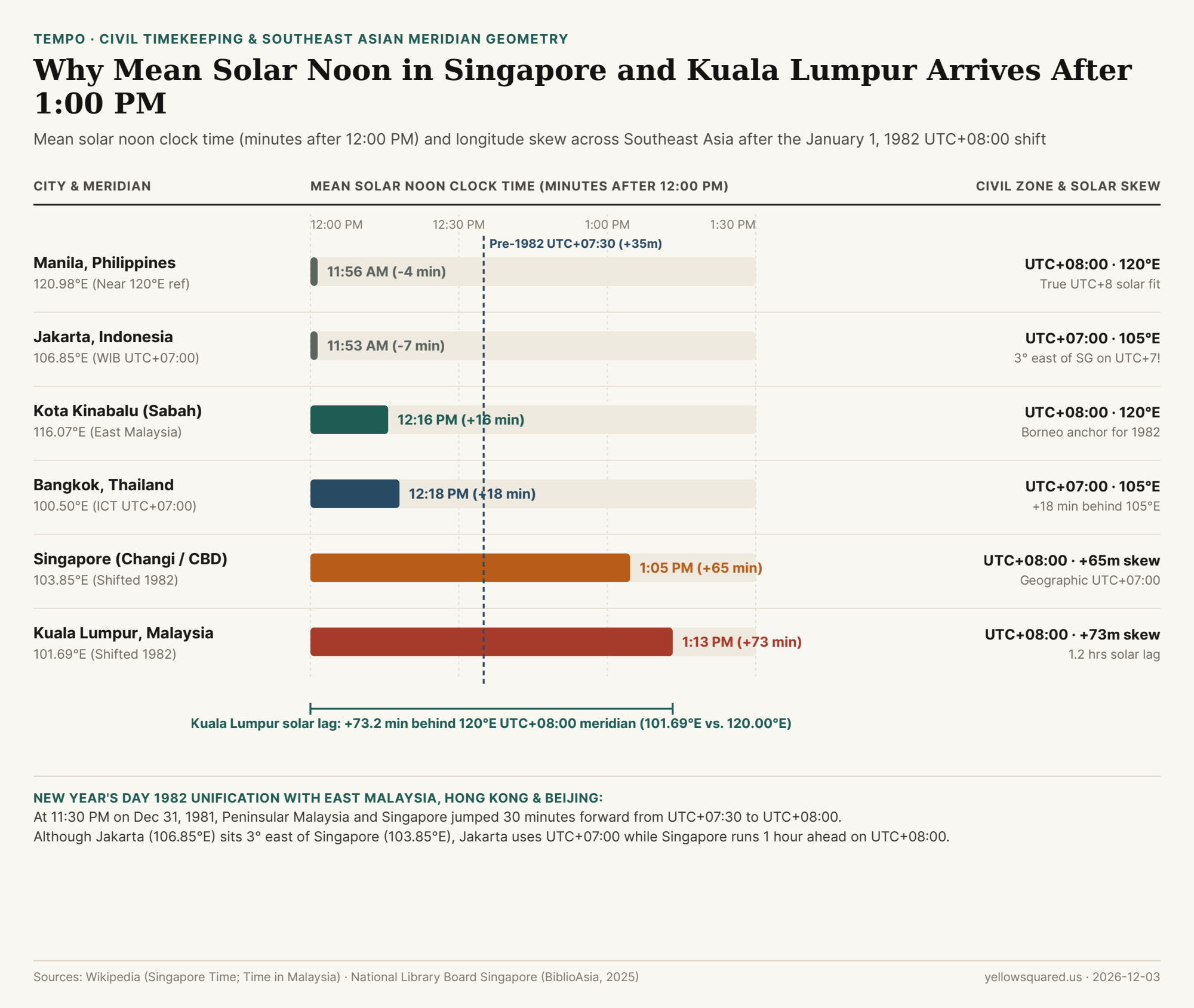
| City & Region | Longitude | Natural Solar Zone | Observed Civil Zone | Mean Solar Noon | Solar-Clock Skew |
|---|---|---|---|---|---|
| Manila, Philippines | 120°59'E (120.98°E) |
UTC+08:00 (120°E) |
UTC+08:00 (PHT) |
11:56 AM |
-3.9 min |
| Jakarta, Indonesia | 106°51'E (106.85°E) |
UTC+07:00 (105°E) |
UTC+07:00 (WIB) |
11:53 AM |
-7.4 min |
| Kota Kinabalu (East Malaysia) | 116°04'E (116.07°E) |
UTC+08:00 (120°E) |
UTC+08:00 (MYT) |
12:16 PM |
+15.7 min |
| Bangkok, Thailand | 100°30'E (100.50°E) |
UTC+07:00 (105°E) |
UTC+07:00 (ICT) |
12:18 PM |
+18.0 min |
| Singapore | 103°51'E (103.85°E) |
UTC+07:00 (105°E) |
UTC+08:00 (SGT) |
1:05 PM |
+64.6 min |
| Kuala Lumpur (West Malaysia) | 101°41'E (101.69°E) |
UTC+07:00 (105°E) |
UTC+08:00 (MYT) |
1:13 PM |
+73.2 min |
Why Sunrise in Singapore and Kuala Lumpur Happens Around 7:00 AM All Year
Because Singapore (+64.6 minutes behind 120°E) and Kuala Lumpur (+73.2 minutes behind 120°E) live permanently one full hour ahead of their geographic solar zone, the equatorial 6:00 AM–6:00 PM solar day is shifted neatly to 7:00 AM–7:00 PM on the wall clock. In Singapore, earliest sunrise occurs around 6:46 AM in early November and latest sunrise occurs around 7:17 AM in mid-February, while sunset stays between 6:50 PM and 7:19 PM all year long. To coordinate team standups across Singapore (UTC+08:00), Jakarta (UTC+07:00), Tokyo (UTC+09:00), and US West Coast clocks, Open Tempo in your browser and build your multi-region overlap timeline.