
Why Are Last Names Becoming First Names? How Occupational Surnames Like Harper, Mason, Carter, and Parker Rose in SSA Data
In medieval England, a surname was a practical tax-roll descriptor added to distinguish five different villagers named John: John the Mason laid stone, John the Carter drove freight carts, John the Cooper bound wooden barrels, John the Parker patrolled the lord’s hunting park, and John the Harper played music in the hall. For six centuries, those occupational labels stayed locked in the last-name column. Yet in modern U.S. Social Security Administration (SSA) birth registration data, medieval trade surnames have migrated en masse to the front of the birth certificate—with Harper (#11 Girl), Mason (#31 Boy), Carter (#42 Boy), Cooper (#60 Boy), and Parker (#64 Boy / #128 Girl) outranking dozens of classic first names.
When you analyze multi-decade naming trajectories in Name Scout, tracking how occupational surnames moved from rare family-tree middle names to top-100 first names reveals why two-syllable -er and -on endings dominate modern American nurseries—and why several have crossed over from boy names to girl names.
SSA Data Scope & Limitations
When interpreting U.S. Social Security Administration baby-name records, keep three structural dataset rules in mind:
- SSN Card Applications, Not All Live Births: The public SSA file counts first names submitted on U.S. Social Security Number (SSN) card applications rather than NCHS birth certificates directly.
- Exact-Spelling Separation: Every distinct spelling is tabulated independently (for example,
Jackson#20 andJaxon#67, orRileyandRylee, are ranked as separate strings rather than pooled). - Small-Count Privacy Suppression (
<5Births): Any name with fewer than 5 applications within a given sex and birth year is omitted from the national file to protect individual privacy.
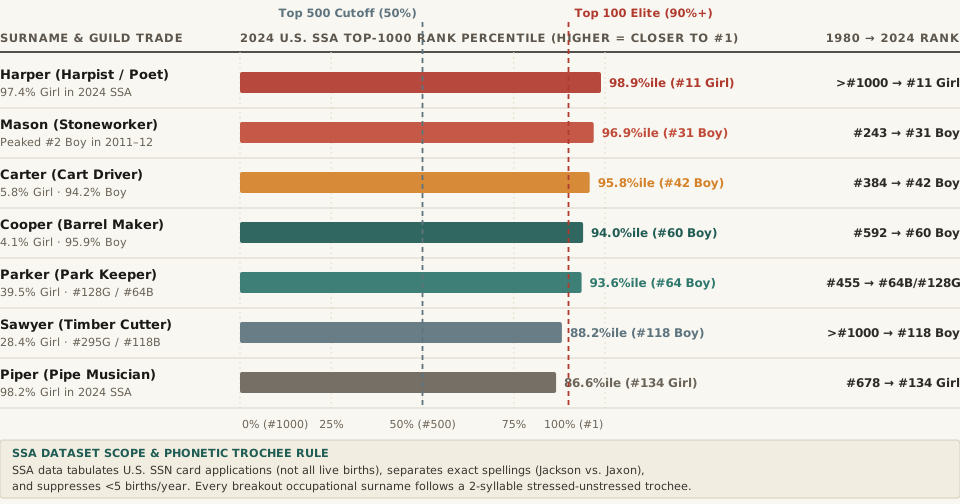
7 Flagship Occupational Surnames in U.S. SSA Data (1980 vs. 2024)
Comparing 1980 vs. 2024 U.S. SSA rankings across seven medieval trade surnames (given names derived from surnames) highlights both the magnitude of the post-1990 surge and the sharp gender split between male-leaning and female-leaning trades:
| Given Name | Medieval Trade Etymology | 1980 Best SSA Rank | 2024 Best SSA Rank | 2024 Female Share (%) | Phonetic Structure | Gender Trajectory Pattern |
|---|---|---|---|---|---|---|
| Harper | Harp player / minstrel | >#1000 (Unranked) |
#11 Girl | 97.4% Girl |
2-syllable -er trochee |
Explosive shift to Top-15 Girl |
| Mason | Stoneworker / builder | #243 Boy |
#31 Boy | 1.2% Girl |
2-syllable -on trochee |
Peaked at #2 Boy (2011–2012) |
| Carter | Cart driver / transporter | #384 Boy |
#42 Boy | 5.8% Girl |
2-syllable -er trochee |
Top-50 Boy + emerging Girl |
| Cooper | Wooden barrel maker | #592 Boy |
#60 Boy | 4.1% Girl |
2-syllable -er trochee |
Surged 532 ranks since 1980 |
| Parker | Royal park gamekeeper | #455 Boy |
#64 Boy / #128 Girl | 39.5% Girl |
2-syllable -er trochee |
Two-way unisex convergence |
| Sawyer | Timber sawyer / cutter | >#1000 (Unranked) |
#118 Boy / #295 Girl | 28.4% Girl |
2-syllable -er trochee |
Literary + occupational unisex |
| Piper | Flute / reed-pipe player | #678 Girl |
#134 Girl | 98.2% Girl |
2-syllable -er trochee |
Musical trade favored for girls |
“In 1980, Harper did not even appear in the U.S. Top 1000 for boys or girls. By 2024, Harper ranked #11 among all U.S. baby girls, with 97.4% of registrations going to daughters.”
Three Linguistic and Cultural Forces Driving the Surname-to-First-Name Wave
- From Maternal Maiden-Name Preservation to Stylistic Choice: Beginning in seventeenth- and eighteenth-century England and the American South, families frequently gave a mother’s maiden surname to a child as a first or middle given name so the maternal family line would not vanish under patrilineal surname laws. By the late 1990s, names like
Mason,Carter, andMadisondetached from literal family trees and became mainstream phonetic templates. - The Trochaic Meter (
DUM-da) and Neutral-er/-onEndings: Every breakout occupational surname in the U.S. Top 150 (HAR-per,MA-son,CAR-ter,COO-per,PAR-ker,SAW-yer,PI-per,ARCH-er,TAY-lor) is a two-syllable trochee (a stressed first syllable followed by an unstressed-eror-onsyllable). Because English-eragentive nouns carry no romance-language feminine (-a,-ia,-elle) or masculine (-o,-us) inflection, parents easily adapt them for either sex. - Why Musical & Cloth Trades Skew Female While Heavy Construction Skews Male: Notice the semantic divide inside the SSA gender ratios: musical and textile trades (
Harper97.4%female,Piper98.2%female,Taylor79%+female,Weaver/Bailey) shifted heavily toward girls, whereas stone and heavy-timber trades (Mason98.8%male,Cooper95.9%male,Carter94.2%male,Archer99%male) remained predominantly male, withParker(39.5%female) andSawyer(28.4%female) occupying the middle ground.
Curious whether a surname-style first name is rising, peaking, or shifting from boy to girl in your state? Open Name Scout to explore 140+ years of U.S. SSA birth trajectories and gender ratios, or read our data-driven baby name guides.