
Why Does Arizona Not Observe Daylight Saving Time?
Arizona does not observe Daylight Saving Time because summer evening temperatures frequently exceed 100°F (38°C), meaning extending daylight by one hour would force residents to run expensive air conditioning longer during peak power hours. Under an exemption granted by the Uniform Time Act of 1966, Arizona opted out of clock shifts in 1968, keeping Phoenix locked permanently on Mountain Standard Time (UTC-7) all year round.
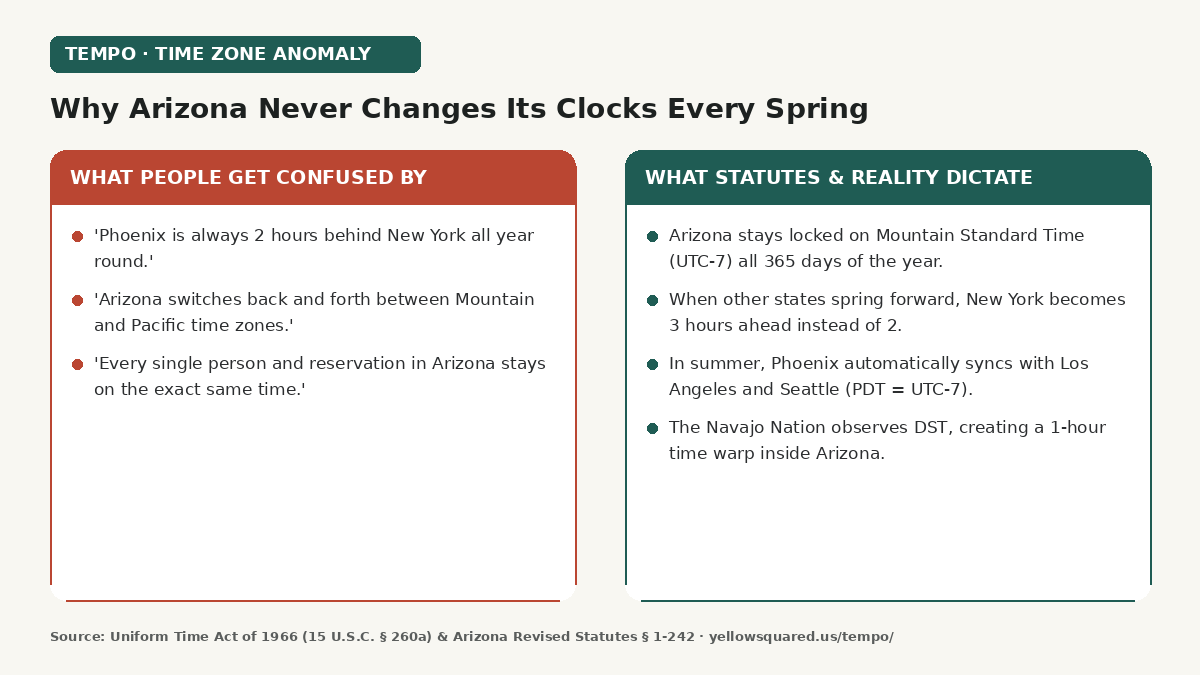
Every spring, when the rest of the United States springs forward, Arizona appears to change time zones. In reality, Arizona never moves its hands; everyone else does. During the winter, Phoenix shares the exact same hour as Denver and Salt Lake City. When daylight saving time begins on the second Sunday in March, the Rocky Mountain region advances to Mountain Daylight Time (MDT, UTC-6), while Arizona remains on UTC-7—effectively aligning Phoenix with Los Angeles and Seattle on Pacific Daylight Time (PDT).
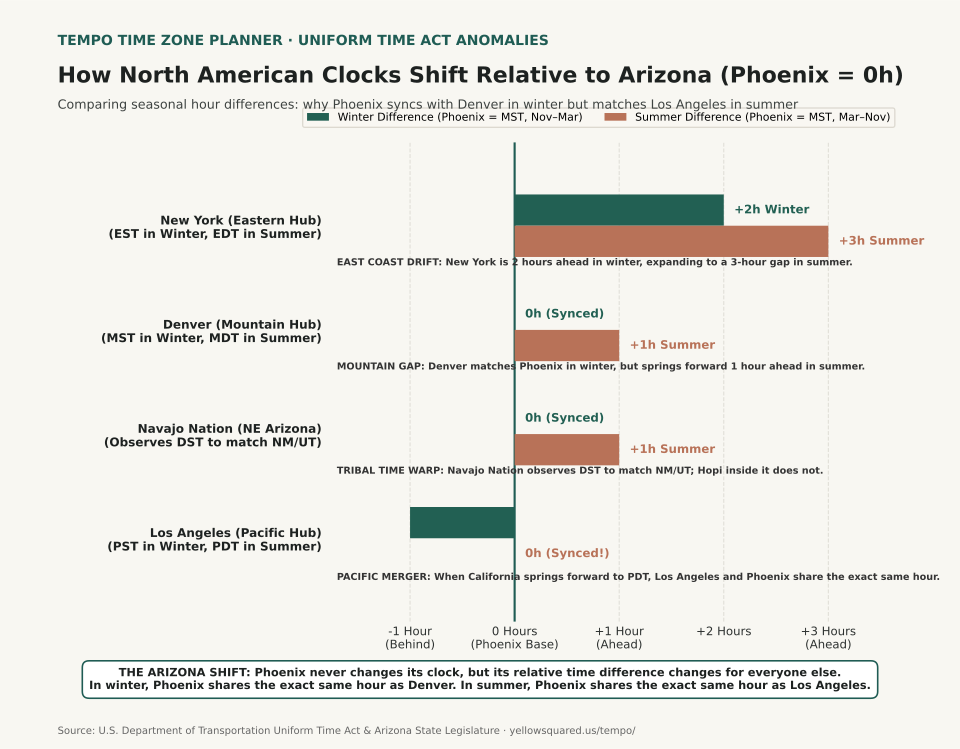
Arizona never moves its clocks; the rest of the continent moves around it, shifting relative time gaps twice a year.
The 1967 Energy Backlash That Ended DST in Arizona
When the U.S. Congress passed the Uniform Time Act of 1966, states were mandated to observe daylight saving time unless state legislatures specifically passed an exemption. In 1967, Arizona observed DST for one summer. The public backlash was immediate and intense:
- Excessive Evening Heat: With sunset pushed past 8:40 PM in June and July, children could not sleep, outdoor evening activities were unbearable, and homes absorbed punishing solar radiation well into late evening hours.
- Soaring Air Conditioning Bills: Utility studies demonstrated that an extra hour of late sunlight dramatically increased residential peak cooling loads, costing families significantly more in electricity.
- Legislative Exemption (1968): In March 1968, the Arizona State Legislature enacted Senate Bill 1 (codified in Arizona Revised Statutes § 1-242), permanently exempting the state from daylight saving adjustments.
The Navajo Nation Time Warp Inside Arizona
There is one major geographic exception within Arizona borders: the Navajo Nation. Covering over 27,000 square miles across northeastern Arizona, northwestern New Mexico, and southeastern Utah, the Navajo Nation chose to observe daylight saving time to maintain synchronized administrative operations with its tribal offices in New Mexico and Utah.
To complicate matters further, the Hopi Reservation, which is entirely surrounded by the Navajo Nation, follows Arizona state policy and does not observe DST. Driving across northeastern Arizona in July can cause your car clock to shift back and forth four times in a two-hour journey.
Seasonal Time Differences: Phoenix vs. Major Hubs
| Region / Hub | Winter Time Difference | Summer Time Difference | Why It Changes |
|---|---|---|---|
| New York (Eastern) | 2 Hours Ahead (EST) | 3 Hours Ahead (EDT) | New York springs forward; Phoenix stays at UTC-7 |
| Chicago (Central) | 1 Hour Ahead (CST) | 2 Hours Ahead (CDT) | Chicago springs forward; Phoenix stays at UTC-7 |
| Denver (Mountain) | Same Time (MST) | 1 Hour Ahead (MDT) | Denver springs forward; Phoenix stays at UTC-7 |
| Los Angeles (Pacific) | 1 Hour Behind (PST) | Same Time (PDT) | Los Angeles springs forward to UTC-7, syncing with Phoenix |
How to Coordinate With Arizona Teammates
- Watch out for calendar invites scheduled during spring: A recurring 9:00 AM New York meeting lands at 7:00 AM in Phoenix during winter, but automatically shifts to 6:00 AM Phoenix time once New York springs forward.
- Do not assume Pacific or Mountain defaults: In scheduling software, always select the explicit IANA time zone identifier
America/Phoenixrather than generic Mountain or Pacific labels. - Check date-specific multi-city alignment: You can Open Tempo in your browser to test synchronized time zone dials and inspect real-time overlap across changing seasonal borders.